


Gospel in Art: Maundy Thursday
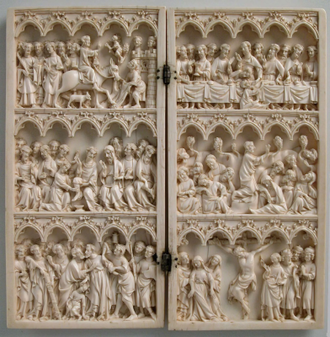
Scenes from Christ's Passion, top left to bottom right: entry into Jerusalem, Last Supper; Christ washing disciples' feet, Agony in the Garden; Betrayal of Christ the Crucifixion © Alamy
Source: Christian Art
Gospel of 2 April 2026
John 13:1-15
Before the Feast of the Passover, when Jesus knew that his hour had come to depart out of this world to the Father, having loved his own who were in the world, he loved them to the end. During supper, when the devil had already put it into the heart of Judas Iscariot, Simon's son, to betray him, Jesus, knowing that the Father had given all things into his hands, and that he had come from God and was going back to God, rose from supper. He laid aside his outer garments, and taking a towel, tied it round his waist. Then he poured water into a basin and began to wash the disciples' feet and to wipe them with the towel that was wrapped round him. He came to Simon Peter, who said to him, 'Lord, do you wash my feet?' Jesus answered him, 'What I am doing you do not understand now, but afterwards you will understand.' Peter said to him, 'You shall never wash my feet.' Jesus answered him, 'If I do not wash you, you have no share with me.' Simon Peter said to him, 'Lord, not my feet only but also my hands and my head!' Jesus said to him, 'The one who has bathed does not need to wash, except for his feet, but is completely clean. And you are clean, but not every one of you.' For he knew who was to betray him; that was why he said, 'Not all of you are clean.'
When he had washed their feet and put on his outer garments and resumed his place, he said to them, 'Do you understand what I have done to you? You call me Teacher and Lord, and you are right, for so I am. If I then, your Lord and Teacher, have washed your feet, you also ought to wash one another's feet. For I have given you an example, that you also should do just as I have done to you.'
Reflection on the Carved Ivory Diptych
Like Peter, we can sometimes struggle to accept a God who loves in such a humble and unsettling way. Would we let Jesus wash our feet? We would certainly want to wash His feet, but we would feel uncomfortable letting Him wash our feet. Our reading is so current and relevant. Peter finds it difficult to allow Jesus to kneel before him and wash his feet. Yet Jesus responds firmly: if Peter refuses this act of service, he cannot remain in communion with him. If those words would be spoke to us, we would feel very shocked.
To belong to Christ means first allowing ourselves to be loved and served by him in the way he chooses. Only after receiving that love are we called to pass it on to others, loving as we ourselves have been loved. So we first must accept God's love, and only then can we pass it on.
Yet the washing of the feet points forward to something even greater. In humbly laying aside his garments to serve his disciples, Jesus anticipates the stripping off of clothes and complete self-giving that will unfold on the Cross the next day. The love revealed there is the same love we celebrate each time we gather for the Eucharist. The Eucharist draws us into the very same mystery the disciples experienced at the Last Supper: receiving Christ's self-giving love so that we may carry that love into the world.
You carved ivory diptych is so beautiful in its detail. From top left to bottom right we see the following scenes of the Passion depicted, with in them middle left, the washing of the feet: the entry into Jerusalem and the Last Supper (top tier); Christ washing his disciples' feet and the Agony in the Garden (middle tier); the Betrayal of Christ and the Crucifixion (bottom strip). In the Middle Ages, especially from the 13th to the 15th centuries, some of the most refined works of art were these carved ivory diptychs. They were small devotional objects made from two (or three) thin ivory panels joined by hinges so that they could fold together like a book. The word diptych simply means "two panels." Triptych means "three panels". These pieces were often intricately carved in high relief with scenes from the life of Christ, the Virgin Mary, or the Passion. They were mainly produced in and around Paris. They were not primarily altar pieces but personal devotional objects, used by clergy, nobles, or wealthy patrons for private prayer and meditation. When opened, the two panels formed a small sacred image before which the owner could pray; when closed, the carvings were protected, making them ideal portable companions.
LINKS
Christian Art: https://christian.art/
Today's reading: https://christian.art/daily-gospel-reading/john-13-1-15-2026/
 Facebook
 Twitter
 LinkedIn
 Print
Print Email
Email












 Facebook
 Twitter
 YouTube
 LinkedIn
 Pinterest