


Gospel in Art: Monday of Holy Week
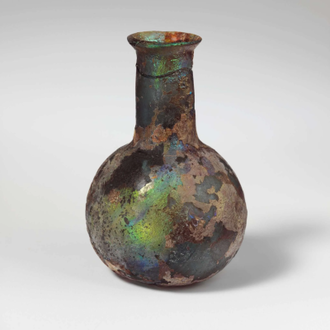
Roman glass perfume bottle, 1st century AD © Metropolitan Museum of Art, New York
Source: Christian Art
Gospel of 30 March 2026
John 12:1-11
Six days before the Passover, Jesus came to Bethany, where Lazarus was, whom Jesus had raised from the dead. So they gave a dinner for him there. Martha served, and Lazarus was one of those reclining with him at table. Mary therefore took a pound of expensive ointment made from pure nard, and anointed the feet of Jesus and wiped his feet with her hair. The house was filled with the fragrance of the perfume. But Judas Iscariot, one of his disciples (he who was about to betray him), said, 'Why was this ointment not sold for three hundred denarii and given to the poor?' He said this, not because he cared about the poor, but because he was a thief, and having charge of the money bag he used to help himself to what was put into it. Jesus said, 'Leave her alone, so that she may keep it for the day of my burial. For the poor you always have with you, but you do not always have me.'
When the large crowd of the Jews learned that Jesus was there, they came, not only on account of him but also to see Lazarus, whom he had raised from the dead. So the chief priests made plans to put Lazarus to death as well, because on account of him many of the Jews were going away and believing in Jesus.
Reflection on the glass perfume bottle
At the beginning of Holy Week the Gospel slows the pace of the story. Jesus is approaching the final days of his earthly life, a journey that will lead him to Jerusalem, to the Cross, and ultimately to the Resurrection. Much of what surrounds him in these days is tension and hostility. The authorities are already plotting, suspicion hangs in the air, and the shadow of the Passion is drawing closer. Yet the Gospel today pauses to show us a moment of extraordinary tenderness amongst it all. Six days before the Passover (we are today Monday indeed six days away from Easter), Jesus sits at the table in the house of his good friends in Bethany. In that quiet home, Mary, the sister of Lazarus, performs a gesture of remarkable generosity. She pours costly perfume over the feet of Jesus and wipes them with her hair, filling the house with fragrance. It is an act of pure love.
In a striking way, Mary's gesture anticipates what Jesus himself will soon do. Not long afterwards, he will kneel before his disciples and wash their feet, revealing that true love expresses itself in humble service. Mary, in her own way, has already entered that same logic of love. And the Gospel quietly invites us to learn from Mary. Along the road of life we will meet people who make the journey harder, but we will also encounter those whose generosity strengthens us.
So for today we are simply looking at a perfume bottle from the time of Jesus, 1st Century, Roman. In the Roman world perfume was widely available. It was used for far more than just a luxury scent. It was also used for purposes of worship, hospitality, and burial customs. Romans stored these perfumes in small, beautifully crafted bottles known as unguentaria (small, narrow-necked glass bottles), usually made of glass, alabaster, or ceramic. These delicate vessels were designed to pour out precious oils slowly, since the contents were valuable. Although the most refined perfumes were certainly associated with the wealthy (especially those imported from Arabia, Egypt, or India) perfume itself was not restricted to the elite. Many ordinary Romans owned small bottles with simpler scented oils, while the aristocracy used rare and highly costly fragrances.
Roman perfumes were usually oil-based rather than alcohol-based, made by infusing olive oil with aromatic ingredients. Common components included myrrh, frankincense, nard (spikenard), cinnamon, saffron, rose, iris, and balsam, often imported along long trade routes from the East. Because these ingredients travelled vast distances, some perfumes were extremely expensive. Pliny the Elder even complained that Rome was spending fortunes on imported scents. The most prized perfumes, such as nard, could cost a year's wages for a labourer. This background helps us understand just how extravagant and beautiful the gesture was when Mary poured a jar of costly perfume over Jesus' feet...
LINKS
Christian Art: https://christian.art/
Today's reading: https://christian.art/daily-gospel-reading/john-12-1-11-2026/
 Facebook
 Twitter
 LinkedIn
 Print
Print Email
Email

















 Facebook
 Twitter
 YouTube
 LinkedIn
 Pinterest