


Gospel in Art: We are going to stone you for blasphemy
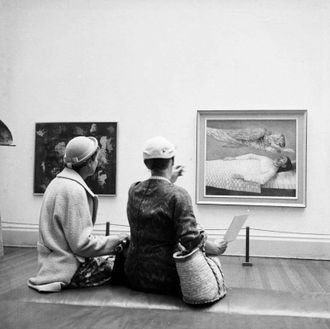
The Art of Blasphemy, photograph by Frank Martin, 1958 © Frank Martin, all right reserved
Source: Christian Art
Gospel of 27 March 2026
John 10:31-42
At that time: The Jews picked up stones again to stone him. Jesus answered them, 'I have shown you many good works from the Father; for which of them are you going to stone me?' The Jews answered him, 'It is not for a good work that we are going to stone you but for blasphemy, because you, being a man, make yourself God.' Jesus answered them, 'Is it not written in your Law, "I said, you are gods"? If he called them gods to whom the word of God came - and Scripture cannot be broken - do you say of him whom the Father consecrated and sent into the world, "You are blaspheming," because I said, "I am the Son of God"? If I am not doing the works of my Father, then do not believe me; but if I do them, even though you do not believe me, believe the works, that you may know and understand that the Father is in me and I am in the Father.' Again they sought to arrest him, but he escaped from their hands.
He went away again across the Jordan to the place where John had been baptising at first, and there he remained. And many came to him. And they said, 'John did no sign, but everything that John said about this man was true.' And many believed in him there.
Reflection on the photograph
In today's reading, the Jewish leaders accuse Jesus of blasphemy. But what exactly is blasphemy? Blasphemy is speech that treats God with contempt; words or actions that mock, scorn, or dishonour the divine. In the Christian tradition it is considered a grave failure of love towards God. And blasphemy is not confined to words alone; it can also appear in images. Art, too, can wound our sense of the sacred. Over the centuries, many works have provoked outrage or discomfort because they seemed to treat God irreverently. Most of us, at some point, have encountered an image that left us unsettled or even shocked.
Yet there was a time in Christian history when all religious images were accused of being blasphemous. In the eighth century a powerful movement known as Iconoclasm sought to abolish Christian images altogether. Its supporters pointed to Old Testament commands forbidding graven images of God. Their concern was understandable: how could the invisible, transcendent God ever be captured in paint, stone, or mosaic? At that crucial moment a brilliant voice arose in defence of sacred art: St John of Damascus (d. 749). His argument was simple mainly referring to Saint Paul. Saint Paul calls Jesus the "image", the icon of the invisible God. Yes, God is beyond all representation; yes, He is invisible and infinite. But in the Incarnation, God himself chose to become visible. In Jesus Christ, the unseen God gave us His own image. So if God uses images, then we can use images too. If God himself has made an icon in the humanity of Christ, then depicting Christ in art is not a betrayal of God, it is actually celebration of the Incarnation. Our icons, paintings, sculptures and mosaics therefore participate in what we might call the first iconography, the image God himself revealed in Christ. Thanks to the courage and clarity of St John of Damascus, the Church affirmed the place of sacred images, allowing the magnificent tradition of Christian art to flourish.
Of course, our sensitivities about images change over time. What one generation finds shocking may appear quite ordinary to another. A fascinating example is a photograph taken in July 1958 by Frank Martin titled The Art of Blasphemy. It shows visitors at the Tate Gallery in London studying a painting from an exhibition organised by the Contemporary Art Society on the theme of religion. The painting under scrutiny was Gabriel and Mary by Bateson Mason, and many visitors at the time considered it scandalous. Mary was not portrayed as the serene, kneeling maiden of traditional art. Instead she lies in bed, her hair ruffled, startled by the angel's arrival. The angel himself appears imposing, even unsettling, rather than graceful and serene. To mid-twentieth-century viewers this felt irreverent, even blasphemous. Yet when we look at it today, from the perspective of the twenty-first century, it may simply strike us as an unusual or experimental interpretation of the Annunciation rather than an attack on the sacred.
The boundary between reverence and offence in art is not always obvious. What remains constant, however, is the profound truth articulated by St John of Damascus: because God became visible in Christ, the Christian imagination has permission to paint, carve, and depict the mystery of salvation. Sacred art, at its best, does not compete with God.... it points us toward Him.
LINKS
Christian Art: https://christian.art/
Today's reading: https://christian.art/daily-gospel-reading/john-10-31-42-2026/
 Facebook
 Twitter
 LinkedIn
 Print
Print Email
Email









 Facebook
 Twitter
 YouTube
 LinkedIn
 Pinterest