

Gospel in Art: They picked up stones to throw at him
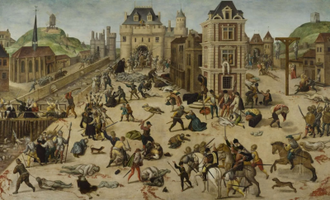
St Bartholomew's Day Massacre by François Dubois, 1574 © The Cantonal Museum of Fine Arts, Lausanne, Switzerland
Source: Christian Art
Gospel of 26 March 2026
John 8:51-59
At that time: Jesus said to the Jews, 'Truly, truly, I say to you, if anyone keeps my word, he will never see death.' The Jews said to him, 'Now we know that you have a demon! Abraham died, as did the prophets, yet you say, "If anyone keeps my word, he will never taste death." Are you greater than our father Abraham, who died? And the prophets died! Who do you make yourself out to be?' Jesus answered, 'If I glorify myself, my glory is nothing. It is my Father who glorifies me, of whom you say, "He is our God." But you have not known him. I know him. If I were to say that I do not know him, I would be a liar like you, but I do know him and I keep his word. Your father Abraham rejoiced that he would see my day. He saw it and was glad.' So the Jews said to him, 'You are not yet fifty years old, and have you seen Abraham?' Jesus said to them, 'Truly, truly, I say to you, before Abraham was, I am.' So they picked up stones to throw at him, but Jesus hid himself and went out of the Temple.
Reflection on the painting
In Monday's Gospel reading, the religious leaders were ready to stone a woman whom they had dragged before Jesus. In today's reading, that same group once again takes up stones, but this time their target is Jesus Himself. They had wanted to stone the woman because she had been caught in adultery. Now they wish to stone Jesus because of the bold claims He is making about His identity, especially His declaration that He existed before Abraham. To them, such words sounded like blasphemy. What we see here is how religious 'certainty', when mixed with pride and fear, can lead to hostility and even violence against those who appear to challenge it.
Yet the Gospel reveals a very different vision of God. True faith does not lead us to condemn or destroy others, but to seek communion with them, even when they are different from us. To find common ground, and then to work from there. On this occasion Jesus escapes the stones, but we know that next week during Holy Week, He will face the Cross. Being deeply convinced in our faith is important and necessary, but absolute certainty mixed with pride can become dangerous, even violent.
Sadly many religious wars have risen over time. Today's reading reminded me of the French Wars of Religion. They tore France apart between 1562 and 1598, pitting the Catholic majority against French Protestants, known as Huguenots. The tensions began when the Protestant Reformation spread into France and large numbers of people adopted the teachings of John Calvin. Political rivalries between noble families quickly intertwined with religious divisions, and the country descended into decades of intermittent warfare. Between two and four million people died from violence, famine or disease directly caused by the conflict.
One of the most infamous episodes of these wars was the St. Bartholomew's Day Massacre in August 1572, depicted in our painting by François Dubois. Thousands of Protestant Huguenots had gathered in Paris for the wedding of the Protestant prince Henry of Navarre to the Catholic princess Margaret of Valois, an event meant to promote peace between the two communities. Instead, violence erupted after the attempted assassination of the Protestant leader Admiral Coligny. On the night of 23-24 August 1572, royal orders led to the killing of several Protestant leaders, and the situation quickly spiralled into mob violence. Over several days, Catholics massacred Huguenots in Paris and then in cities across France, with estimates of the dead ranging to as many as 30,000 people. The artist fled France after the massacre. The painting does not show a single moment but a wide panorama of violence unfolding across Paris. In one corner we see the body of Admiral Coligny being thrown from a window, while in another the powerful queen mother Catherine de' Medici walks among the bodies of the dead. The crowded composition and scattered scenes of killing capture the chaos and brutality of the massacre.
LINKS
Christian Art: https://christian.art/
Today's reading: https://christian.art/daily-gospel-reading/john-8-51-59-2026/
 Facebook
 Twitter
 LinkedIn
 Print
Print Email
Email





 Facebook
 Twitter
 YouTube
 LinkedIn
 Pinterest