


Gospel in Art: Solemnity of The Annunciation of the Lord
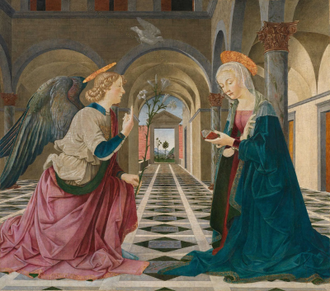
The Annunciation, by Piermatteo d'Amelia , 1487 © The Isabella Stewart Gardner Museum, Boston
Source: Christian Art
Gospel of 25 March 2026
Luke 1:26-38
At that time: The angel Gabriel was sent from God to a city of Galilee named Nazareth, to a virgin betrothed to a man whose name was Joseph, of the house of David. And the virgin's name was Mary. And he came to her and said, 'Hail, full of grace, the Lord is with you!' But she was greatly troubled at the saying, and tried to discern what sort of greeting this might be. And the angel said to her, 'Do not be afraid, Mary, for you have found favour with God. And behold, you will conceive in your womb and bear a son, and you shall call his name Jesus. He will be great and will be called the Son of the Most High. And the Lord God will give to him the throne of his father David, and he will reign over the house of Jacob for ever, and of his kingdom there will be no end.'
And Mary said to the angel, 'How will this be, since I am a virgin?' And the angel answered her, 'The Holy Spirit will come upon you, and the power of the Most High will overshadow you; therefore the child to be born will be called holy - the Son of God. And behold, your relative Elizabeth in her old age has also conceived a son, and this is the sixth month with her who was called barren. For nothing will be impossible with God.' And Mary said, 'Behold, I am the servant of the Lord; let it be to me according to your word.' And the angel departed from her.
Reflection on the painting
In yesterday's Gospel we heard the Pharisees ask Jesus a direct question: "Who are you?" Today, on the solemnity of the Annunciation, we encounter another direct question, this time asked by Mary. When the angel announces that she will bear the Son of God, Mary responds in a very human way: "How can this be?" It is a question that echoes throughout the Scriptures. When Jesus stood with His disciples before a hungry crowd in the wilderness, they too asked, "How can we feed all these people here in the desert?" Whenever we face something that seems beyond our strength or understanding, we often find ourselves asking the same question: How will this be possible? How will I manage this? How can this be?
The angel Gabriel's answer gently shifts Mary's attention away from her own limitations and towards God's power: "The Holy Spirit will come upon you, and the power of the Most High will overshadow you." Mary is being invited to take part in something extraordinary, something that will reshape her entire life. Yet she is not asked to rely solely on her own strength. God's grace will sustain her. And with that trust, Mary gives her beautiful response: "Let it be done to me according to your word." For this reason, the Church has long seen Mary as the model disciple: someone who trusts that God can work through human weakness. The question "How can this be?" does not have to paralyse us; like Mary, it can become the doorway through which the Holy Spirit begins to work in our lives.
Yesterday we reflected on a painting by Fra Angelico, an artist who stands at the very beginning of the Renaissance. Today's painting, created some sixty years later, shows us how rapidly the Renaissance had developed. The Annunciation by Piermatteo d'Amelia, depicts a world that is fully Renaissance: a carefully constructed space, elegant architecture, and a new fascination with perspective and the geometry of vision. The tiled floor and the strong lines of perspective lead us toward a central doorway, opening onto a soft landscape of hills in the distance. Then we see the archangel Gabriel on the left gazing toward the Virgin Mary on the right. Between Gabriel and Mary we see the traditional symbols of the Annunciation: the white lilies, signs of purity, and above them the descending dove, representing the Holy Spirit.
This painting was originally created for the main altar of a Franciscan church in Amelia, a small town in Umbria near Spoleto. For many years scholars were unsure who painted it, referring to the anonymous artist simply as the "Master of the Gardner Annunciation." Only later did documents reveal that the painter was Piermatteo d'Amelia, a pupil and assistant of Filippo Lippi, one of the important figures of the Florentine Renaissance. Wonderful that such discoveries are still being made nowadays.
LINKS
Christian Art: https://christian.art/
Today's reading: https://christian.art/daily-gospel-reading/luke-1-26-38-2026/
 Facebook
 Twitter
 LinkedIn
 Print
Print Email
Email









 Facebook
 Twitter
 YouTube
 LinkedIn
 Pinterest