


Gospel in Art: Jesus raising Lazarus from the dead
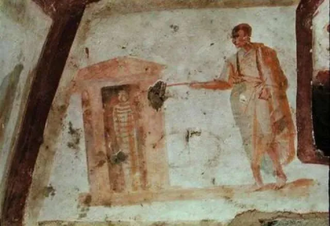
Jesus Christ raising Lazarus from the dead, Catacombs of Callistus, Rome © Christian Art
Gospel of 22 March 2026
John 11:1-45
At that time: The sisters of Lazarus sent to Jesus, saying, 'Lord, he whom you love is ill.' But when Jesus heard it he said, 'This illness does not lead to death. It is for the glory of God, so that the Son of God may be glorified through it.'
Now Jesus loved Martha and her sister and Lazarus. So, when he heard that Lazarus was ill, he stayed two days longer in the place where he was. Then after this he said to the disciples, 'Let us go to Judea again.'
Now when Jesus came, he found that Lazarus had already been in the tomb four days. So when Martha heard that Jesus was coming, she went and met him, but Mary remained seated in the house. Martha said to Jesus, 'Lord, if you had been here, my brother would not have died. But even now I know that whatever you ask from God, God will give you.' Jesus said to her, 'Your brother will rise again.' Martha said to him, 'I know that he will rise again in the resurrection on the last day.' Jesus said to her, 'I am the resurrection and the life. Whoever believes in me, though he die, yet shall he live, and everyone who lives and believes in me shall never die. Do you believe this?' She said to him, 'Yes, Lord; I believe that you are the Christ, the Son of God, who is coming into the world.'
Jesus was deeply moved in his spirit and greatly troubled. And he said, 'Where have you laid him?' They said to him, "Lord, come and see." Jesus wept. So the Jews said, 'See how he loved him!' But some of them said, 'Could not he who opened the eyes of the blind man also have kept this man from dying?'
Then Jesus, deeply moved again, came to the tomb. It was a cave, and a stone lay against it. Jesus said, 'Take away the stone.' Martha, the sister of the dead man, said to him, 'Lord, by this time there will be a smell, for he has been dead four days.' Jesus said to her, 'Did I not tell you that if you believed you would see the glory of God?' So they took away the stone. And Jesus lifted up his eyes and said, 'Father, I thank you that you have heard me. I knew that you always hear me, but I said this on account of the people standing around, that they may believe that you sent me.' When he had said these things, he cried out with a loud voice, 'Lazarus, come out.' The man who had died came out, his hands and feet bound with linen strips, and his face wrapped with a cloth. Jesus said to them, 'Unbind him, and let him go.'
Many of the Jews therefore, who had come with Mary and had seen what he did, believed in him.
Reflection on the early Christian Catacomb Painting
As the days slowly grow longer and the first signs of life begin to appear in nature, we start to feel that winter is loosening its grip. The air may still be cold, yet there is a quiet sense that something is changing. Buds appear on branches, flowers push their way through the soil, and the earth begins to wake from its long sleep. With this awakening of nature comes new work: grass will soon need cutting, gardens will need tending. A new season is upon us. The longer evenings will draw us outside again, to walk more and feel a little more alive.
Yet not everyone experiences this season in the same way. For some, the arrival of spring does not immediately bring new energy. Those who have recently lost someone they love may feel that a part of themselves has been taken away. Others may be burdened by illness, disappointment, exhaustion, or the quiet weight of personal struggles. Life can sometimes feel drained of colour, even when the world around us begins to bloom. As individuals, as families, even as communities, we can find ourselves longing for a deeper kind of renewal, a life that goes beyond the changing of seasons.
That is very much the situation we encounter in today's Gospel (I copied in the short version of the reading). A family of friends very close to Jesus sends Him an urgent message: "Lord, the one you love is ill." By the time Jesus arrives, the illness has given way to death. They are frustrated, even annoyed with Jesus: "If you had been here, my brother would not have died." Yet Jesus enters fully into their sorrow. Standing before the tomb of Lazarus, He raises him from the dead. In that moment Jesus reveals something extraordinary about Himself: that He is not simply a comforter in times of loss, but the actual "resurrection and the life."
One of the earliest depictions of today's Gospel story can be found in the Catacomb of Saint Callistus in Rome, dating from the early third century. This simple but powerful fresco may well be among the first images in the world showing Christ calling Lazarus out of the tomb. What is striking is how different Jesus appears compared to later Christian art. Rather than the familiar bearded figure, He is shown as a young, clean-shaven man with short hair, dressed in the simple tunic of a Roman citizen. Early Christians often portrayed Christ in this youthful way, emphasising His vitality. In the scene Jesus raises His hand and holds a thin rod (known as a virga) as He performs the miracle. This small rod symbolises divine authority and may deliberately recall the staff of Moses, through which God worked miracles in the Old Testament. Just as Moses struck the rock and life-giving water flowed in the desert, here Christ, with a gesture of authority, calls Lazarus out of death.
LINKS
Christian Art: https://christian.art/
Today's reading: https://christian.art/daily-gospel-reading/john-11-1-45-2026/
 Facebook
 Twitter
 LinkedIn
 Print
Print Email
Email

















 Facebook
 Twitter
 YouTube
 LinkedIn
 Pinterest