


Gospel in Art: Palm Sunday
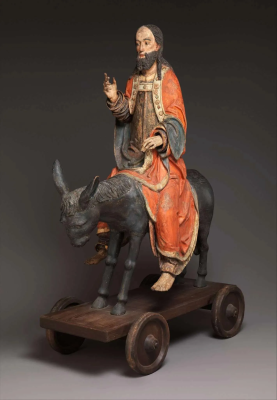
Polychrome painted Palmesel, German,15th century © Metropolitan Museum of Art, NY
Source: Christian Art
Gospel of 29 March 2026
Matthew 27:11-54
At that time: Jesus stood before Pontius Pilate, the governor, and the governor asked him, 'Are you the King of the Jews?' Jesus said, 'You have said so.' But when he was accused by the chief priests and elders, he gave no answer. Then Pilate said to him, 'Do you not hear how many things they testify against you?' But he gave him no answer, not even to a single charge, so that the governor was greatly amazed.
Now at the feast the governor was accustomed to release for the crowd any one prisoner whom they wanted. And they had then a notorious prisoner called Barabbas.
So when they had gathered, Pilate said to them, 'Whom do you want me to release for you: Barabbas, or Jesus who is called Christ?' For he knew that it was out of envy that they had delivered him up. Besides, while he was sitting on the judgement seat, his wife sent word to him, 'Have nothing to do with that righteous man, for I have suffered much because of him today in a dream.'
Now the chief priests and the elders persuaded the crowd to ask for Barabbas and destroy Jesus. The governor again said to them, 'Which of the two do you want me to release for you?' And they said, 'Barabbas.' Pilate said to them, 'Then what shall I do with Jesus who is called Christ?' They all said, 'Let him be crucified!' And he said, 'Why? What evil has he done?' But they shouted all the more, 'Let him be crucified!'
So when Pilate saw that he was gaining nothing, but rather that a riot was beginning, he took water and washed his hands before the crowd, saying, 'I am innocent of this man's blood; see to it yourselves.' And all the people answered, 'His blood be on us and on our children!' Then he released for them Barabbas, and having scourged Jesus, delivered him to be crucified.
Then the soldiers of the governor took Jesus into the governor's headquarters, and they gathered the whole battalion before him. And they stripped him and put a scarlet robe on him, and twisting together a crown of thorns, they put it on his head and put a reed in his right hand. And kneeling before him, they mocked him, saying, 'Hail, King of the Jews!' And they spat on him and took the reed and struck him on the head. And when they had mocked him, they stripped him of the robe and put his own clothes on him and led him away to crucify him.
As they went out, they found a man of Cyrene, Simon by name. They compelled this man to carry his cross. And when they came to a place called Golgotha (which means Place of a Skull), they offered him wine to drink, mixed with gall, but when he tasted it, he would not drink it. And when they had crucified him, they divided his garments among them by casting lots. Then they sat down and kept watch over him there. And over his head they put the charge against him, which read, 'This is Jesus, the King of the Jews.' Then two robbers were crucified with him, one on the right and one on the left. And those who passed by derided him, wagging their heads and saying, 'You who would destroy the Temple and rebuild it in three days, save yourself! If you are the Son of God, come down from the cross.' So also the chief priests, with the scribes and elders, mocked him, saying, 'He saved others; he cannot save himself. He is the King of Israel; let him come down now from the cross, and we will believe in him. He trusts in God; let God deliver him now, if he desires him. For he said, "I am the Son of God." ' And the robbers who were crucified with him also reviled him in the same way.
Now from the sixth hour there was darkness over all the land until the ninth hour. And about the ninth hour Jesus cried out with a loud voice, saying, 'Eli, Eli, lema sabachthani?' that is, 'My God, my God, why have you forsaken me?' And some of the bystanders, hearing it, said, 'This man is calling Elijah.' And one of them at once ran and took a sponge, filled it with sour wine, and put it on a reed and gave it to him to drink. But the others said, 'Wait, let us see whether Elijah will come to save him.' And Jesus cried out again with a loud voice and yielded up his spirit.
All kneel for a period of silence.
And behold, the curtain of the temple was torn in two, from top to bottom. And the earth shook, and the rocks were split. The tombs also were opened. And many bodies of the saints who had fallen asleep were raised, and coming out of the tombs after his resurrection they went into the holy city and appeared to many. When the centurion and those who were with him, keeping watch over Jesus, saw the earthquake and what took place, they were filled with awe and said, 'Truly this was the Son of God!'
Reflection on the Sculpture
On Palm Sunday this year we hear the Passion as told by Gospel of Matthew (I copied the short version of today's Gospel here). Matthew's telling of the Passion has several striking details that the other Gospels do not include. Only Matthew tells us about Pilate's wife, who sends an urgent message to her husband after a troubling dream, warning him: "Have nothing to do with that innocent man." Matthew also alone describes Pilate washing his hands before the crowd, symbolically distancing himself from the decision that will lead Jesus to the cross. These details highlight how even outsiders recognised Jesus' innocence, while the crowd moves toward condemnation. Matthew's account also ends with dramatic cosmic signs that underline who Jesus truly is. When Jesus dies, the earth quakes, rocks split, and the curtain of the Temple is torn in two. Matthew even tells us that tombs are opened and holy people are raised, a striking sign that Christ's death already begins to defeat death itself in that very moment.
Today we celebrate Palm Sunday though, the moment when Jesus enters Jerusalem and is welcomed like a king. The crowds lay down cloaks and wave palm branches, shouting "Hosanna!" In the ancient world, palms were symbols of victory, triumph, and honour. Victorious rulers and heroes were welcomed with palms, and in Christian art the same symbol came to represent the ultimate victory: faithfulness to Christ even unto death. That is why so many martyrs are depicted holding a palm branch: it is the sign that, though they suffered, they have shared in Christ's victory. As we collect a palm branch at the end of mass today to take home, we take it home as a reminder that we too are called to walk with Christ, not only in the joy of his entry into Jerusalem, but also along the difficult road that leads to the Cross. The palm in our hands becomes a quiet symbol of discipleship.
Today's work of art is a 15th-century German 'Palmesel'. The German word Palmesel (palm donkey) refers to the statue of Jesus on a donkey. Our sculpture is mounted on a wheeled platform and is of a type used in Palm Sunday processions in many German-speaking regions till the late 16th century. These processions took place on the main streets of cities and villages, reenacting Christ's entry into Jerusalem on Palm Sunday. They were lively pageants in which hymns were sung, palms waved and clothes spread on the ground before the Palmesel. The figure of Christ would originally have held leather reins in his left hand, and the donkey would have had a bridle, enhancing the naturalistic effect.
The donkey is also symbolic of something else. It was not swayed that day in Jerusalem by the joyful acclamations, nor later by the screaming words of hate. The donkey did a particular job, which was to bear a particular burden. It did this, humbly, not expecting praise or reward. There it was, front and centre, carrying Christ,... unnoticed,... invisible..., executing the noblest of tasks in greatest humility.
LINKS
Christian Art: https://christian.art/
Today's reading: https://christian.art/daily-gospel-reading/matthew-27-11-54-2026/
 Facebook
 Twitter
 LinkedIn
 Print
Print Email
Email








 Facebook
 Twitter
 YouTube
 LinkedIn
 Pinterest