


Gospel in Art: Caiaphas said: 'You know nothing at all.'
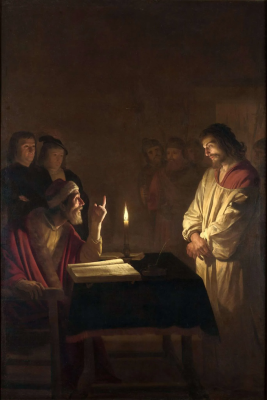
Christ before the High Priest Caiaphas, by Gerard van Honthorst, 1617 © National Gallery, London
Source: Christian Art
Gospel of 28 March 2026
John 11:45-56
At that time: Many of the Jews, who had come with Mary and had seen what Jesus did, believed in him, but some of them went to the Pharisees and told them what Jesus had done. So the chief priests and the Pharisees gathered the council and said, 'What are we to do? For this man performs many signs. If we let him go on like this, everyone will believe in him, and the Romans will come and take away both our Place and our nation.' But one of them, Caiaphas, who was high priest that year, said to them, 'You know nothing at all. Nor do you understand that it is better for you that one man should die for the people, not that the whole nation should perish.' He did not say this of his own accord, but being high priest that year he prophesied that Jesus would die for the nation, and not for the nation only, but also to gather into one the children of God who are scattered abroad. So from that day on they made plans to put him to death.
Jesus therefore no longer walked openly among the Jews, but went from there to the region near the wilderness, to a town called Ephraim, and there he stayed with the disciples.
Now the Passover of the Jews was at hand, and many went up from the country to Jerusalem before the Passover to purify themselves. They were looking for Jesus and saying to one another as they stood in the Temple, 'What do you think? That he will not come to the feast at all?'
Reflection on the painting
At the end of today's Gospel, the Jewish authorities reach a decisive conclusion: Jesus must die. To them he had become a threat. They wanted a status quo. They wanted to kill him, not because he had done harm, but because his presence unsettled the established order from which they benefited. In every age, those who disturb the familiar patterns of power and security are often pushed aside or silenced. Only moments earlier (just before today's Gospel reading) he had raised Lazarus from the dead, restoring joy and life to a grieving household. Yet this very act of life-giving mercy was perceived as dangerous. The one who brought life was condemned because the life he brought challenged the structures that preferred things to remain as they were.
Here we encounter the great paradox at the heart of the Gospel. The Life-Giver is put to death. In giving life to Lazarus, Jesus sets in motion the events that will cost him his own life. And yet, even in death, His life-giving work does not cease. From the cross He continues to pour out life for the world. As He had done while walking the dusty roads of Galilee and the crowded streets of Jerusalem, so too on Calvary He reveals the fullness of God's love and life. That is why Christians 'dare' to call the day of his crucifixion 'Good' Friday. We do not simply mourn the cross; we venerate it: because through the wood of the cross the life of God was given to the world.
We are introduced to Caiaphas in today's Gospel reading. He was the High Priest of the Temple in Jerusalem, the most powerful religious authority among the Jewish leadership at the time of Jesus. In our passage he argues that it would be better for one man to die for the people than for the whole nation to suffer. Caiaphas will appear again during the Passion, when Jesus is brought before him for questioning after his arrest. There, according to the Gospels, he accuses Jesus of blasphemy when Jesus affirms his divine identity, and the council decides that Jesus must die. He is thus a tragic figure who, in trying to safeguard the temple system, fails to recognise the very Messiah standing before him.
This dramatic moment is captured in the painting "Christ before the High Priest" by the Dutch artist Gerrit van Honthorst, painted around 1617. The scene is illuminated by a single candle. The small flame divides the composition: on one side sits Caiaphas, leaning forward and pointing accusingly while resting his hand on the book of the Mosaic Law; on the other stands Christ, calm and silent. What is striking is the contrast between the two figures. Caiaphas is animated, accusatory, almost agitated. Jesus, by contrast, appears serene and composed, his gaze calm and inward. Even the colours carry meaning: Caiaphas wears strong red tones (the wants blood to be spilled), while Christ is clothed largely in white, a traditional symbol of innocence and purity. Behind them other members of the council linger in shadow, suggesting the quiet machinery of judgment already in motion.
LINKS
Christian Art: https://christian.art/
Today's reading: https://christian.art/daily-gospel-reading/john-11-45-56-2029/
 Facebook
 Twitter
 LinkedIn
 Print
Print Email
Email








 Facebook
 Twitter
 YouTube
 LinkedIn
 Pinterest