


Gospel in Art: Commemoration of Saint Cyril of Jerusalem, Bishop, Doctor
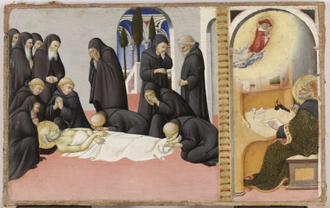
Death of Saint Jerome in the Presence of His Disciples and His Appearance to Bishop Saint Cyril of Jerusalem, by Sano di Pietro © Louvre, Paris
Source: Christian Art
Gospel of 18 March 2026
John 5:17-30
At that time: Jesus answered the Jews, 'My Father is working even now, and I am working.' This was why the Jews were seeking all the more to kill him, because not only was he breaking the Sabbath, but he was even calling God his own Father, making himself equal with God.
So Jesus said to them, 'Truly, truly, I say to you, the Son can do nothing of his own accord, but only what he sees the Father doing. For whatever the Father does, that the Son does likewise. For the Father loves the Son and shows him all that he himself is doing. And greater works than these will he show him, so that you may marvel. For as the Father raises the dead and gives them life, so also the Son gives life to whom he will. For the Father judges no one, but has given all judgement to the Son, that all may honour the Son, just as they honour the Father. Whoever does not honour the Son does not honour the Father who sent him. Truly, truly, I say to you, whoever hears my word, and believes him who sent me, has eternal life. He does not come into judgement, but has passed from death to life.
'Truly, truly, I say to you, an hour is coming, and is now here, when the dead will hear the voice of the Son of God, and those who hear will live. For as the Father has life in himself, so he has granted the Son also to have life in himself. And he has given him authority to execute judgement, because he is the Son of Man. Do not marvel at this, for the hour is coming when all who are in the tombs will hear his voice and come out, those who have done good to the resurrection of life, and those who have done evil to the resurrection of judgement.
'I can do nothing on my own. As I hear, I judge, and my judgement is just, because I seek not my own will but the will of him who sent me.'
Reflection on the painting
Cyril of Jerusalem (c. 313-386) was bishop of Jerusalem during one of the most delicate periods in early Christianity. Living only a few decades after the Edict of Milan had legalised Christianity and stopped the persecutions of Christians, Cyril helped shape the Church at a time when Christian identity was rapidly developing. He is especially famous for his Catechetical Lectures, a remarkable series of teachings given to those preparing for baptism in Jerusalem. These talks explain the Creed, the sacraments, and the meaning of Christian life with great pastoral warmth. Because of the depth of these writings, the Church later honoured him with the title Doctor of the Church.
Cyril also lived through intense theological controversy. The Church was still wrestling with the implications of the First Council of Nicaea (325), particularly the debate about the nature of Christ (fully human, fully divine). Because of these tensions, Cyril was exiled three times during his lifetime, caught in political and doctrinal struggles within the Church. Although Cyril himself held the orthodox faith affirmed at Nicaea, he tried to speak in careful, conciliatory language to maintain peace in a deeply divided Church. This made him suspicious in the eyes of some and he had to flee three times, spending a total of 17 years away from Jerusalem. Yet despite these hardships, his legacy endured. His catechetical teaching remains one of the most vivid windows we possess into the early liturgy of Jerusalem, describing in beautiful detail how the newly baptised were introduced into the mysteries of the Eucharist.
The painting by Sano di Pietro is part of a larger altarpiece painted in 1444 for the Jesuit convent of San Girolamo in Siena. Our scene here tells a fascinating story linking Cyril to Jerome, the great biblical scholar who translated the Scriptures into Latin (the Vulgate). According to medieval tradition, at the moment of Jerome's death, his soul appeared in a vision to Bishop Cyril of Jerusalem, revealing that he had entered heavenly glory. The artist depicts both moments within the same scene: Jerome dying among his disciples while, at the same time, his radiant spirit appears to Cyril. The image beautifully reminds us that the communion of saints transcends time and place: scholars, bishops, and believers across centuries are united in the same faith and the same hope of eternal life.
LINKS
Christian Art: https://christian.art/
Today's reading: https://christian.art/daily-gospel-reading/john-5-17-30-2026/
 Facebook
 Twitter
 LinkedIn
 Print
Print Email
Email












 Facebook
 Twitter
 YouTube
 LinkedIn
 Pinterest