

Gospel in Art: Feast of Saint Scholastica
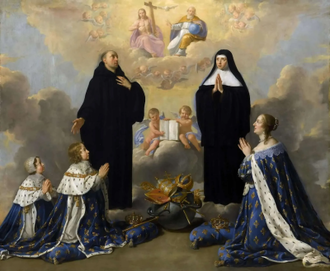
Anne of Austria and her Children at Prayer with St Benedict and St. Scholastica by Philippe de Champaigne © Château de Versailles, France
Source: Christian Art
Gospel of 10 February 2026
Luke 10:38-42
At that time: Jesus entered a village. And a woman named Martha welcomed him into her house. And she had a sister called Mary, who sat at the Lord's feet and listened to his teaching. But Martha was distracted with much serving. And she went up to him and said, 'Lord, do you not care that my sister has left me to serve alone? Tell her then to help me.' But the Lord answered her, 'Martha, Martha, you are anxious and troubled about many things, but one thing is necessary. Mary has chosen the good portion, which will not be taken away from her.'
Reflection on the painting
Today we celebrate the Feast of Saint Scholastica (c. 480-543). According to the Dialogues of Gregory the Great, Scholastica was born in Nursia, Umbria, of wealthy parents. While Gregory states that Scholastica was Saint Benedict's sister, a later tradition says she was actually his twin (whether this is meant biologically or spiritually, or both, is unclear). Gregory also states that she was dedicated to God from a young age. She and her brother Benedict were brought up together until the time he left to pursue studies in Rome. Benedictine tradition holds that Scholastica established a hermitage about five miles from Monte Cassino and that this was the first convent of Benedictine nuns that she founded.
The most commonly told story about her is that Scholastica would, once a year, go to visit her brother at a place near his abbey, and they would spend the day worshipping together and discussing sacred texts and issues. One day they had supper and continued their conversation. When Benedict indicated it was time for him to leave, Scholastica, perhaps sensing that the time of her death was drawing near, asked him to stay with her for the evening so they could continue their discussions. Not wishing to break his own Rule, Benedict refused, insisting that he needed to return to his cell. At that point, Scholastica closed her hands in prayer, and after a moment, a wild storm began outside the guest house in which they were staying. Benedict asked, "What have you done?", to which she replied, "I asked you and you would not listen; so I asked my God and he did listen. So now go off, if you can; leave me and return to your monastery." Benedict was unable to do this and they spent the night in discussion. Three days later, from his cell, Benedict saw his sister's soul leaving the earth and ascending to heaven in the form of a shining white dove.
Our 17th-century painting, attributed to Jean Baptiste de Champaigne, depicts Saint Benedict and Saint Scholastica praying to the Holy Trinity depicted above them. Below them are Anne of Austria (1601-66) and her children at prayer. Anne of Austria was an Infanta of Spain who became Queen of France (hence the fleur-de-lys embroidered on the cope) as the wife of King Louis XIII from their marriage in 1615 until Louis XIII died in 1643. She was also Queen of Navarre until that kingdom was annexed into the French crown in 1620. All her regalia, crowns, sceptre and jewellery are placed on a cushion in front of the saints. These insigniae of the temporal are worthless in presence of the eternal.
Saint Scholastica, pray for us.
LINKS
Christian Art: https://christian.art/
Today's reading: https://christian.art/daily-gospel-reading/luke-10-38-42-2026/
 Facebook
 Twitter
 LinkedIn
 Print
Print Email
Email










 Facebook
 Twitter
 YouTube
 LinkedIn
 Pinterest