


Gospel in Art: Memorial of Saint Joseph the Worker
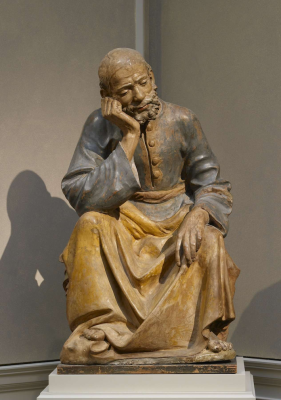
Saint Joseph, Anonymous Italian Sculptor, 1475-1500 © The Walters Art Museum, Baltimore
Source: Christian Art
Gospel of 1 May 2026
John 14:1-6
At that time: Jesus said to his disciples, 'Let not your hearts be troubled. Believe in God; believe also in me. In my Father's house are many rooms. If it were not so, would I have told you that I go to prepare a place for you? And if I go and prepare a place for you, I will come again and will take you to myself, that where I am you may be also. And you know the way to where I am going.' Thomas said to him, 'Lord, we do not know where you are going. How can we know the way?' Jesus said to him, 'I am the way, and the truth, and the life. No one comes to the Father except through me.'
Reflection on the sculpture
The Gospels tell us that Joseph was a skilled craftsman, a carpenter. In the context of a small village, such a trade would have brought in some income, enough to support a modest but stable household. While not wealthy, the Holy Family likely lived with a degree of self-sufficiency. Just a few kilometres from Nazareth, the city of Sepphoris was being developed by Herod Antipas during Jesus' early years. The remains of that city can still be seen today. It is possible that Joseph, as a tradesman, may have found work there during its construction or perhaps supplied some of his carpentry work to support the building efforts.
Saint Joseph is one of the most striking figures in the Gospels because he never speaks a single word. He shows us that holiness is lived, not spoken! And yet, his life is full of decisive action. He receives four dreams: first, to take Mary as his wife; then to flee with the child Jesus into Egypt; later to return to Israel; and finally to settle in Nazareth for safety. Each time, he responds immediately, no hesitation, no argument, just quiet obedience to God. A carpenter by trade, he becomes the guardian of the Holy Family, protecting them in moments of real danger. Tradition calls him a "just man," and perhaps that is his greatest lesson: that God often works not through loud voices, but through those who are quiet, but listen deeply... and then act.
Our tender sculpture of Saint Joseph captures him not in action, but in a quiet moment. He is seated, reflective, perhaps even drifting into sleep. It is easy to imagine this as part of a Nativity scene, where Joseph is often shown slightly apart, watchful yet withdrawn, holding the mystery in silence. Perhaps he is dreaming one of his four dreams. There is something deeply human in this sculpture: Joseph depicted not as a traditional saint or hero, but as guardian, thinking, protecting, pondering the weight of what has been entrusted to him.
The sculpture belongs to the rich tradition of glazed terracotta in Renaissance Italy, a technique made famous by the workshop of the Della Robbia family. Using clay coated in a luminous tin glaze, these artists created works that were both durable and radiant, the glaze almost glowing with light. Unlike marble, this material allowed for warmth and intimacy.
LINKS
Christian Art: https://christian.art/
Today's reading: https://christian.art/daily-gospel-reading/john-14-1-6-2026/
 Facebook
 Twitter
 LinkedIn
 Print
Print Email
Email













 Facebook
 Twitter
 YouTube
 LinkedIn
 Pinterest