


Gospel in Art: He who ate my bread has lifted his heel against me
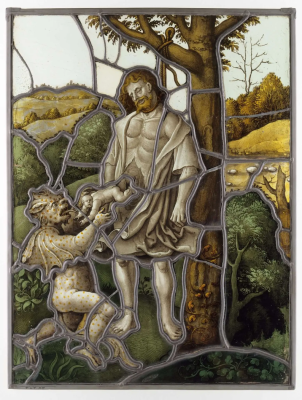
The Hanging of Judas, German, 1515-1525 © The Art institute of Chicago
Source: Christian Art
Gospel of 30 April 2026
John 13:16-20
After Jesus had washed the feet of his disciples, he said to them, 'Truly, truly, I say to you, a servant is not greater than his master, nor is a messenger greater than the one who sent him. If you know these things, blessed are you if you do them. I am not speaking of all of you; I know whom I have chosen. But the Scripture will be fulfilled, "He who ate my bread has lifted his heel against me." I am telling you this now, before it takes place, that when it does take place you may believe that I am he. Truly, truly, I say to you, whoever receives the one I send receives me, and whoever receives me receives the one who sent me.'
Reflection on the stained glass window
The betrayal of Jesus by one of his closest companions is one of the most painful moments in the Gospel, and it is something the early Church wrestled deeply to understand. Knowing that his followers would find it hard to understand that Jesus let the betrayal happen, he quotes from Scripture: Psalm 41:9: "He who ate my bread has lifted his heel against me." Or more freely translated: Even my close friend in whom I trusted, who ate my bread, who shared the table with me, has now betrayed me. So already in the psalms, King David describes betrayal by a close friend. There are few wounds as deep as being betrayed by someone close to us. And it is into this human experience that the story of Judas enters.
And yet, what makes this moment even more striking is what surrounds it. In the Gospel of John, Jesus speaks of betrayal just after he has knelt to wash the feet of his disciples, including Judas. He knows what is coming, and still he serves. Still he loves. This is what faithfulness looks like in the kingdom of God: not a response to others' goodness, but a generosity even to those who betray us or who don't particularly like us. All people need to be served by us. It is easy to serve friends, but far less easy to serve people we don't warm to. That is when our faith really blossoms, when our faithfulness is not dependent on reciprocity.
The tragic end of Judas Iscariot is described most clearly in the Gospel of Matthew where we are told that, filled with remorse, he returned the thirty pieces of silver and then went away and hanged himself. It is a stark and sobering moment. Yet the deepest tragedy of Judas is not only the betrayal (terrible as that was) but what followed. He recognised his sin, he felt sorrow, but he could not believe in mercy. He could not imagine that Jesus might forgive him. And that is where his story turns into despair. Because the truth is: Christ would have forgiven him. The same Lord who forgave Peter, who forgave those who crucified him, would surely have forgiven Judas. Judas' tragedy was not that he fell, but that he could not believe he could be lifted up again.
Our stained glass window, was made in Germany circa 1520, depicts an unsettling image of the Hanging of Judas, It belongs to a long medieval tradition that tried to make visible what happens to the soul at the moment of death. In the stained glass panel, Judas Iscariot hangs lifeless from the tree, but the real drama unfolds in a disturbing detail: a demon tears from his body a small, child-like figure emerging from his belly. This "child" represents the soul. Medieval artists often imagined the soul as something small and vulnerable, almost infant-like, being born out of the body at death... and here, tragically, it is not received by angels, but seized by the forces of evil.
LINKS
Christian Art: https://christian.art/
Today's reading: https://christian.art/daily-gospel-reading/john-13-16-20-2026/
 Facebook
 Twitter
 LinkedIn
 Print
Print Email
Email
















 Facebook
 Twitter
 YouTube
 LinkedIn
 Pinterest