


Gospel in Art: Jesus said, 'I am the good shepherd'
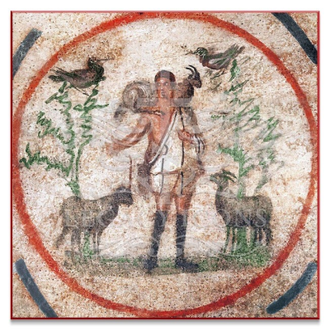
The Good Shepherd, Cubiculum of the Donna Velata, Ceiling fresco, Roman Early Christian, 3C
Source: Christian Art
Gospel of 27 April 2026
John 10:11-18
At that time: Jesus said, 'I am the good shepherd. The good shepherd lays down his life for the sheep. He who is a hired hand and not a shepherd, who does not own the sheep, sees the wolf coming and leaves the sheep and flees, and the wolf snatches them and scatters them. He flees because he is a hired hand and cares nothing for the sheep. I am the good shepherd. I know my own and my own know me, just as the Father knows me and I know the Father; and I lay down my life for the sheep. And I have other sheep that are not of this fold. I must bring them also, and they will listen to my voice. So there will be one flock, one shepherd. For this reason the Father loves me, because I lay down my life that I may take it up again. No one takes it from me, but I lay it down of my own accord. I have authority to lay it down, and I have authority to take it up again. This charge I have received from my Father.'
Reflection on the Catacomb Fresco
The earliest Christian images do not come from grand churches or gilded altarpieces, but from underground: from the quiet, hidden world of the Roman catacombs, such as those of Priscilla and Callixtus. There, in dim corridors carved beneath the earth, the first Christians painted their faith onto damp plaster walls, using simple, cheap pigments. And among these images, one appears again and again: Christ as the Good Shepherd. Not the majestic, bearded figure we might expect, but a young, beardless man, carrying a sheep across his shoulders. It is an image not of power, but of closeness.
This image must have spoken deeply to those early Christians. In a time of uncertainty and persecution, they did not first depict Christ as judge or king, or as a mighty ruler, but as one who seeks, who finds, who carries. The shepherd carries the sheep with tenderness and care. That is what the early christians connected with the most with Christ. It is a profoundly personal image, as Jesus carries just one sheep, one by one. The one sheep matters. Each of us matters. The relationship with Christ is deeply intimate. And that is exactly what Christ says in today's Gospel: that he knows his own, and his own know him.
It is only later, by the 4th century and especially after Christianity was legalised and tehpereecution stopped, that we begin to see Christ depicted with a beard. Influenced by Greco-Roman images of philosophers and by a growing desire to express wisdom and authority, artists began to portray Jesus with a beard. In early art, a beard was used as a visual sign of wisdom and maturity. Since wisdom was associated with age, artists gave Christ a beard to express that he is not only human, but the eternal source of truth and understanding. The bearded Christ would then evolve into the Pantocrator images, depicting Christ as 'ruler of all'.... It is beautiful to think that in the catacombs before Christ is shown as ruler of the universe… he is first shown as the one who carries us home.
Note also how to there is a goat to Christ's left and a sheep to his right. It quietly suggests that Jesus is the divine judge as well, separating the goats from the sheep.
LINKS
Christian Art: https://christian.art/
Today's reading: https://christian.art/daily-gospel-reading/john-10-11-18-2026/
 Facebook
 Twitter
 LinkedIn
 Print
Print Email
Email













 Facebook
 Twitter
 YouTube
 LinkedIn
 Pinterest