

Gospel in Art: Saints Erkenwald and Mellitus, Bishops of London
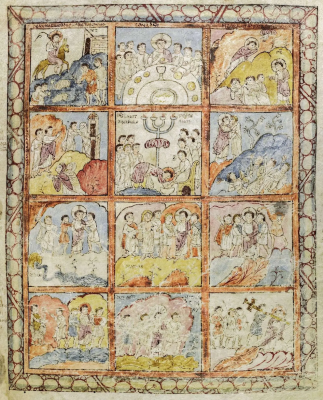
Gospels of Saint Augustine, Tradition states that this book was the personal property of St Mellitus © Parker Library, Corpus Christi College, Cambridge
Source: Christian Art
Gospel of 24 April 2026
Matthew 23:8-12
At that time: Jesus said to his disciples, 'You are not to be called rabbi, for you have one teacher, and you are all brothers and sisters. And call no man your father on earth, for you have one Father, who is in heaven. Neither be called instructors, for you have one instructor, the Christ. The greatest among you shall be your servant. Whoever exalts himself will be humbled, and whoever humbles himself will be exalted.'
Reflection on the 6th Century Manuscript
Today we remember two great contributors of the early Church in London: Mellitus and Erkenwald. These two men, in very different ways, helped plant the Christian faith in a fragile and uncertain land. Mellitus came first, sent as part of the great mission from Rome. Mellitus was directly part of Saint Augustine on Canterbury's mission. He was one of the second group of missionaries sent from Rome around 601 to support Augustine. Augustine himself appointed Mellitus as the first Bishop of London, entrusting him with establishing the Church in one of the most important cities of the land. When Mellitus arrived in London around the year 604, he did not come into a fully Christian city, but into a place of transition-still shaped by its Roman past and largely pagan in practice. It was under the protection of Æthelberht of Kent, the first Anglo-Saxon king to convert to Christianity, that the mission could take root. Although London itself was ruled by Æthelberht's nephew, King Sæberht of Essex, it was Æthelberht's influence that made it possible for Mellitus to establish a Christian presence there. With royal backing, Mellitus founded what would become the first cathedral dedicated to St Paul on the site we now know as St Paul's Cathedral.
Years later, the story continues with Erkenwald, living a generation after Mellitus, in the later 7th century (he died around 693). He was born into Anglo-Saxon nobility. His royal and aristocratic connections helped him enormously in his mission to spread the Christian faith in London. Before becoming bishop, he founded two important monasteries: one at Chertsey for monks, and one at Barking for nuns, where his own sister, Saint Ethelburga, became abbess. These foundations became centres of prayer, learning, and stability in a still-fragile Christian landscape in and around London. He was made bishop in 675. So whilst Mellitus had founded the first Christian presence in London, Erkenwald helped to expand it and root it deeply into the daily life of Londoners.
And perhaps that is why they are remembered together. One began the work; the other built upon those foundations it. Their lives remind us that the Church is never built in a single moment. It grows, falters, is rebuilt, and grows again. They also show us that holiness is not always dramatic our spectacular. Holiness is often patient, faithful, hidden and about laying foundations and quietly building, stone by stone.
Our illustration is taken from a 6th manuscript which is considered "more or less the oldest substantially complete copy" of Jerome's translation of the Gospels. Only two full-page miniatures remain, yet they are of immense importance, precisely because so few works from this period have survived. They are like fragile windows into the very beginnings of Western Christian art. Jerome had died only a short time before this copy was written in 420 AD. Our page depicts scenes from the Passion of Christ. It is believed that this manuscript may once have been the personal Gospel book of Mellitus.
LINKS
Christian Art: https://christian.art/
Today's reading: https://christian.art/daily-gospel-reading/matthew-23-8-12-2026-3/
 Facebook
 Twitter
 LinkedIn
 Print
Print Email
Email













 Facebook
 Twitter
 YouTube
 LinkedIn
 Pinterest