


Gospel in Art: Saint Anselm of Canterbury, Bishop, Doctor
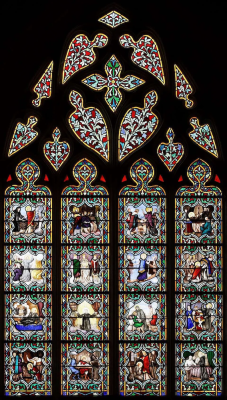
The Life of St Anselm of Canterbury, St Corentin Cathedral, Quimper, Finistère, Brittany 19th C © Wikimedia
Source: Christian Art
Gospel of 21 April 2026
John 6:30-35
At that time: The crowd said to Jesus, 'Then what sign do you do, that we may see and believe you? What work do you perform? Our fathers ate the manna in the wilderness; as it is written, "He gave them bread from heaven to eat."' Jesus then said to them, 'Truly, truly, I say to you, it was not Moses who gave you the bread from heaven, but my Father gives you the true bread from heaven. For the bread of God is he who comes down from heaven and gives life to the world.' They said to him, 'Sir, give us this bread always.'
Jesus said to them, 'I am the bread of life; whoever comes to me shall not hunger, and whoever believes in me shall never thirst.'
Reflection on the stained glass window
Saint Anselm of Canterbury was born around 1033 in Aosta, in northern Italy, and from a young age felt drawn to God, though his path was not straightforward. As a boy he longed to enter the monastery, but was refused, and for a time he drifted, searching for direction. Only later, after a period of restlessness and wandering across Europe, did he finally arrive at the Benedictine abbey of Bec in Normandy. There his life began to take shape. The monastic rhythm of prayer, study, and silence appealed to him deeply, and he grew into a teacher of remarkable clarity and gentleness, eventually becoming abbot of the community.
From this quiet monastic setting, Anselm's mind began to blossom and expand. He sought not simply to believe, but to understand, to see how faith and reason belong together. His writings, such as Proslogion and Cur Deus Homo, tried to express the mystery of God in a way that was both rational and deeply prayerful. He is often called the "father of scholasticism," because he helped shape a way of thinking that would influence the whole Middle Ages. Yet for Anselm, theology was never abstract, it was always rooted in contemplation, in a heart seeking God.
Following the Norman Conquest, the abbey of Bec received extensive lands in England. This meant that Anselm frequently crossed the Channel, not only to oversee the monastery's estates, but also to serve his sovereign, William I of England. During these visits, he would spend time in Canterbury, where his former mentor Lanfranc had become archbishop. Anselm's wisdom and humility, left a deep impression, not only on the king, but also on the monks of the cathedral chapter, who began to see in him a future shepherd. When Lanfranc died, the see of Canterbury was left vacant for several years. In 1093, Anselm, though reluctant and deeply attached to the monastic life, was summoned and, almost against his will, chosen as Archbishop of Canterbury. It was not a position he sought, but one he accepted out of obedience. And so, the quiet monk and contemplative thinker was drawn into the heart of politics. He died on 21 April 1109, the day on which we now remember him: a man who helped generations to see that faith is not blind, but rooted in heart and reason.
Our stained glass window at St Corentin Cathedral in Quimper, Finistère, Brittany, France, depicts 16 scenes from the life of St Anselm: his birth in Aosta; his childhood and early desire for the monastic life; his refusal entry into the monastery; his wandering years; his arrival at the abbey of Bec; his formation under Lanfranc; his life as a monk; his teaching and growing reputation; his election as abbot; his journeys to England; his relationship with King William I; his nomination as Archbishop of Canterbury; his reluctant acceptance of the office; his conflicts with the king; his exile and suffering for the freedom of the Church; and finally his death and entry into glory.
LINKS
Christian Art: https://christian.art/
Today's reading: https://christian.art/daily-gospel-reading/john-6-30-35-2026/
 Facebook
 Twitter
 LinkedIn
 Print
Print Email
Email
















 Facebook
 Twitter
 YouTube
 LinkedIn
 Pinterest