


Gospel in Art: Do not work for the food that perishes
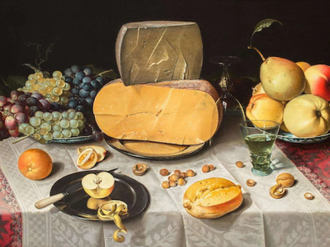
Still Life with Fruit, Nuts and Cheese by Floris van Dyck 1613 © National Gallery London
Source: Christian Art
Gospel of 20 April 2026
John 6:22-29
After Jesus had fed the five thousand, the disciples saw him walking on the lake. On the next day the crowd that remained on the other side of the lake saw that there had been only one boat there, and that Jesus had not entered the boat with his disciples, but that his disciples had gone away alone. Other boats from Tiberias came near the place where they had eaten the bread after the Lord had given thanks. So when the crowd saw that Jesus was not there, nor his disciples, they themselves got into the boats and went to Capernaum, seeking Jesus.
When they found him on the other side of the lake, they said to him, 'Rabbi, when did you come here?' Jesus answered them, 'Truly, truly, I say to you, you are seeking me, not because you saw signs, but because you ate your fill of the loaves. Do not work for the food that perishes, but for the food that endures to eternal life, which the Son of Man will give to you. For on him God the Father has set his seal.' Then they said to him, 'What must we do, to be doing the works of God?' Jesus answered them, 'This is the work of God, that you believe in him whom he has sent.'
Reflection on the painting
In today's reading Jesus is asking us what we are hungry for in life. Is it food? A successful work career? Money?… Or are we hungry for something more? Yes, we can be hungry for things that may well satisfy our senses and please us physically, but there is also the spiritual hunger that needs to be nurtured. I guess we are basically needy beings. We crave physical, emotional, intellectual nourishment. But the spiritual need is often less of an obvious need. It is only when we are aware of a spiritual hunger and thirst within us, that we can grow to spiritual fullness. And that is what Jesus is asking of us today: to be 'aware' of our spiritial lives and 'to work for food that endures to eternal life'.
Jesus uses the analogy of food (not just because today's passage takes place after the feeding of the five thousand), as he understands we would do anything for food if we are hungry. Jesus so often turns to the language of food to reveal the mysteries of the spiritual life, because food is something we all understand at the most basic level. He speaks of bread, of hunger, of thirst, not as abstract ideas, but as daily realities that are part of daily life. In the Gospel of John, he calls himself the Bread of Life; elsewhere he speaks of living water, of a banquet prepared, of seeds sown and harvest gathered. Through these images, he shows us that our deepest needs are not only physical but spiritual: that just as the body longs for nourishment, so the soul longs for God. And perhaps most beautifully, he does not simply speak about food… he becomes it! In the Eucharist, Christ offers himself as nourishment for our journey, reminding us that the spiritual life is not something distant or abstract, but something to be received, tasted, and lived.
In our richly laid table painted by Floris van Dijck, we are presented with an almost overwhelming display of abundance: stacked cheeses, ripe grapes, apples, bread, nuts, fine glassware and porcelain, all carefully arranged and seen from above so that every detail can be savoured. At first glance, it is a celebration of prosperity; a proud display of the wealth and refinement of the Dutch Golden Age. The cheeses, piled high, suggest plenty and success; the gleaming glass and imported porcelain hint at global trade and luxury. Yet, as with so many still life paintings of this period, there is something much deeper at work beneath the surface.
The bread placed at the edge of the table comes into our space: it is the bread of the eucharist. The grapes, so full and luminous, remind us of wine, of sacrifice, of Christ's blood. The nuts, enclosed and hard to open, often symbolise hidden truth or the inner life of the soul. Indeed we can be tough nuts to crack! And even the fruit, so fresh now, carries within it the suggestion of passing time, of ripeness that will not last. These paintings hold a tension: they delight in material beauty, yet gently remind us that all such abundance is fleeting.
LINKS
Christian Art: https://christian.art/
Today's reading: https://christian.art/daily-gospel-reading/john-6-22-29-2026/
 Facebook
 Twitter
 LinkedIn
 Print
Print Email
Email















 Facebook
 Twitter
 YouTube
 LinkedIn
 Pinterest