


Gospel in Art: There is a boy here who has five barley loaves and two fish
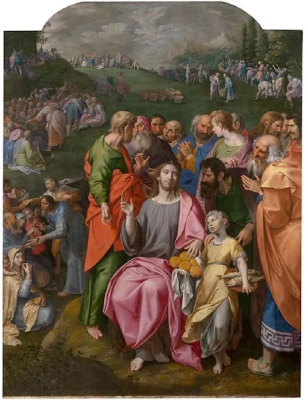
The Multiplication of Loaves and Fishes by Ambrosius Francken I, 1598 © Royal Museum of Fine Arts Antwerp
Source: Christian Art
Gospel of 17 April 2026
John 6:1-15
At that time: Jesus went away to the other side of the Sea of Galilee, which is the Sea of Tiberias. And a large crowd was following him, because they saw the signs that he was doing for the sick. Jesus went up on the mountain, and there he sat down with his disciples. Now the Passover, the feast of the Jews, was at hand. Lifting up his eyes, then, and seeing that a large crowd was coming towards him, Jesus said to Philip, 'Where are we to buy bread, so that these people may eat?' He said this to test him, for he himself knew what he would do. Philip answered him, 'Two hundred denarii worth of bread would not be enough for each of them to get a little.' One of his disciples, Andrew, Simon Peter's brother, said to him, 'There is a boy here who has five barley loaves and two fish, but what are these for so many?' Jesus said, 'Make the people sit down.' Now there was much grass in the place. So the men sat down, about five thousand in number. Jesus then took the loaves, and when he had given thanks, he distributed them to those who were seated. So also the fish, as much as they wanted. And when they had eaten their fill, he told his disciples, 'Gather up the leftover fragments, that nothing may be lost.' So they gathered them up and filled twelve baskets with fragments from the five barley loaves left by those who had eaten. When the people saw the sign that he had done, they said, 'This is indeed the Prophet who is to come into the world!' Perceiving then that they were about to come and take him by force to make him king, Jesus withdrew again to the mountain by himself.
Reflection on the painting
In today's Gospel, the image of the young boy with his simple meal (five barley loaves and two fish) brings to mind a child heading to school with a lunch box, holding just enough to get through the day. It is a small provision, nothing extraordinary, certainly not enough to feed a great crowd. And yet, this boy does something remarkable: he offers what little he has. On its own, it is insignificant. But placed into the hands of Jesus, it becomes something far greater than anyone could have imagined.
What follows is not just a miracle of multiplication, but a revelation of how God works. The boy could not feed the crowd by himself, and yet Jesus chooses not to act without him. He receives the small gift and transforms it, so that all are fed, and even more remains. It is a gentle but powerful reminder: what we have may seem small, even inadequate, but when we entrust it to the Lord, it becomes enough. More than enough. The boy lets go of what he has, and in doing so, others are nourished.
Our large (280 cm; 110 in. high) and vibrant painting by Ambrosius Francken I captures the miracle of the multiplication of the loaves and fishes with a remarkable sense of colour and abundance. Painted in 1598, the work in the Mannerist style. Mannerism emerged in the 16th century after the High Renaissance, marked by elongated figures, exaggerated poses, heightened emotion, and complex, often crowded compositions. The term comes from the Italian word 'maniera', meaning "style" or "manner," and it originally referred to artists working in a highly stylised, sometimes artificial way, prioritising elegance, drama, and expression over strict naturalism or classical balance. It is a style that moved beyond the calm balance of the High Renaissance into something more theatrical, but not yet the Baroque.
At the centre sits Christ, calm and composed, blessing the bread. Around him unfolds a bustling crowd: disciples distributing food, people gathering in groups, and, in the foreground, the small boy offering his loaves and fish. The composition draws our eye outward: from the intimate moment of offering to the wide-reaching miracle as the food is shared across the multitude in the distance. Francken fills the canvas with detail, almost overwhelming us with bodies, colours, and gestures, as if to emphasise the scale of the miracle. This painting was originally commissioned by a guild of bakers, making the abundance of bread all the more meaningful.
LINKS
Christian Art: https://christian.art/
Today's reading: https://christian.art/daily-gospel-reading/john-6-1-15-2026/
 Facebook
 Twitter
 LinkedIn
 Print
Print Email
Email














 Facebook
 Twitter
 YouTube
 LinkedIn
 Pinterest