


Gospel in Art: He who comes from heaven is above all
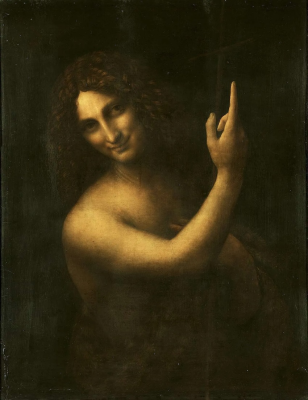
Saint John the Baptist by Leonardo da Vinci © Musée du Louvre, Paris
Source: Christian Art
Gospel of 16 April 2026
John 3:31-36
He who comes from above is above all. He who is of the earth belongs to the earth and speaks in an earthly way. He who comes from heaven is above all. He bears witness to what he has seen and heard, yet no one receives his testimony. Whoever receives his testimony sets his seal to this, that God is true. For he whom God has sent utters the words of God, for he gives the Spirit without measure. The Father loves the Son and has given all things into his hand. Whoever believes in the Son has eternal life; whoever does not obey the Son shall not see life, but the wrath of God remains on him.
Reflection on the painting
In today's Gospel, we hear the voice of John the Baptist, a man who understood his place in the story of salvation with remarkable clarity. Just before this passage, he declares of Jesus, "He must increase, but I must decrease." And here, he continues by pointing to Jesus as the one who comes from above; one who stands beyond all others. John recognises that Jesus comes from heaven, that the Father pours out the Spirit upon him without measure, and that everything has been entrusted into his hands. None of this, John knows, can be said of himself. His greatness lies precisely in this humility: he sees clearly who Jesus is, and he steps aside.
We never quite grasp the fullness of who Christ is. The closer we draw to him, the more we realise how much further there is to go. The more we see, the more we sense what we have not yet seen. And so the words of John remain a lifelong prayer: that Christ may increase in us, and that we may decrease. But this is not about losing ourselves. Quite the opposite. The more Christ grows within us, the more we become who we are truly meant to be: our deepest, truest selves can only be shaped through his presence in us.
In this striking painting by Leonardo da Vinci, now in the Louvre Museum (where another Da Vinci hangs, the Mona Lisa), John the Baptist is shown emerging from darkness, his body softly modelled in that characteristic Leonardo sfumato technique. What immediately captures our attention is his gesture: one hand rests on his heart, while the other points upward, beyond the frame, beyond himself. It is a simple movement, yet so theologically correct. John does not draw attention to himself, he always points beyond him. It is almost a visual echo of his words in today's Gospel.
There is something mysterious, even slightly unsettling, in his expression, a half-smile, a knowing look, as if he sees something we do not yet see. The dark background removes all distraction, so that only the figure and the gesture remain. Everything in the painting serves that single purpose: to guide our eyes upward. This work was already part of the royal collection of Louis XIV in Versailles before entering the Louvre.
LINKS
Christian Art: https://christian.art/
Today's reading: https://christian.art/daily-gospel-reading/john-3-31-36-2026/
 Facebook
 Twitter
 LinkedIn
 Print
Print Email
Email














 Facebook
 Twitter
 YouTube
 LinkedIn
 Pinterest