


Gospel in Art: Jesus said to Nicodemus, 'For God so loved the world...'
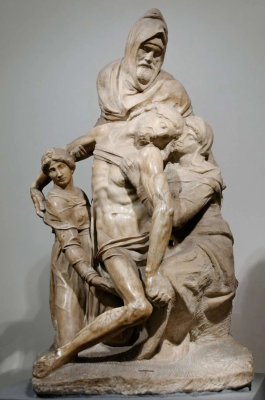
The Florence Pieta, Nicodemus taking down Christ from the Cross, by Michelangelo di Lodovico Buonarroti Simoni. Unfinished marble sculpture,1547-1555 ©Museo dell'Opera del Duomo in Florence
Source: Christian Art
Gospel of 15 April 2026
John 3:16-21
At that time: Jesus said to Nicodemus, 'For God so loved the world, that he gave his only begotten Son, that whoever believes in him should not perish but have eternal life. For God did not send his Son into the world to condemn the world, but in order that the world might be saved through him. Whoever believes in him is not condemned, but whoever does not believe is condemned already, because he has not believed in the name of the only begotten Son of God. And this is the judgement: the light has come into the world, and people loved the darkness rather than the light because their works were evil. For everyone who does wicked things hates the light and does not come to the light, lest his works should be exposed. But whoever does what is true comes to the light, so that it may be clearly seen that his works have been carried out in God.'
Reflection on the sculpture
In today's Gospel, Jesus enters again into conversation with Nicodemus, and in that dialogue, something profound in unveiled. Little by little, layer by layer, Jesus reveals who he truly is. The truth is not handed over all at once, but gently disclosed, as Nicodemus is drawn ever deeper into mystery. It is not unlike the work of a sculptor. A block of marble stands before the artist, and through patient chiselling, the hidden form begins to emerge. Michelangelo famously believed that the figure was already there within the stone: it simply needed to be revealed! In the same way, through his words, Jesus slowly unveils the divine reality that is already present, waiting to be seen.
Michelangelo started working on our sculpture seven years before he died but never completed it. We see here the sculpture being slowly freed from its marble block, or as Michelangelo put it: "The sculpture is already complete within the marble block, before I start my work. It is already there, I just have to chisel away the superfluous material". What a humble way to look at his talent.
Michelangelo intended this sculpture for his own tomb. The figure of Nicodemus, supporting Christ's lifeless body, is widely believed to be a self-portrait; Michelangelo placing himself at the moment of taking Christ down from the Cross. Yet, as he worked the marble, flaws began to emerge in the stone. Frustrated, and perhaps also wrestling spiritually with the weight of what he was carving (death, redemption, his own mortality), Michelangelo took a hammer to the sculpture and tried to destroy it. Michelangelo did not keep the sculpture. Around 1561, he gave (or effectively sold) the damaged Florence Pietà to a Florentine banker named Francesco Bandini. Bandini had the work restored, most likely by the sculptor Tiberio Calcagni, who repaired the broken parts and completed some sections. This is why today the sculpture is partly Michelangelo's hand (90%) and partly that of another artist.
So the work we see now carries a layered history: conceived as Michelangelo's own tomb monument, damaged in a moment of frustration, then passed on, restored, and preserved... an unfinished masterpiece that has, in a sense, lived more than one life.
The sculpture shows four figures: the dead body of Christ, Mary Magdalen, the Virgin Mary and the main over-towering figure of Nicodemus. Throughout history there has been much debate about what exactly it depicts: the deposition from the cross, a pietà or the entombment. A clearly defined composition is already visible though.
LINKS
Christian Art: https://christian.art/
Today's reading: https://christian.art/daily-gospel-reading/john-3-16-21-2026/
 Facebook
 Twitter
 LinkedIn
 Print
Print Email
Email












 Facebook
 Twitter
 YouTube
 LinkedIn
 Pinterest