


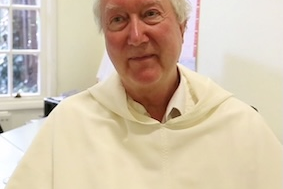
Second Sunday of Easter Homily with Canon Pat Browne
When the Covid epidemic ended, it was reckoned in many London parishes that about a third of those who used to come to Mass never returned. They simply stopped. Some of these people had never missed a Sunday in their lives.
It raises an uncomfortable question: what were they doing all those years? Were they getting nothing out of it? Were they simply going through the motions? We cannot judge individual stories without listening to them, but the question is worth asking for ourselves.
Every day, we all go through motions. We brush our teeth, take a shower, wash our clothes. These are routine actions, and that is enough. The job gets done. Going through the motions ensures our teeth are clean, our clothes are fresh, and the purpose is fulfilled. The mind is minimally involved and the heart usually not at all.
But religion is different. When it comes to our relationship with God, simply going through the motions will never satisfy us. It is not enough. It leaves a person feeling empty and dry. Why? Because real religion is not about routine; it is about relationship. The mind reflects and the heart loves.
Like any meaningful relationship, it is not always easy. On one hand, it can be exciting, challenging, even an adventure. On the other hand, it can also be painful. There is no deep love between two people without facing difficult questions-about oneself and about the other. It's the same in a relationship with God.
We see this clearly in the lives of the saints. Mother Teresa of Calcutta, for example, was canonised not because she always FELT close to God, but because she remained faithful even when she did not feel close. After her death, letters she wrote to a priest revealed that she experienced profound doubt and spiritual dryness. At one point she wrote words that are striking in their honesty:
"Lord, you have thrown me away as unwanted, unloved.
I call, I cling, I want, and there is no answer."
She even questioned whether she had made a mistake in giving herself so completely to God.
What she experienced has been described by many great saints before her. It is often called the "dark night of the soul"-a time when a person feels as though they are speaking into emptiness, when God seems absent, when life itself can feel without meaning or purpose.
But this is not necessarily a lack of faith. In fact, if someone remains faithful through such darkness, that is a deeper and truer kind of faith.
Many people think faith means feeling close to God all the time. That is a mistake. Faith is not a feeling; it is a choice, a commitment.
We can see a similar pattern in human relationships. Why do some marriages or friendships fall apart? Often it is because people say, "We don't feel close anymore." But no one feels close to another person all the time. Feelings come and go. What matters is whether we continue to believe in one another, to remain committed even in those times when the feelings are not there.
Faith, in this sense, means faithfulness-remaining true, regardless of how we feel. It is this kind of faith that builds lasting friendships, strong marriages, and a meaningful relationship with God. Yes, there are moments when we do feel close, and those moments are precious. They are gifts, moments of grace. But they cannot be the foundation.
Think of a mountain. From a distance, it looks beautiful and majestic. You can admire it, even be in awe of it. Some people relate to God in this way-like a distant object to admire, even adore. That is good. To adore is good.
But if you remain far away from the mountain, you do not really know it. You are not involved in it. You see its outline, but not its reality. The people who truly know the mountain are those who live in it. They experience it daily-its beauty and its harshness, its shelter and its dangers. They know it in sunshine and in fog, in clarity and in confusion.
So it is with God. We are not meant to stand at a distance, simply admiring. We are meant to live in relationship with Him, to enter into the mystery. That means bringing everything into that relationship-our praise, our gratitude, our doubts, our questions, even our complaints. These are not signs of failure; they are signs of a living relationship.
To doubt is to have questions, and there is nothing wrong with that.
To believe is to say, "In spite of my questions, I choose you."
In today's Gospel, Thomas believes because he sees the risen Christ. Jesus accepts his faith, but He also points beyond it. "Blessed are those who have not seen and yet believe."
That blessing is for us. You and me. We have not seen, and yet we believe-not because we always feel God's presence, but because we use our minds to choose Him, again and again, day by day. We use our hearts to try and love him and our neighbour.
May the Lord strengthen us in this endeavour. Amen
 Facebook
 Twitter
 LinkedIn
 Print
Print Email
Email











 Facebook
 Twitter
 YouTube
 LinkedIn
 Pinterest