


St Mellitus and St Erkenwald
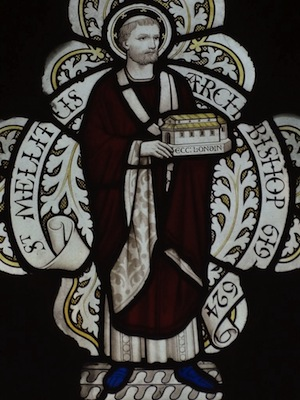
Bishop. Mellitus was one of the second band of missionaries sent from Rome to England, by Pope Gregory I.
He took with him a letter advising Augustine not to destroy the temples of the Saxons, but only their idols. The temples he was told, should be turned into churches, and the pagan feasts adapted to Christian purposes.
In 604 he was consecrated the first bishop of the East Saxons, with his see in London. He converted the King Sabert, but not his sons. When the king died they drove Mellitus out, after he refused their demand to give them the 'white bread' (the Eucharist).
Mellitus withdrew to Gaul for a year with St Justus of Rochester. When he returned to England he was made Archbishop of Canterbury. He built St Mary's Church there.
Mellitus died on this day in 624 and was buried near St Augustine in the abbey church of St Peter and St Paul. Bede said that he was 'noble by birth but yet nobler in mind'.
and St Erkenwald
Bishop of London. This seventh century saint was London's most important religious figure for many centuries. His diocese extended over Essex and Middlesex. Reputed to be of royal blood, he founded the monasteries of Chertsey in Surrey and Barking in Essex. He ruled Chertsey while his sister, St Ethleburga was abbess of Barking.
During his lifetime he had a great reputation for holiness. He helped to bring about reconciliation between Wilfred and Theodore. He died at Barking on this day in 693 and was buried in St Paul's Cathedral.
His relics survived the fire of 1087. His shrine become more ornate each century as it was endowed by London canons and merchants. It was a popular place of pilgrimage until it was destroyed during the Reformation.
 Facebook
 Twitter
 LinkedIn
 Print
Print Email
Email







 Facebook
 Twitter
 YouTube
 LinkedIn
 Pinterest