

Sunday Reflection with Canon Robin Gibbons: January 18 2026
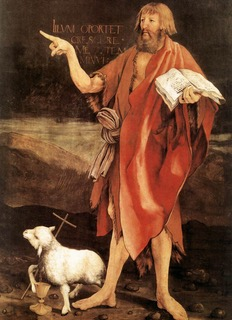
Matthias Grunewald The Crucifixion detail. National Gallery
Second Sunday in Ordinary Time
The testimony of John the Baptist is unequivocal, and we trust his words because of John's great witness to Jesus, but they are also couched in a rather dream-like manner, for John is attempting to describe something well outside his comfort zone! Think of the way we describe happenings that are rather difficult to capture in straightforward language, such as major events, negatively a big accident or calamity in which we are not only spectators but actors, or more positively an encounter what is life changing. `How we describe them is often by making comparisons or giving images to describe something we are not fully able to express clearly. How would you describe the baptism of Jesus and its associated happenings? By using familiar terms and images I suspect, ordinary language attempting to convey something numinous. So it is with John, his resources are the scriptural imagery familiar to him and the natural world in which he lives. Whatever happened at the baptism something powerful took place that both transformed John's view of Jesus but also touched Jesus with a sense of divinely inspired power.
If we look at what John is telling us, and take the trouble to investigate the background to what he says, several clear points emerge. If we start with his opening words we will find in our Christian understanding, three main theological statements:' The next day he saw Jesus coming toward him and said, "Behold, the Lamb of God, who takes away the sin of the world. He is the one of whom I said 'A man is coming after me who ranks ahead of me because he existed before me.' I did not know him, but the reason why I came baptizing with water was that he might be made known to Israel." (Jn 1:29-31) Immediately we have the the first image of a sacrificial lamb, well known in the tradition of Israel, but Jesus in John's eyes is seem as the coming messiah who will have to be sacrificed, not for his sins but for the sins of the whole world.
He is THE Lamb of God and the full meaning of why this image is symbolically appropriate has to be understood through the lens of Christ's death and resurrection, where for us who believe the ultimate victory is made manifest.
The second part of this statement gives us a bigger picture and pur second statement. This Jesus is pre-existent, in other words part of the divine world, and John did not recognise him until that moment, when in the waters of the Jordan, the theophany of divine revelation occurred, and then John understood in his soul, heart and mind! This echoes part of John's prologue where Jesus the Word is not recognised by those who saw him and yet is known by us who see him with the eyes of faith: 'He came to what was his own,
but his own people did not accept him.
But to those who did accept him he gave power to become children of God, to those who believe in his name, who were born not by natural generation nor by human choice nor by a man's decision but of God'.(Jn 1:11-13) Implicit in these words is the pointer to our third statement and the meaning of our own baptism, that through it we are born again as the adopted children of God, brothers and sisters of our good Lord Jesus the Christ.
The great moment and realisation of who Jesus actually, is was given to John in the moment which he explains as the descent of the Spirit 'as a dove', a gentle yet powerfully defining piece of Christian iconography, helping us perceive that the Holy Spirit, though powerful, cleansing and illuminating life-burning fire, is nevertheless kind and embracing towards us. In other words the power of divine love made manifest. Here we need to take a step back into quietness and contemplation and let the words of John sink into our souls. For here set before us in wonderful prose is the great gift of Christ, incarnate, enfleshed and now the sacrificial gift for our salvation. It is such an enormous thought that we need time to assimilate John the Baptist's words and images and make them our own. It is also true that the prophecy of Isaiah in our first reading, applies to each one of us in the semi-darkness of our present world!
'I will make you a light to the nations,
that my salvation may reach to the ends of the earth'.
(Is 42:6)
Lectio
The Prologue of John's Gospel
In the beginning* was the Word,
and the Word was with God,
and the Word was God.
He was in the beginning with God.
All things came to be through him,
and without him nothing came to be.
What came to be through him was life,
and this life was the light of the human race;
the light shines in the darkness,
and the darkness has not overcome it.
A man named John was sent from God. He came for testimony, to testify to the light, so that all might believe through him. He was not the light, but came to testify to the light. The true light, which enlightens everyone, was coming into the world.
He was in the world,
and the world came to be through him,
but the world did not know him.
He came to what was his own,
but his own people did not accept him.
But to those who did accept him he gave power to become children of God, to those who believe in his name, who were born not by natural generation nor by human choice nor by a man's decision but of God.
And the Word became flesh
and made his dwelling among us,
and we saw his glory,
the glory as of the Father's only Son,
full of grace and truth.
John testified to him and cried out, saying, "This was he of whom I said, 'The one who is coming after me ranks ahead of me because he existed before me.'" From his fullness we have all received, grace in place of grace, because while the law was given through Moses, grace and truth came through Jesus Christ. No one has ever seen God. The only Son, God, who is at the Father's side, has revealed him.
The Lamb
by William Blake
Little Lamb who made thee
Dost thou know who made thee
Gave thee life & bid thee feed.
By the stream & o'er the mead;
Gave thee clothing of delight,
Softest clothing wooly bright;
Gave thee such a tender voice,
Making all the vales rejoice!
Little Lamb who made thee
Dost thou know who made thee
Little Lamb I'll tell thee,
Little Lamb I'll tell thee!
He is called by thy name,
For he calls himself a Lamb:
He is meek & he is mild,
He became a little child:
I a child & thou a lamb,
We are called by his name.
Little Lamb God bless thee.
Little Lamb God bless thee.
 Facebook
 Twitter
 LinkedIn
 Print
Print Email
Email













 Facebook
 Twitter
 YouTube
 LinkedIn
 Pinterest