


Sunday Reflection with Canon Robin Gibbons: 22 February 2026
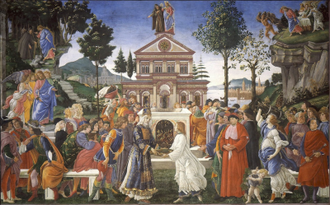
Temptations of Christ - Botticelli - Sistine Chapel
First Sunday of Lent
1. Genesis
In our first reading from Genesis this Sunday, we are given a poetic and artistic snapshot of the awakening conscience of humanity. The innocent status of human life exemplified in Adam and Eve, is compromised and changed by the testing choice between knowledge of good and evil, in which they choose evil but in sorrow desire forgiveness! And yet stark though the image of wrong choice and its consequences might be, there is given to us hope in the drama of salvation, where we begin to understand a developing relationship between ourselves and a God who covenants with us, loves us, forgives us and desires our love; a story which courses though the Hebrew Testament and reaches its greatest revelation in the New Testament understanding of Jesus the Christ.
2. Romans
The opening words of Paul in Romans 5, which come just before this Sundays text of our second reading, lays out before us this hope of restoration and peace with God through Jesus: 'Therefore, since we have been justified by faith, we have peace* with God through our Lord Jesus Christ, through whom we have gained access [by faith] to this grace in which we stand, and we boast in hope of the glory of God'. (Rm 5:1,2).
In more explicit terms we discover in this reading the forgiveness and gift of salvation through the actions of the Christ: '… just as through one transgression condemnation came upon all, so through one righteous act acquittal and life came to all. The law entered in so that transgression might increase but, where sin increased, grace overflowed all the more, so that, as sin reigned in death, grace also might reign through justification for eternal life through Jesus Christ our Lord (Rm5:18,20-21)
This quote deserves careful unpacking, for Paul here is making contrasts to expound his theme about the salvation given to us in Christ. Nevertheless we can grasp that our restoration is found in the Incarnation and subsequent Resurrection of Jesus who is the Christ. He is the absolute gift of love, for he unites himself with us all, in all aspects of our human life except for sin, though in love he take on himself the sin of the world in order that we may find peace, salvation and forgiveness.
3. Matthew
These insights about the role of Jesus are actually the setting for Matthew's temptations, which is our gospel this Sunday. In my many years preaching, I, like so many others, have tried to link these temptations with those we ourselves go through, but I realise this is very much a secondary element in what the word of God is laying bare before us. The main point is that these are specific tests for Jesus, temptations which reveal his hidden divinity. Twice the tempter addresses him as 'Son of God', in the third example there is a test for Jesus in which a bad exchange of divine presence for earthly power is offered. All these temptations are to do with the reign, rule and omnipresence of the Most High, now understood in Jesus, and of our loving obedience to the reign of God in our lives, meaning that obedience in the more expressive understanding of our relationship with God by mutual listening, dialogue and loving service!
4. Hope
This year my own promise to listen to the Word more attentively in Lent leads me to appreciate these temptations as firstly unique, but ones in which truth reveals itself in Jesus words. There I find hope, that the defeat of the tempter and temptation is also a glimpse of the defeat of sin and death now understood in the presence and love of the Risen Christ for us all.
But there is another lesser but more practical insight. Jesus is not alone in this desert experience, the Spirit is there present, the angels minster to him as do the wild beasts, an important point for us to grasp. For us it means we are never totally alone, the experience of testing/temptation as well as prayer, helps us to discern the Spirit present in all things, and times, and places, and also that in seeking the Christ we too will find salvation
Lenten lectio
Saint Augustine Confessions Chapter 5
5. Who shall bring me to rest in thee? Who will send thee into my heart so to overwhelm it that my sins shall be blotted out and I may embrace thee, my only good? What art thou to me? Have mercy that I may speak. What am I to thee that thou shouldst command me to love thee, and if I do it not, art angry and threatenest vast misery? Is it, then, a trifling sorrow not to love thee? It is not so to me. Tell me, by thy mercy, O Lord, my God, what thou art to me. "Say to my soul, I am your salvation."14 So speak that I may hear. Behold, the ears of my heart are before thee, O Lord; open them and "say to my soul, I am your salvation." I will hasten after that voice, and I will lay hold upon thee. Hide not thy face from me. Even if I die, let me see thy face lest I die.
6. The house of my soul is too narrow for thee to come in to me; let it be enlarged by thee. It is in ruins; do thou restore it. There is much about it which must offend thy eyes; I confess and know it. But who will cleanse it? Or, to whom shall I cry but to thee? "Cleanse thou me from my secret faults," O Lord, "and keep back thy servant from strange sins."
15 "I believe, and therefore do I speak."
16 But thou, O Lord, thou knowest. Have I not confessed my transgressions unto thee, O my God; and hast thou not put away the iniquity of my heart?17 I do not contend in judgment with thee,18 who art truth itself; and I would not deceive myself, lest my iniquity lie even to itself. I do not, therefore, contend in judgment with thee, for "if thou, Lord, shouldst mark iniquities, O Lord, who shall stand?"
From Paradise Lost
'Eden' by John Milton
From Paradise Lost, Book IV, (The Argument)
Southward through Eden went a river large,
Nor changed his course, but through the shaggy hill
Passed underneath ingulfed; for God had thrown
That mountain, as his garden-mould, high raised
Upon the rapid current, which, through veins
Of porous earth with kindly thirst updrawn,
Rose a fresh fountain, and with many a rill
Watered the garden; thence united fell
Down the steep glade, and met the nether flood,
Which from his darksome passage now appears,
And now, divided into four main streams,
Runs diverse, wandering many a famous realm
And country whereof here needs no account;
But rather to tell how, if Art could tell
How, from that sapphire fount the crisped brooks,
Rowling on orient pearl and sands of gold,
With mazy error under pendant shades
Ran nectar, visiting each plant, and fed
Flowers worthy of Paradise, which not nice Art
In beds and curious knots, but Nature boon
Poured forth profuse on hill, and dale, and plain,
Both where the morning sun first warmly smote
The open field, and where the unpierced shade
Imbrowned the noontide bowers. Thus was this place,
A happy rural seat of various view:
Groves whose rich trees wept odorous gums and balm,
Others whose fruit, burnished with golden rind,
Hung amiable-Hesperian fables true,
If true, here only-and of delicious taste.
Betwixt them lawns, or level downs, and flocks
Grazing the tender herb, were interposed,
Or palmy hillock; or the flowery lap
Of some irriguous valley spread her store,
Flowers of all hue, and without thorn the rose.
Another side, umbrageous grots and caves
Of cool recess, o'er which the mantling vine
Lays forth her purple grape, and gently creeps
Luxuriant; meanwhile murmuring waters fall
Down the slope hills dispersed, or in a lake,
That to the fringèd bank with myrtle crowned
Her crystal mirror holds, unite their streams.
The birds their quire apply; airs, vernal airs,
Breathing the smell of field and grove, attune
The trembling leaves, while universal Pan,
Knit with the Graces and the Hours in dance,
Led on the eternal Spring.
 Facebook
 Twitter
 LinkedIn
 Print
Print Email
Email














 Facebook
 Twitter
 YouTube
 LinkedIn
 Pinterest