


Sunday Reflection with Canon Robin Gibbons: February 15th 2026
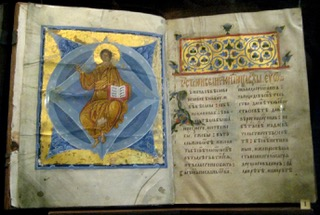
Andronicov Gospels
Sixth Sunday in Ordinary Time
In our first reading from Sirach two sentences ought to grab our attention, and if I may be so bold as to suggest to you all, they could act as part of our observance of Great Lent which begins this week, a meditation on the two simple phrases of fundamental importance for our faith-life development :
'…keep the commandments, they will save you;
if you trust in God, you too shall live.'(Sirach 15:15)
Of course they need unpacking, but Lent is the time to do such tasks. Like so many profound words they seem inordinately simple, but as we let them enter our hearts, souls and minds, we begin to tease out the art and poetry of God, so as to go beyond the immediate and learn to both look and listen for the 'living Word'.
As we move into the great and holy season of Lent, this Sunday's readings provide a springboard. If we look at those two commands of Sirach we find ourselves being asked to look into our own lives, not other people's, for it is we who must keep the commandments, and each one of us must learn to meet our God in trust.
But what commandments must we keep? How do we find the living God? The answer to the second question is already before us, or at least a way into the great adventure of seeking the Holy One, it is to learn again that deep sense of trust, something modern society needs so badly, yet trust is necessary if we are to fully love, it is the path to the heart of the Lord. The answer to the first question about commandments we shall find in the teachings of Jesus, helped in the explanation of them by wise saints and good scripture scholars.
Todays gospel puts us on the right path to search for our commandments and how we interpret and keep them, in fact it is an excellent springboard to Great Lent. But we cannot just rush at the scriptures and take them out of context, nor cherry pick passages to suit our own ends. Pope Leo XIV reminded us at his Wednesday audience on February 4th 2026;' "A correct interpretation of the sacred texts cannot dispense with the historic environment in which they developed and the literary forms that were used. On the contrary, to renounce the study of the human words that God used risks leading to fundamentalist or spiritualist readings of Scripture, which betray its meaning."' This is a helpful reminder that we need guidance through the scriptures even as we make them part of our lives. The discipline of lectio divina teaches us that as we ruminate on the Word we let it become part of us, but an informed part.
Thus our gospel today, in particular the longer form, (Matthew 5:17-37) we find a number of Jesus' teachings placed before us. They repay careful examination and judicious exploration, but with the help of those whose study of the texts, allows us to understand them in our own context and time. I'll give you one small example, whilst some of us may at first take this gospel and use it to examine adultery, oath taking, murder, anger , all the points Jesus makes, we might stumble at his opening words thinking they apply to ourselves. 'Do not think that I have come to abolish the law or the prophets. I have come not to abolish but to fulfill. Amen, I say to you, until heaven and earth pass away, not the smallest letter or the smallest part of a letter will pass from the law, until all things have taken place".(Mt 5:17,18) They do apply but not in the rigid sense of overarching Old Testament Law in all its permutations. No! The turning of the ages, the passing away of the old heavens and earth have taken place in the apocalyptic event of Jesus' death and resurrection, from now on we see things through the lens of the new commandment given to us of love.. This marks a huge change because it allows us to enter the scriptural text seen through the lens of the new kingdom, and apply it to here and now without placing heavy burdens on others.
I suggest we take this particular gospel text and use it as a reflective means of entering Lent, seeing in Jesus teachings those hints and pointers showing where he is leading his disciples to a freer and fuller love without fear. Jesus is also taking us to a mirror of righteousness where we can look at ourselves first and then examine our consciences. He is holding us by the hand and walking with us into self-discovery, that of the interior person, not dine for any egotistical means but as an opening in trust to the merciful love of God.
When we are warned not to call our bother or sisters by the utterly derogatory and contemptuous term 'Raqa', it is to find it is more more than simply insulting, calling them fools or imbeciles, it is dismissive, a cutting off by us of a person understood as brother or sister, to demean them. We are led to an understanding that what matters comes from within ourselves and leads us to understand that the abuse of others making them insignificant, is interpreted by Jesus as a sin as bad as murder an evil action.
The antidote to this behaviour is before us, both in those two phrases from Sirach, but also in this beautiful admonition:
'Therefore, if you bring your gift to the altar,
and there recall that your brother
has anything against you,
leave your gift there at the altar,
go first and be reconciled with your brother,
and then come and offer your gift'. (Mt 5:22,23)
But also remember that we who live in the new age of Jesus have also another helper, and advocate in our searching of the scriptures!
'For the Spirit scrutinizes everything, even the depths of God'.
(I Cor 2:10)
And so, with hope, Great Lent begins!
Lectio
Psalm 119
Vv 1-16
Aleph
1 Blessed are those whose ways are blameless,
who walk according to the law of the Lord.
2 Blessed are those who keep his statutes
and seek him with all their heart-
3 they do no wrong
but follow his ways.
4 You have laid down precepts
that are to be fully obeyed.
5 Oh, that my ways were steadfast
in obeying your decrees!
6 Then I would not be put to shame
when I consider all your commands.
7 I will praise you with an upright heart
as I learn your righteous laws.
8 I will obey your decrees;
do not utterly forsake me.
Beth
9 How can a young person stay on the path of purity?
By living according to your word.
10 I seek you with all my heart;
do not let me stray from your commands.
11 I have hidden your word in my heart
that I might not sin against you.
12 Praise be to you, Lord;
teach me your decrees.
13 With my lips I recount
all the laws that come from your mouth.
14 I rejoice in following your statutes
as one rejoices in great riches.
15 I meditate on your precepts
and consider your ways.
16 I delight in your decrees;
I will not neglect your word
Prayer
Lord Jesus, let me know myself and know You, and desire nothing save only You.
Let me hate myself and love You.
Let me do everything for the sake of You.
Let me humble myself and exalt You.
Let me think of nothing except You.
Let me die to myself and live in You.
Let me accept whatever happens as from You.
Let me banish self and follow You, and ever desire to follow You.
Let me fly from myself and take refuge in You,
That I may deserve to be defended by You.
Let me fear for myself.
Let me fear You, and let me be among those who are chosen by You.
Let me distrust myself and put my trust in You.
Let me be willing to obey for the sake of You.
Let me cling to nothing save only to You,
And let me be poor because of You.
Look upon me, that I may love You.
Call me that I may see You, and for ever enjoy You. Amen.
Saint Augustine
 Facebook
 Twitter
 LinkedIn
 Print
Print Email
Email
















 Facebook
 Twitter
 YouTube
 LinkedIn
 Pinterest