


Sunday Reflection with Canon Robin Gibbons: 8th March 2026
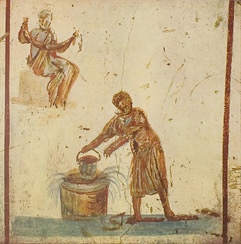
Christ and the woman drawing water Catacomb of Callistus, Rome. 2C AD
Third Sunday of Lent
The true Place of the Woman at the Well
Let us begin our reflection by letting the woman of Sychar unsettle us for a good cause, challenging our own preconceptions about the company Jesus kept, to help us place this Samaritan woman not only as a key figure but a primary witness in John's Gospel.
This is a form of recovery, rebalancing ourselves if you like, by letting the facts and events described in the gospel shake us up a bit. It is easy to get trapped in our own version of the parables and stories of Jesus revealed in the gospels, not made any easier by centuries of overlay, popular piety and colourful imaginings sometimes need careful analysis to get to the heart of the matter.
If we take our search for God seriously we will be asked to come on a voyage of rediscovery, seeking the good Lord who is the truth and the way. Time and time again we will need to let go of our perceptions and yes, particularly our historical and ecclesial prejudices when we are examining the differing roles various scriptural people play within the gospel tradition. This is not always easy, but it requires of us a trust that the Spirit is at work in and with us!
Let the gospel speak!
Now let each of us encourage one another to go back to our gentle study of scripture, to find good biblical scholars who can help us understand what is going on, discern the nuances of each writer, finding through them elements we may miss in order to help us understand the situation given us in the text and pray through them to hear the living Word speak. This is important particularly at this point in Great Lent when we begin to rediscover the narratives of Jesus' ministry that lead us through what we understand are the last active events of his pastoral life, which then opens for us into the revelatory drama of his trial, passion and death.
In these passages from the gospels we both 'see' and 'hear' salvation so deeply are they imprinted in our faith. The Dogmatic Constitution on Divine Revelation, 'Dei verbum' of Vatican II, encourages us to remember that the gospel authors wrote their accounts as truth: 'For their intention in writing was that either from their own memory and recollections, or from the witness of those who "themselves from the beginning were eyewitnesses and ministers of the Word" we might know "the truth" concerning those matters about which we have been instructed (see Luke 1:2-4)'.(DV, V:19)
Recovering her place
Today we are given the story of the Samaritan woman at the well. This tale is worth rereading a number of times, paying attention to the encounter between Jesus and the Woman. It is unfortunate that she, like Mary of Magdala has been turned into something she is not, a fallen woman so to speak, one of the least in the religious structures of yesterday, and unfortunately also today in certain religious circles. But we who are following Jesus cannot ignore her message and need to give thanks for her ministry to us as well! For she reveals just how scandalous and subversive Jesus was, how unsafe he is for established religious figures, how much love, compassion and healing he gave to the outcast, but also how by turning the world upside down, he reveals the truth of God found in weakness.
A careful meeting
Let us meet her! First of all we need to be careful with literal meanings, her context is far greater than simply a random encounter, it is quite literally a story of redemption and salvation! The well is Jacob's well associated with the story of Jacob and God as well as his meeting with Rachel, a holy space and a watering place where men, women and animals congregated, yet Jesus from Galilee meets the Woman from Sychar not at the normal time but at noon, a time when hardly anybody would be there but a time of light when all can be seen, a reminder too of the connection this passage has with the encounter of Jesus with Nicodemus by night. Immediately John is telling us this is a definite and important encounter.
We need to be careful with the situation of her own life commentators remind us it is not exactly what it seems, if we widen the immediate to see her also as a symbol of the wider Samaria then the five 'husbands' are understood to be a word that refers to gods of some kind, a different kind of faithlessness - and this makes more sense in terms of the dialogue between Jesus and the Woman.
The first disciple proclaiming the Messiah!
Read the passage carefully and you will see in the woman the evolution of her faith which having met Jesus, goes on growing to fully recognise him as he truly is, the Messiah. In John's gospel she is one of the few disciples of Jesus who deeply engage with him, recognise him as the Messiah and then minister to the word by openly proclaiming him.
The whole of her dialogue with Jesus reveals this progression, but what it also does is remove yet another human veil, important for our journey in the Church. It empowers the role of women by restoring a place for this woman. Just as Mary of Magdala is the first witness of the resurrection and proclaims it to the brothers, so this woman is the first witness of Jesus as the Messiah, but much more than that, both are not simply witnesses, they are the first disciples to do so. Rejoice a little for in this story Jesus is reminding us that discipleship is based on the growth of love and faith in him, not on gender and power. May the woman of Sychar remember us all in prayer in the Kingdom!
Lectio for Lent
1. John 4:28-42
The woman left her water jar
and went into the town and said to the people,
"Come see a man who told me everything I have done.
Could he possibly be the Christ?"
They went out of the town and came to him.
Meanwhile, the disciples urged him, "Rabbi, eat."
But he said to them,
"I have food to eat of which you do not know."
So the disciples said to one another,
"Could someone have brought him something to eat?"
Jesus said to them,
"My food is to do the will of the one who sent me
and to finish his work.
Do you not say, 'In four months the harvest will be here'?
I tell you, look up and see the fields ripe for the harvest.
The reaper is already receiving payment
and gathering crops for eternal life,
so that the sower and reaper can rejoice together.
For here the saying is verified that 'One sows and another reaps.'
I sent you to reap what you have not worked for;
others have done the work,
and you are sharing the fruits of their work."
Many of the Samaritans of that town began to believe in him
because of the word of the woman who testified,
"He told me everything I have done."
When the Samaritans came to him,
they invited him to stay with them;
and he stayed there two days.
Many more began to believe in him because of his word,
and they said to the woman,
"We no longer believe because of your word;
for we have heard for ourselves,
and we know that this is truly the saviour of the world.
2. From an Article in the National Catholic Reporter
What Mary Magdalene and the Samaritan teach the church
BY JAMIE MANSON
July 24, 2012
Listening to the Gospel stories, the early church understood just how subversive Jesus' words were and how scandalous his work was. They heard in the Gospel narrative after narrative of unlikely disciples, people like Mary Magdalene and the Samaritan woman, who lived on the edge of society and become models of faith.
…The margins of the church seem to be widening every day. It's easy to despair of all of this exclusion. In those moments, it is helpful to remember the Gospel stories. Jesus constantly faced rigid religious leaders who were so preoccupied with maintaining purity and orthodoxy, they either could not see or refused to see the incarnation of God right in their midst. While the 12 disciples remained confused about Jesus' identity and the religious leaders were busy trying to undermine him, it was the marginalized who recognized him and helped him bring the life of God more fully into the world. Mary Magdalene and the Samaritan woman are two of the finest examples of this Gospel paradox.
 Facebook
 Twitter
 LinkedIn
 Print
Print Email
Email















 Facebook
 Twitter
 YouTube
 LinkedIn
 Pinterest