

Sunday Reflection with Canon Robin Gibbons - 12 April 2026
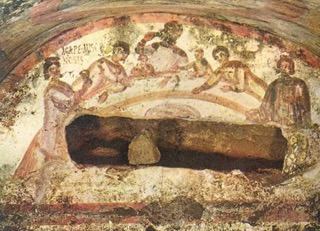
Agape feast - Fresco in Catacomb of Saints Marcellinus and Peter, Rome. Public Domain
Second Sunday of Easter
Divine Mercy Sunday
Our first reading from the Book of Acts is a passage we need to really study and hold up before communities, our churches and ourselves. Here is a snapshot of the way of life as experienced by that first community of Christians. This passage from Acts 2:42-47, puts before us a wonderful synopsis of the early community with the qualities and virtues they value as essential for their lives as disciples and followers of the Lord.
We can break it down into several areas: There is the basic vocation of a community who individually and collectively 'devote themselves to the teaching of the apostles and to the communal life, to the breaking of bread and to the prayers'.(Acts 2:42)
We might understand the teaching of the apostles as the reception of the gospels, then in the process of compilation. Then there are the regular acts of worship together in the breaking of the bread which is our Eucharist, celebrated not in great buildings but in the domestic houses of each one of them, and then daily prayers, some in the ritual setting of the temple area (which will soon be destroyed by the Romans) but others I suspect either in a synagogue or domestic setting, where the prayers followed that Jewish format, using the psalms and portions of scripture which eventually becomes our tradition of those hours of common prayer, the present liturgy of the hours, which is the preserve not only of clergy and religious but all of the Church.
When we look at that picture, might we rethink how we ourselves live out our daily Christian life, and how we might creatively understand the common life that binds us all by threads of charity? These early Christians were perhaps more like the Religious of the present day, but the ideal is always there to be a compass point of daily reference and possibly as a challenge to the consumerism and greed of our society: "All who believed were together and had all things in common; they would sell their property and possessions and divide them among all according to each one's need".(Acts 2:44,45)
One of the key points being made is their essential fidelity to the risen Lord Jesus and his teaching, descriptive words like 'exultation', 'sincerity of heart', 'praising God,' 'enjoying favour with all' suggest a people of joy and commitment and through this example of a life lived in God, 'every day the Lord added to their number those who were being saved'. (Acts 2: 47)
But there is something more that we might reflect upon, a word which needs better understanding - they are described as a people filled with 'awe'. - not the shock and awe tactics of those who 'bible bash' or teach a dangerously lop sided pastiche of Christianity - one filled with anger, hate and combative approaches to any persons outside of the faith. They were not as we never can be fundamentalists, because like them we are the sisters and brothers of the risen Lord Jesus, 'our good Lord'.
This awe is a deeper more creative spiritual knowledge and understanding of the heart, for it In the book of Acts, it represents the Spirit-produced and deeply profound sense of reverence, wonder and holy fear, an awe that occurs when the holiness of God is experienced particularly through signs and wonders (Acts 2:43).
But perhaps the greatest awe we discover in our own faith journey is something described in today's gospel, the mercy of God who fills the hearts and minds of those who have not had the opportunity to physically experience the risen Jesus and yet believe in Him. At the very conclusion of his gospel, John has Jesus tell us through the story of Thomas - of a blessing and also a Spirit filled belief that will come to us. Jesus said to him: "Have you come to believe because you have seen me? Blessed are those who have not seen and have believed."
'Jesus did many other signs in the presence of his disciples that are not written in this book. But these are written that you may [come to] believe that Jesus is the Messiah, the Son of God, and that through this belief you may have life in his name'. (Jn 20:29-31) - Here is the merciful Christ filling us through the Spirit with the 'awe' of love, a song of hope and joy in our hearts, which as our second reading so very movingly puts it: 'Although you have not seen him you love him; even though you do not see him now yet believe in him, you rejoice with an indescribable and glorious joy, as you attain the goal of your faith, the salvation of your souls. (I Peter 1:8,9,) That truly is a song of 'alleluia!
LECTIO
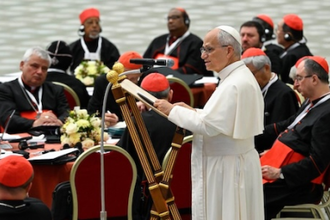
Extracts from Pope Benedict XVI
Paul VI Audience Hall - Wednesday, 19 January 2011
In the passage cited from the Acts of the Apostles, four characteristics define the first Christian community of Jerusalem as a place of unity and love. St Luke, moreover, does not only want to describe something from the past. He presents this community to us as a model, as a norm for the Church today, since these four characteristics must always constitute the Church's life.
The first characteristic is its unity, its devotion to listening to the Apostles' teaching, then to fellowship, to the breaking of the bread and the prayers.
We first have devotion to the teaching of the Apostles, that is, listening to their testimony to the mission, to the life, and to the death and Resurrection of the Lord. This is what Paul calls simply the "Gospel". The first Christians received the Gospel from the lips of the Apostles, they were united by listening to it and by its proclamation because, as St Paul says, "the Gospel... is the power of God for salvation to every one who has faith" (Rom 1:16).
Still today the community of believers recognises the reference to the Apostles' teaching as the norm of its own faith.
The second element is fraternal communion….We read in the Acts of the Apostles that the early Christians had all things in common and those with possessions and goods sold them to share the proceeds with the needy (cf. Acts 2:44-45).
This sharing of goods has found ever new forms of expression in the history of the Church. Distinctive among these are the brotherly relations and friendships established between Christians of different denominations... This is primarily communion with God through faith; but communion with God creates communion among ourselves and is necessarily expressed in that concrete communion of which the Acts of the Apostles speak, in other words sharing.
No one in the Christian community must be hungry or poor: this is a fundamental obligation. Communion with God, expressed as brotherly communion, is lived out in practice in social commitment, in Christian charity and in justice.
The third element: essential in the life of the first community of Jerusalem was the moment of the breaking of the bread … "The Church draws her life from the Eucharist. This truth does not simply express a daily experience of faith, but recapitulates the heart of the mystery of the Church" (John Paul II, Ecclesia de Eucharistia, n. 1).
Lastly, prayer …is the fourth characteristic of the early Church of Jerusalem described in the Book of the Acts of the Apostles. Prayer has always been a constant attitude of disciples of Christ, something that accompanies their daily life in obedience to God's will, as the Apostle Paul's words in his First Letter to the Thessalonians also attest: "Rejoice always, pray constantly, give thanks in all circumstances; for this is the will of God in Christ Jesus for you (1 Thes 5:16-18; cf. Eph 6:18).
…Dear brothers and sisters, as disciples of the Lord we have a common responsibility to the world. We must undertake a common service; like the first Christian community of Jerusalem, starting with what we already share, we must bear a powerful witness supported by reason and spiritually founded on the one God who revealed himself and speaks to us in Christ, in order to be heralds of a message that guides and illumines people today, who all too often lack clear and effective reference points.
 Facebook
 Twitter
 LinkedIn
 Print
Print Email
Email













 Facebook
 Twitter
 YouTube
 LinkedIn
 Pinterest