


Sunday Reflection with Canon Robin Gibbons: May 24th 2026
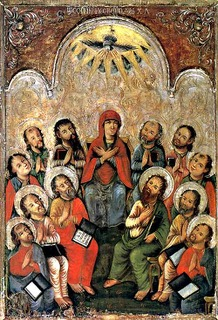
The Descent of the Holy Spirit upon the Apostles - Wiki image
Pentecost
How can one relate to the unseen Spirit? The paucity of our various languages reveals the difficulty of expressing just who the Spirit is to us, and the wisdom of Christianity in its best sense, uses descriptive metaphors and symbols just as Jesus' teaching in the gospel does. The manner in which we use our various languages to describe the Spirit does not capture or determine the essence and nature of this gift giver. They help us express the immensity, and the 'beyond spatial-boundaries' of the Spirits work and action amongst us. This also applies to the descriptive ways in which we use personal pronouns, different languages use them in different ways to describe the Holy Spirit, but we can determine that this is not to attach any gender to the Spirit itself. We are talking about the mystery of the Triune God, who exits beyond time and place and each person cannot be defined by human categories-except in the person and nature of Jesus the Christ, the Word who was made flesh for our sakes, but is now risen and glorified as we shall be! I write this not to start any great discussion concerning the nature of the Holy One, that has been done often, but rather, like those traditions of the Eastern Christian Community, want to help each of us open up to the gracious gift of the dynamic of love reaching out to us.
In the four alternative first readings from the Vigil of Pentecost, we have Genesis telling us of the fracturing, fragmenting and scattering of human beings to create a real babble of voices . Moses in Exodus opens the way to understand a God who wants to form a Covenant with humans and draw them together as a special 'possession'. Ezekiel in the visionary and descriptive manner he has, tells of the Spirit who will restore the dead to life, which in the fourth reading from Joel becomes a poem and prayer of the promise and delight of the Lord who will pour out the Spirit on creation and all flesh! As one of my favourite poets puts it so well in his beautiful poem Little Gidding, in The Four Quartets: 'These are only hints and guesses, Hints followed by guesses; and the rest Is prayer, observance, discipline, thought and action'. That is our way into the encounter of the SPIRIT.
Yet we do have knowledge of what the Spirit does: it renews the face of the earth(Ps 104) : It is the gift of hope to help us in our weakness and the One who intercedes for us when we are unable to pray (Rm 8:26) :The Spirit is the source of the living water that is the glorified Christ (Jn 7) The Spirit is the one who also reveals in the many languages of earth the 'mighty acts of God' and draws us together into the Kingdom yet to come, but revealed imperfectly in the Church now! (Acts 2:11). Paul in 1 Corinthians 12 and 13 enumerates the gifts that the Spirit gives to us and points out they are not ours for power but for service, reminding us which are the permanent three higher gifts; of faith, hope and love.
But perhaps the most eloquent of the gifts bestowed on us is the one mentioned in the gospel of the day taken from John, a sentence from Jesus which reveals the all encompassing tenderness of the Most High : '…he breathed on them and said to them, "Receive the holy Spirit. Whose sins you forgive are forgiven them, and whose sins you retain are retained."(Jn 20: 22b,23) This is part of the harvest of the fruit of that hidden Spirit, who as TS Eliot writes in Little Gidding, calls to us in the voice of Love:
' With the drawing of this Love and the voice of this
Calling
We shall not cease from exploration
And the end of all our exploring
Will be to arrive where we started
And know the place for the first time'.
But until then, we hold in our hands and mouths each time we come to communion the mystery of the Spirit's tangible gift for us:
"In your bread is hidden the Spirit which cannot be eaten.
In your wine dwells the fire that cannot be drunk.
Spirit in your bread, fire in your wine:
It is a distinct wonder that our lips have received!"(St Ephrem the Syrian)
Lectio
Paul's Hymn of the Spirit's gift of Love
I Corinthians 13
If I speak in the tongues of men or of angels, but do not have love, I am only a resounding gong or a clanging cymbal.
If I have the gift of prophecy and can fathom all mysteries and all knowledge, and if I have a faith that can move mountains, but do not have love, I am nothing.
If I give all I possess to the poor and give over my body to hardship that I may boast, but do not have love, I gain nothing.
Love is patient, love is kind. It does not envy, it does not boast, it is not proud.
It does not dishonour others, it is not self-seeking, it is not easily angered, it keeps no record of wrongs.
Love does not delight in evil but rejoices with the truth.
It always protects, always trusts, always hopes, always perseveres.
Love never fails. But where there are prophecies, they will cease; where there are tongues, they will be stilled; where there is knowledge, it will pass away.
For we know in part and we prophesy in part,
but when completeness comes, what is in part disappears.
When I was a child, I talked like a child, I thought like a child, I reasoned like a child. When I became a man, I put the ways of childhood behind me.
For now we see only a reflection as in a mirror; then we shall see face to face. Now I know in part; then I shall know fully, even as I am fully known.
And now these three remain: faith, hope and love. But the greatest of these is love.
TS Eliot from Little Gidding
The dove descending breaks the air
With flame of incandescent terror
Of which the tongues declare
The one discharge from sin and error.
The only hope, or else despair
Lies in the choice of pyre or pyre-
To be redeemed from fire by fire.
Who then devised the torment? Love.
Love is the unfamiliar Name
Behind the hands that wove
The intolerable shirt of flame
Which human power cannot remove.
We only live, only suspire
Consumed by either fire or fire.
 Facebook
 Twitter
 LinkedIn
 Print
Print Email
Email















 Facebook
 Twitter
 YouTube
 LinkedIn
 Pinterest