


Gospel in Art: Feast of Our Lord Jesus Christ the Eternal High Priest
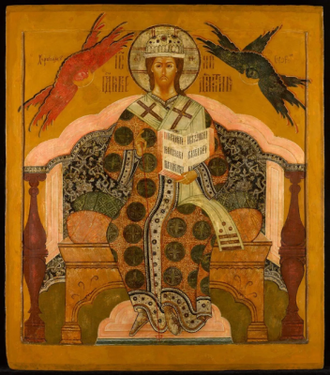
Christ enthroned as High Priest, Russia, Kostroma Region, mid-17th century, © Sotheby's London, 30 November 2021
Source: Christian Art
Gospel of 28 May 2026
Matthew 26:36-42
Jesus went with them to a place called Gethsemane, and he said to his disciples, 'Sit here, while I go over there and pray.' And taking with him Peter and the two sons of Zebedee, he began to be sorrowful and troubled. Then he said to them, 'My soul is very sorrowful, even to death; remain here, and watch with me.'
And going a little further he fell on his face and prayed, saying, 'My Father, if it be possible, let this cup pass from me; nevertheless, not as I will, but as you will.' And he came to the disciples and found them sleeping. And he said to Peter, 'So, could you not watch with me one hour? Watch and pray that you may not enter into temptation. The spirit indeed is willing, but the flesh is weak.' Again, for the second time, he went away and prayed, 'My Father, if this cannot pass unless I drink it, your will be done.'
Reflection on the Russian icon
The Feast of Our Lord Jesus Christ, the Eternal High Priest is a relatively recent addition to the liturgical calendar. It was first established in 1987 by the Congregation for Divine Worship for observance in Spain, and gradually gained wider recognition across the universal Church. It is now observed in many dioceses around the world on the first Thursday after Pentecost, a fitting time that follows the outpouring of the Holy Spirit and reflects the Church's ongoing mission under Christ's eternal priesthood.
The feast directs our attention to the Priestly Office of Christ, who is both sacrifice and priest. It serves as a powerful model for all the baptised (as through our baptism all of us are priest, prophet and king), and in a particular way, for the ordained priesthood. As priests act in persona Christi (in the person of Christ) they are called to mirror the self-giving love of the Eternal High Priest. Today, we are reminded to pray for our priests, that their lives may ever more closely reflect the holiness, humility, and compassion of Christ.
Our 17th century icon of Christ Enthroned as High Priest belongs to a long and deeply theological tradition that emerged early within Byzantine art and later spread throughout the Slavic and Russian Orthodox world. The image draws especially upon the Letter to the Hebrews, where Christ is described as the eternal High Priest (Heb 3:1-10:39): 'He, because he remains forever, has a priesthood that does not pass away'. Unlike the priests of the Old Covenant, whose sacrifices had to be repeated continually, Christ offers Himself once and for all. Byzantine artists therefore began depicting Jesus not only as Pantocrator (the ruler of all creation) but also clothed in the liturgical vestments of a high priest, seated upon a heavenly throne in divine authority. This iconography developed especially between the 12th and 13th centuries in Byzantium before spreading northward into Russia.
In our icon Christ sits frontally upon the throne with immense stillness and authority. His gaze is direct, penetrating, almost timeless. He blesses with one hand while holding the Gospel book with the other, reminding us that He is both priest and teacher, sacrifice and Word. His vestments are rich with symbolism. He wears priestly robes resembling those of a Byzantine bishop or patriarch. The omophorion (stole) draped across his shoulders, symbolises the shepherd carrying the lost sheep home. In Byzantine theology, earthly liturgy was understood as participation in the heavenly liturgy itself. Thus Christ appears here not merely as a historical figure from the past, but as the eternal celebrant of the heavenly mysteries.
Flanking Christ are two great seraphim, the mysterious six-winged beings described in the vision of the prophet Isaiah. These fiery heavenly creatures surround the throne of God singing "Holy, Holy, Holy." Their six wings traditionally symbolise the overwhelming holiness of divine presence: with two wings they cover their faces, unable fully to gaze upon God's glory; with two they cover their feet in humility; and with two they fly in perpetual worship. The contrasting colours are also symbolic. The red seraph evokes divine fire, burning love, heavenly energy and purification. The darker, almost black, seraph suggests mystery, transcendence, and the unknowable aspect of God beyond human understanding.
LINKS
Christian Art: https://christian.art/
Today's reading: https://christian.art/daily-gospel-reading/matthew-26-36-42-2026/
 Facebook
 Twitter
 LinkedIn
 Print
Print Email
Email









 Facebook
 Twitter
 YouTube
 LinkedIn
 Pinterest