


Gospel in Art: John pointed two disciples to Jesus
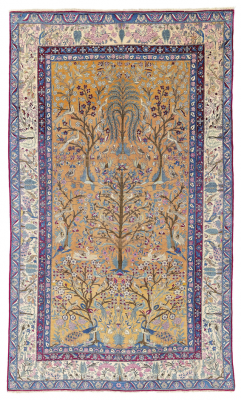
Tehran Carpet, North Persia,1910 © Christie's London, 25/06/2020, lot 219
Source: Christian Art
Gospel of 4 January 2024
John 1:35-42
As John stood with two of his disciples, Jesus passed, and John stared hard at him and said, 'Look, there is the lamb of God.' Hearing this, the two disciples followed Jesus. Jesus turned round, saw them following and said, 'What do you want?' They answered, 'Rabbi,' - which means Teacher - 'where do you live?' 'Come and see' he replied; so they went and saw where he lived, and stayed with him the rest of that day. It was about the tenth hour.
One of these two who became followers of Jesus after hearing what John had said was Andrew, the brother of Simon Peter. Early next morning, Andrew met his brother and said to him, 'We have found the Messiah' - which means the Christ - and he took Simon to Jesus. Jesus looked hard at him and said, 'You are Simon son of John; you are to be called Cephas' - meaning Rock.
Reflection on the carpet
The beauty of today's Gospel reading is in John the Baptist's generosity of spirit. John the Baptist was a very charismatic person who drew people to himself. As a result, he had his own disciples. Yet, in this morning's gospel reading we find John directing two of his disciples away from himself and towards the one whom he proclaimed as the Lamb of God. As a result John's two disciples became disciples of Jesus. Having responded to John's invitation to go towards Jesus, they subsequently respond to Jesus' invitation to 'come and see'. John was not possessive about his disciples. On the contrary, he encouraged them to go towards someone else who had more to offer them than he had. This is love at its most generous. To love others in the way God loves them is to want what is best for them, and that will often mean letting them go to others who can help them to grow as human beings and as children of God in ways that we cannot.
Parents know better than I do, how letting go of one's children is necessary at times to make them blossom and live their lives. Wedding days therefore can be bitter-sweet occasions, where the joy of the event is somewhat mixed with a feeling of letting go. The greatest act of love we can show others is to let them go so they can become the persons God intended them to be. As Christians, whatever life paths we walk, we are always asked to direct people to the Lord, as John the Baptist directed his own disciples.
It is similar to planting a seed in the fertile soil it deserves. It may not be the soil you can offer, but a soil someone else looks after. Only when planted in the right environment will we come to our full potential and fruition. Our Northern Persian carpet shows how a tiny seed can blossom into a series of colourful trees with spring blossoms and hosting a myriad of songbirds.
Carpet making has a rich and significant tradition in Persia, which is present-day Iran. Archaeological evidence suggests that carpet weaving was practiced in the region as early as the Achaemenid Empire (550-330 BCE). The skill and techniques have been passed down through generations, and are largely still the same nowadays. Persian carpet making has strong ties to nomadic life, as they were easy to transport and immediately give a homely feel to wherever the tribe settled next.
LINKS
Gospel in Art: https://christian.art/
Today's Reflection: https://christian.art/daily-gospel-reading/john-1-35-42-2024/
 Facebook
 Twitter
 LinkedIn
 Print
Print Email
Email










 Facebook
 Twitter
 YouTube
 LinkedIn
 Pinterest