


Gospel in Art: Wednesday of Holy Week
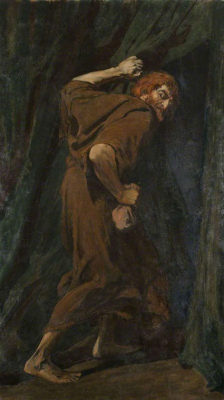
Judas the Iscariot: And It Was Night, by Christopher Williams © Aberystwyth University School of Art Museum and Galleries
Source: Christian Art
Gospel of 1 April 2026
Matthew 26:14-25
At that time: One of the Twelve, whose name was Judas Iscariot, went to the chief priests and said, 'What will you give me if I deliver him over to you?' And they paid him thirty pieces of silver. And from that moment he sought an opportunity to betray Jesus.
Now on the first day of Unleavened Bread the disciples came to Jesus, saying, 'Where would you have us prepare for you to eat the Passover?' He said, 'Go into the city to a certain man and say to him, "The Teacher says, My time is at hand. I will keep the Passover at your house with my disciples." ' And the disciples did as Jesus had directed them, and they prepared the Passover.
When it was evening, he reclined at table with the Twelve. And as they were eating, he said, 'Truly, I say to you, one of you will betray me.' And they were very sorrowful and began to say to him one after another, 'Not I, Lord?' He answered, 'He who has dipped his hand in the dish with me will betray me. The Son of Man goes as it is written of him, but woe to that man by whom the Son of Man is betrayed! It would have been better for that man if he had not been born.' Judas, who would betray him, answered, 'Not I, Rabbi?' He said to him, 'You have said so.'
Reflection on the painting
The early Christian community never tried to hide a very difficult reality: that Jesus was betrayed by one of his own disciples, by his close friend. I have always found that the Gospels speak about this with remarkable honesty. The one who would betray Christ was not a distant enemy but someone who had shared the road with him, someone who had sat at the same table and eaten from the same dish. We could well imagine that the early Christians may have preferred to sweep this under the carpet, or not even account it in the Gospels, as it is an uncomfortable truth. Yet the Gospel writers record it plainly and honestly. And in doing so they reveal something important: the Gospels are not polished legends designed to protect reputations. They are faithful accounts of what truly happened! Their honesty, even when it exposes weakness and failure among Jesus' closest followers, reminds us that we are reading real, true events that unfolded in the life of Christ.
When Jesus announces at the meal that one of those present will betray him, the Gospel of Matthew tells us that the disciples are deeply troubled. The shock of betrayal cuts deeply because it comes from within a circle of trust. It is painful not only for the one betrayed, but for everyone who witnesses it. Many of us know something of that experience ourselves; the sadness of trust broken, when words spoken in confidence are turned against us. And it upsets us when this happens.
Yet Holy Week reveals something greater than betrayal. The treachery that led to the Cross did not have the final word. God did. Through the Resurrection, God transformed the darkest moment of human disloyalty into the beginning of salvation. These sacred days invite us to trust that no painful experience, however heavy it may seem, lies beyond the reach of God's redeeming grace. Even in the shadow of any betrayal we may experience, God is there to help us.
Our painting by Welsh artist Christopher Williams we see the dramatic moment described in the Gospel of John when Judas Iscariot sneaks out and leaves the Last Supper. The entire scene is dominated by darkness, visually echoing the Gospel's haunting line: "and it was night." Judas is shown stepping away from the table into the shadows, behind a curtain, his figure caught in a narrow beam of light that reveals his troubled face and tense posture. He is holding his purse of coins given to him as a reward for betrayal. The painting therefore becomes a meditation on human freedom: how someone who has walked so closely with Jesus can still choose to step into the night.
LINKS
Christian Art: https://christian.art/
Today's reading: https://christian.art/daily-gospel-reading/matthew-26-14-25-2026/
 Facebook
 Twitter
 LinkedIn
 Print
Print Email
Email















 Facebook
 Twitter
 YouTube
 LinkedIn
 Pinterest