


Gospel in Art: Tuesday of Holy Week
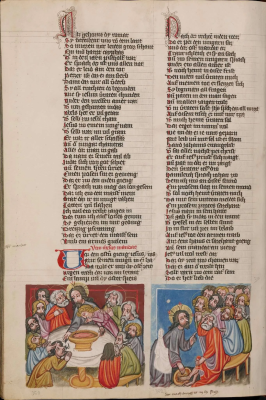
The Last Supper: Jesus handing Judas a morsel of Bread (left illustration) and Jesus washing feet of the Disciples (illustration on right), Unknown, Br Philipp,1400-1410 © The John Paul Getty Museum, Los Angeles
Source: Christian Art
Gospel of 31 March 2026
John 13:21-33, 36-38
At that time: Jesus was reclining at table with his disciples. He was troubled in his spirit, and testified, 'Truly, truly, I say to you, one of you will betray me.' The disciples looked at one another, uncertain of whom he spoke. One of his disciples, whom Jesus loved, was reclining at table at the side of Jesus, so Simon Peter motioned to him to ask Jesus of whom he was speaking. So that disciple, leaning back against Jesus, said to him, 'Lord, who is it?' Jesus answered, 'It is he to whom I will give this morsel of bread when I have dipped it.' So when he had dipped the morsel, he gave it to Judas, the son of Simon Iscariot. Then after he had taken the morsel, Satan entered into him. Jesus said to him, 'What you are going to do, do quickly.' Now no one at the table knew why he said this to him. Some thought that, because Judas had the money bag, Jesus was telling him, 'Buy what we need for the feast', or that he should give something to the poor. So, after receiving the morsel of bread, he immediately went out. And it was night.
When he had gone out, Jesus said, 'Now is the Son of Man glorified, and God is glorified in him. If God is glorified in him, God will also glorify him in himself, and glorify him at once. Little children, yet a little while I am with you. You will seek me, and just as I said to the Jews, so now I also say to you, "Where I am going you cannot come." '
Simon Peter said to him, 'Lord, where are you going?' Jesus answered him, 'Where I am going you cannot follow me now, but you will follow afterwards.' Peter said to him, 'Lord, why can I not follow you now? I will lay down my life for you.' Jesus answered, 'Will you lay down your life for me? Truly, truly, I say to you, the cock will not crow till you have denied me three times.'
Reflection on the illuminated manuscript page
Today's passage from the Gospel of John follows directly after Jesus has washed the feet of his disciples. He kneels before each of them without exception... even before Judas Iscariot. In that simple act, Jesus reveals a love that makes no distinctions. He serves them all, loving them all to the very end, including the one who would betray Him. In the scene that follows, our reading today, the Gospel describes another quiet gesture of closeness. At table, Jesus takes a small piece of bread, dips it into the dish, and hands it to Judas. In the culture of the time, such a gesture from the host was a sign of particular honour and friendship.
Yet this final act of kindness is not received as it is intended. As soon as Judas takes the morsel, he leaves the room and steps out into the darkness of the night. The evangelist suggests something deeply moving here: the love of Jesus for Judas was never in doubt. What remains tragic is Judas' unwillingness to accept that love. Love cannot be forced though. Love can only be offered. Even so, the story does not end in despair. Jesus speaks of glory at that very moment, because even the darkest human actions cannot ultimately frustrate God's purpose. The love of God continues to work even through human rejection, weakness and failure. Even when we stray into darkness, the light of God's love does not go out... it always continues to shine.
Our page from a German illuminated manuscript, circa 1400-1410, depicts our gospel reading on the bottom left. We see Christ seated at table with his disciples during the Last Supper. At the centre of the action, Jesus extends his hand to give a small morsel of bread to Judas Iscariot. Judas is depicted kneeling before Christ, which at first glance might seem like a posture of devotion or humility. His hands are held together in what appears to be a prayerful gesture, which could easily be mistaken for reverence. Yet the artist adds a small detail: from Judas' mouth a small devil emerges. This vivid illustration expresses visually what the Gospel text conveys: that Judas' outward gesture does not reflect the inner state of his heart. The devil leaving his mouth symbolises the evil intention that has already taken hold within him.
LINKS
Christian Art: https://christian.art/
Today's reading: https://christian.art/daily-gospel-reading/john-13-21-33-36-38-2026/
 Facebook
 Twitter
 LinkedIn
 Print
Print Email
Email

















 Facebook
 Twitter
 YouTube
 LinkedIn
 Pinterest