

Gospel in Art: My house shall be a house of prayer, not a den of robbers
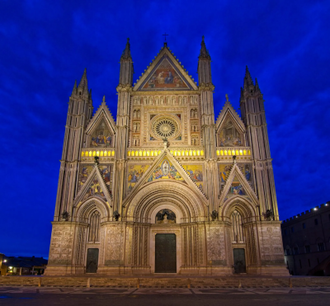
Orvieto Cathedral, Constructed under the orders of Pope Urban IV to commemorate and provide a suitable home for the Corporal of Bolsena, the relic of a miracle which occurred in 1263 in the nearby town of Bolsena Completed in 1591
Source: Christian Art
Gospel of 20 November 2026
Luke 19:45-48
At that time: Jesus entered the Temple and began to drive out those who sold, saying to them, 'It is written, "My house shall be a house of prayer", but you have made it a den of robbers.'
And he was teaching daily in the Temple. The chief priests and the scribes and the principal men of the people were seeking to destroy him, but they did not find anything they could do, for all the people were hanging on his words.
Reflection on Orvieto Cathedral
You enter a church hoping for a few quiet minutes with God, but first you encounter a table of souvenirs, a display of books and a shop selling all sorts of things. Each may serve a good purpose, yet a balance is to be struck so the commercial doesn't intrude on the prayerful aspect of a church - its main purpose.
In today's Gospel, Jesus drives the traders from the Temple, declaring that God's house has become a "den of robbers". His words challenge something deeper than the presence of money: the misuse of a sacred place. We must keep asking whether everything we do in our churches helps people encounter Jesus.
A house of prayer is somewhere we can hear Him. Architects make an extraordinary contribution to that purpose. Through light, proportion, materials and the direction of our gaze, they can help prepare us for prayer before a single word is spoken. Gothic churches do this with particular beauty: pointed arches, rising pinnacles and stained glass windows invite our eyes upwards and awaken a sense of wonder. Orvieto Cathedral, begun in 1290, offers a magnificent example of Italian Romanesque-Gothic architecture. It is one of my favourite churches.
At the heart of the Cathedral is a small linen cloth: the corporal associated with the miracle of Bolsena. In 1263 a priest troubled by doubts about Christ's True Presence in the Eucharist was celebrating Mass at nearby Bolsena when the consecrated Host bled onto the corporal. The cloth was brought to Orvieto, where Pope Urban IV happened to be staying. He ordered a cathedral to be built to house the corporal!
Within the cathedral, a dedicated chapel was built to shelter this precious relic and provide a place for prayer. There is something deeply moving about that relationship of scale: so much architecture, painting and craftsmanship gathered around a small piece of linen, directing attention towards the mystery of Christ's presence. Art at the service of prayer. Beautiful.
Seen at night, the illuminated façade of Orvieto Cathedral offers a particularly beautiful invitation to stop and look. Its three great gables, delicate stonework and golden mosaics give it the appearance of an immense altarpiece facing the city. The mosaics principally tell the story of the Virgin Mary, including her birth, her presentation in the Temple and her marriage; high in the central gable is her Coronation. Created and renewed across successive centuries, these images make the exterior itself a place of contemplation. Prayer not just encouraged inside the church, but also outside. Before we have even crossed the threshold, beauty has begun its quiet work: gathering our scattered attention and inviting us towards the God whose house we are about to enter.
LINKS
Christian Art: www.christian.art
Today's reading: https://christian.art/daily-gospel-reading/luke-19-45-48-2026/
Christian Art Conference 2026: www.indcatholicnews.com/news/56313
 Facebook
 Twitter
 LinkedIn
 Print
 Email











 Facebook
 Twitter
 YouTube
 LinkedIn
 Pinterest