


Gospel in Art: And behold, there was a man named Zacchaeus
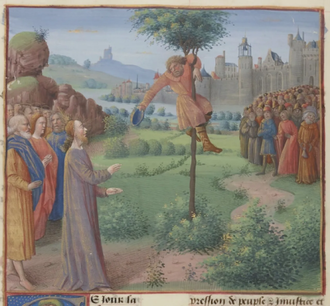
Jesus encounters the tax collector Zacchaeus. Illumination by Jean Colombe 1480 from the manuscript Vie de Jésus-Christ by Ludolf of Saxony © Bibliotheque nationale de France, Paris.
Source: Christian Art
Gospel of 17 November 2026
Luke 19:1-10
At that time: Jesus entered Jericho and was passing through. And behold, there was a man named Zacchaeus. He was a chief tax collector and was rich. And he was seeking to see who Jesus was, but on account of the crowd he could not, because he was small in stature. So he ran on ahead and climbed up into a sycamore tree to see him, for he was about to pass that way. And when Jesus came to the place, he looked up and said to him, 'Zacchaeus, hurry and come down, for I must stay at your house today.' So he hurried and came down and received him joyfully. And when they saw it, they all grumbled, 'He has gone in to be the guest of a man who is a sinner.' And Zacchaeus stood and said to the Lord, 'Behold, Lord, half of my goods I give to the poor. And if I have defrauded anyone of anything, I restore it fourfold.' And Jesus said to him, 'Today salvation has come to this house, since he also is a son of Abraham. For the Son of Man came to seek and to save the lost.'
Reflection on the medieval illumination
Zacchaeus was a wealthy man, but his wealth had come at a cost. As a chief tax collector in Jericho, he belonged to a profession widely resented for its dealings with the Roman authorities and its opportunities for dishonesty. He had money and a position, yet something drew him out into the street to see Jesus. Being short, he could not see over the crowd, so he ran ahead and climbed a sycamore tree. Imagine this important man scrambling up a trunk, setting aside his dignity just to catch a glimpse of someone passing below. Zacchaeus is a wonderful example of allowing our desire for God to become so strong, that we loose the fear of looking foolish. Look at the way he sits in the tree in our medieval illustration. Almost humorous.
But the encounter takes an unexpected turn. Zacchaeus who simply wanted to see Jesus, gets more than he bargained for: Jesus stops and looks up and calls him by name. Before Zacchaeus has offered any explanation or promise to change, Jesus announces that he must stay at his house. Jesus invites himself for dinner. That changed everything for Zacchaeus. The man whose life has revolved around collecting taxes, now has to give. After the taking, now follows the giving. He does not only provide hospitality to Jesus, but he gives even more: half his possessions to the poor, and fourfold repayment to anyone he has cheated. His conversion reaches right into his purse. Conversion + action.
Jean Colombe's illumination, made around 1480 for a manuscript of Ludolf of Saxony's Vie de Jésus-Christ, brings a delightful humanity to the scene. Zacchaeus is almost humorously conspicuous, perched awkwardly in his tree. Our attention is caught by him: the man seeking a view has become a sight himself. His uncomfortable position gives the story movement and personality, inviting us to linger over a detail we might pass over when reading. Zacchaeus doesn't fear to be mocked. Crowds on the left and right of the illumination are watching the very strange man in the tree.
Like Zacchaeus, we may sometimes look a little foolish to the crowd. People may smile at our faith, question why we go to Mass, or mock our belief in a God we cannot see. It can be tempting to keep quiet and avoid drawing attention to ourselves. Yet Zacchaeus reminds us that there is something more precious than the crowd's approval: the joy of encountering Christ. He was willing to risk a few laughs for a glimpse of Jesus, and found himself welcomed by name. May we have that same courage, trusting that whatever others may think of us, the treasure of knowing and loving Christ is worth far more.
LINKS
Christian Art: www.christian.art
Today's reading: https://christian.art/daily-gospel-reading/luke-19-1-10-2026-2/
 Facebook
 Twitter
 LinkedIn
 Print
 Email
















 Facebook
 Twitter
 YouTube
 LinkedIn
 Pinterest