


Gospel in Art: Calling ten of his servants, he gave them ten minas
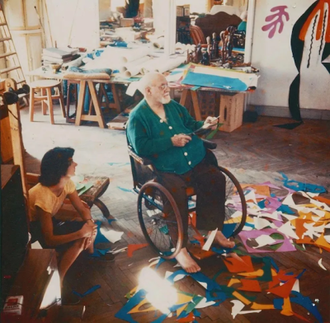
Henri Matisse at Hôtel Régina, Nice, 1952. By Lydia Delectorskaya © Succession H Matisse
Source: Christian Art
Gospel of 18 November 2026
Luke 19:11-28
At that time: Jesus proceeded to tell a parable, because he was near to Jerusalem, and because they supposed that the kingdom of God was to appear immediately. He said therefore, 'A nobleman went into a far country to receive for himself a kingdom and then return. Calling ten of his servants, he gave them ten minas, and said to them, "Engage in business until I come." But his citizens hated him and sent a delegation after him, saying, "We do not want this man to reign over us." When he returned, having received the kingdom, he ordered these servants to whom he had given the money to be called to him, that he might know what they had gained by doing business. The first came before him, saying, "Lord, your mina has made ten minas more." And he said to him, "Well done, good servant! Because you have been faithful in a very little, you shall have authority over ten cities." And the second came, saying, "Lord, your mina has made five minas." And he said to him, "And you are to be over five cities." Then another came, saying, "Lord, here is your mina, which I kept laid away in a handkerchief; for I was afraid of you, because you are a severe man. You take what you did not deposit, and reap what you did not sow." He said to him, "I will condemn you with your own words, you wicked servant! You knew that I was a severe man, taking what I did not deposit and reaping what I did not sow? Why then did you not put my money in the bank, and at my coming I might have collected it with interest?" And he said to those who stood by, "Take the mina from him, and give it to the one who has the ten minas." And they said to him, "Lord, he has ten minas!" "I tell you that to everyone who has, more will be given, but from the one who has not, even what he has will be taken away. But as for these enemies of mine, who did not want me to reign over them, bring them here and slaughter them before me." '
And when he had said these things, he went on ahead, going up to Jerusalem.
Reflection on the photograph
A mina was a sum of money worth about a hundred days' wages: a substantial amount entrusted to someone's care. It was not the same as a talent, the much larger monetary unit found in Matthew's parable. Although the two stories have similarities, Luke in our parable describes ten servants each receiving one mina, with the instruction to put it to work. Two servants put what they have received to good use; another wraps his mina in a cloth and leaves it untouched. Fear has made him inactive. We might begin by asking ourselves: what good am I doing with what God has entrusted to me? Or do I just keep postponing to do anything?
Perhaps you have a gift for listening, but rarely make time for someone who needs to talk. Perhaps you can teach, organise, cook, sing or put people at ease. Could you help a child who struggles at school, prepare a meal for a neighbour, join the parish choir or welcome someone who always stands alone after Mass? We have all received gifts freely from God, including abilities we might hardly recognise as talents. We develop them through practice, patience and the courage to begin to do something with what God has entrusted to us. Life becomes beautiful and fruitful when we put those gifts at someone else's service. It is never too late.
The later life of Henri Matisse offers a beautiful example of finding a new way to use a gift, and the it is never too late to share our gifts. Following major surgery in 1941, he was left severely weakened, and working as he had before became difficult. He turned to a new technique: cutting shapes from coloured paper. Assistants painted sheets with gouache and helped him handle and arrange them; Matisse cut flowing forms with scissors. It is almost all he could do at that stage in life. Those shapes became vibrant compositions. Some critics initially dismissed the cut-outs, yet they became among his most celebrated achievements.
There is encouragement here for anyone who thinks their useful days are over, or that their contribution is too small to matter. The way we use our gifts may change with age, illness or circumstance. We may also need others to help us, as Matisse did. There is something we can offer at every stage in life.
Our photograph, taken by his assistant Lydia Delectorskaya around 1952, shows Matisse absorbed in the simple act of cutting paper. Seated in his wheelchair, wearing glasses and a comfortable patterned robe, he guides his scissors through a sheet of paper while the emerging shape curls below his hands. There is something deeply moving about seeing this great artist at work with such modest materials. Decades of looking, learning and creating are gathered into this quiet gesture. His physical strength has diminished, yet his imagination continues to find expression. In the light of today's Gospel, the photograph invites us to ask how we might use what is still within our reach.
LINKS
Christian Art: www.christian.art
Today's reading: https://christian.art/daily-gospel-reading/luke-19-11-28-2026/
 Facebook
 Twitter
 LinkedIn
 Print
 Email















 Facebook
 Twitter
 YouTube
 LinkedIn
 Pinterest