

Book: African Synodal Theology: A Tall Tree Is as Strong as Its Roots
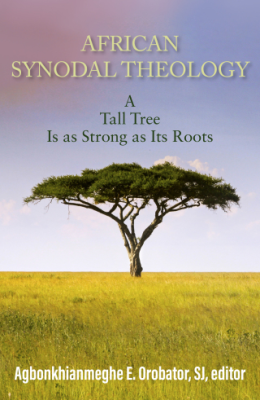
African Synodal Theology: A Tall Tree Is as Strong as Its Roots. Agbonkhianmeghe E Orobator , SJ. Publisher: Orbis, New York
The invention of the imagined social reality of geographies far from European corridors of power has always been challenging for Catholicism's central institutions: Pope Leo X (1475 -1521) kept a pet Indian elephant in the Vatican Gardens, which fascinated Rome, and is said to be buried near St Peter's Basilica.
In 1926 the Holy See convened a 'Great Vatican Exhibition' to display artefacts from around the world and evidence the cataloguing and classification of local peoples by especially Dutch and Belgian missionaries influenced by the then young academic discipline of ethnography. Some of them became origin source materials for the later Rwandan genocide.
In 2025 even Pope Francis was joined at one of his audiences by an 'African' circus troupe who brought with them mechanised 'elephants' for all to 'admire' and 'discover' 'the Church's future'. As Pope Leo XIV knows though, from his regular visits to Africa with the Augustinians, the continent is actually the Church's present not some dematerialised future or zone into which to project children's fables.
This important edited collection represents a project to bring greater substance still to the current Pontiff's wise understandings in these regards.
The book's editor, Fr Abonkhianmeghe E Orobator, has once again set typically impressive standards and gathered a talented community of contributors. They set out to make an 'African' contribution to the social construction - they call it theology and practice - of 'synodality.' What they offer implicitly holds less urgent efforts up to scrutiny.
Across the pages we see glimpses of enquiry as to synodality's meaning in refugee camps and among young people, through the voice of women and as a basis for a possible 'remodelling' of the church. For Orobator the 'marks' of a synodal church are listening, discerning, relationality, and the gift of diversity.
Leocadie Lushombo points us back to the margins and celebrates the contribution of Women Religious. The work of Nigerian Religious Sisters to reduce human trafficking is rightly celebrated. Meanwhile, in a typically astute contribution Anthony Egan seeks to break beyond the confines of a left/right typology of ecclesiastical analysis to advance an ethics of synodality for the long term. He does not hide from the Church's vulnerable persons safeguarding crises along the way.
Fr Marcel Uwineza, an important Rwandan theologian who has done crucial work on theology after genocide, suggests that synodality is a central skill of the church, ready to be rediscovered, but lost in the (European?) Middle Ages. Veronica Jemanyur Rop, also from East Africa, crackles with passion as she describes Consecrated women, their commitment, and their orientation towards unlocking the potential of 'the whole people of God.' No essay disappoints. Collectively they present powerful metaphors of journey, home, personality and mutuality as a cause and consequence of community. This is how 'the roots' will be rebuilt because the whole community may be involved, they propose, through an 'African' prism protected as it is by notions of 'ubuntu,' (we belong to each other) 'palaver' (we may gather to resolve our differences) and only (sometimes) constrained by patriarchy and the legacy of colonialism. In this way, they affirm, a new ethics of mutual support can emerge.
There is a conundrum here however: Just as imaginings of old left us with invented hearts of darkness, notions of savagery and stereotypes of underdevelopment if not carefully approached these fresh essays could be misread as simply painting a series of new potential portraits without introducing enough social analysis, theories of institutional change, or adequate contextualisation. Canon Law, for example, began in Africa and pre-dated almost every modern nation state. Its jurisprudence has much to teach. Meanwhile, rural Zambia now nestles at the heart of geo-political competition between the PRC, the USA and Japan while its Bishops claim they are at risk of threat via Presidential proxies. In the North Western Sahara still struggles with huge political ambiguity decades after Spain's departure as imperial ruler. Burkina Faso's social stratification and violent Islamisms are in very great part the consequence of historic French colonial economic preference for Catholic 'converts' at the expense of the poorest local Muslim populations. Meanwhile, in the Democratic Republic of Congo the Bishops Conference have at times had to save democracy itself. By presenting 'Africa' more narrowly than it might be the book under consideration does not have the space to share the substantial numbers of versions of Africa that go to make up the whole.
From data centres and satellite breakthroughs to AI innovations, banking pioneers and ecological wonders to rural villages impacted by cycles of migration to mines and tourist trades no 'African' day or place is the same. Just as in South America the 'patria grande' is likely more narrative myth than empirical reality then 'Africa's' singularity ought to be treated with serious caution too lest it once again be reduced to a synodal version of an 'exhibition' outside time once more. Future essays will need to explore if it is good enough for the Church to talk of 'Africa' or whether an attentive decentralised synodality needs to excavate the multiple Africas at hand. Such a stance could also help in other ways by resisting the Euro-Atlantic homogenisation of synodality in other quarters to the 'things we moan about over a family cuppa (or at dinner in the presbytery)) ' rather than those social crises that define our present epoch.
Either way, what is central to this collection is the idea that renewal is urgent and that in shaping it the voice of the poor is not, as Bishop Robert Barron from America has said, 'something we can get to' after the real work has been done. As such, whether one thinks synodality is meaningful for the whole church or not if African resident, citizen and diaspora writers such as these are our present and our future there is hope for all of us - free of the false insights of imagined, captive and mechanised elephants and peoples of the past. It is in the (re)planting of such roots that true freedom is found.
Dr Francis Davis is a social entrepreneur, academic and community activist. He holds Professorships at the University of London. His 2021 study based on extensive fieldwork was the first major exploration of the social care needs of Rwandan villagers after genocide. This is a revised version of a forthcoming review in the Journal of Rural Theology (Routledge)
 Facebook
 Twitter
 LinkedIn
 Print
 Email












 Facebook
 Twitter
 YouTube
 LinkedIn
 Pinterest