


Are we entering a Golden Age of Catholic Youth Ministry?

A few years ago I was helping on a residential weekend for teenagers at Worth Abbey when an old friend arrived to give the Saturday evening talk. He looked around the room and asked me how it was all going. The only answer I could find was, "It works. It just works."
He laughed, because he knew exactly what I meant. We had both been in youth ministry a long time, and we had both spent most of it watching things really not work.
I've thought about that conversation a lot this year. For twelve months we were told that Britain was in the middle of a "quiet revival" led by the young. Then, in March, the Bible Society withdrew the report behind the phrase after YouGov admitted its data was faulty. Some people were crushed. Others seemed a little too pleased.
I was neither, because I never thought a survey was the place to look.
If we're honest, we have to admit that most of what the Church does with young people still isn't working. I say that as someone who has done this job for twenty-five years and who has definitely played his part in things not working. I'm by no means a bystander here.
If you're struggling with this idea, ask yourself how many of the people you were confirmed with are still at Mass. A parish I belonged to for years, which was better than most, has confirmed around a thousand young people over the last generation. I would be surprised if fifty of them are still in the pews on any given Sunday.
The bigger problem is that most Catholic youth ministry simply isn't happening. The vast majority of baptised teenagers who drift away never go near a youth group, good or bad, because in most parishes there isn't one.
So no, this isn't a golden age. At least, not yet.
But yet, I'm more hopeful than I have been at any point in my career, and it's got nothing to do with polling.
It's because there are now projects in this country that reliably do the thing we all say we want. They take ordinary teenagers and, a few years later, you meet adults who have put Christ at the centre of their lives. I spent more than a decade studying some of them for my book, How to Start a Fire: A Blueprint for Catholic Youth Ministry. I interviewed their leaders, joined their teams and asked questions until they were sick of me.
There is ASCENT, a three-year discipleship process built on residential weekends, weekly small groups and one-to-one mentoring. One mum told me that soon after the first weekend her daughter rang from the school bus to say she was bringing two friends home to start a prayer group, and could Mum please stay out of the living room.
There is Youth 2000, whose retreats, centred on the Eucharist and Our Lady, have probably done as much as anything in these islands over the last generation to keep young adults in the Church. At their summer festival I once asked a young religious sister what had brought her there. She had found her vocation at the same festival years earlier.
And there is the Metanoia Community in Preston, running youth groups, student ministry, a school chaplaincy and drop-ins for homeless people, all in one town, week in and week out. Not long ago I went to Mass with its founders, and on the way out we bumped into a young man who had come through their programmes and been baptised the previous Easter.
These three look similar in some ways, different in others. Take them apart, though, and you find the same components inside.
They exist to evangelise, and they say so. They are unapologetically Catholic without being angry about it. They put the kerygma, the basic proclamation of what Jesus has done for us, at the heart of everything. They understand that conversion happens in stages (what Sherry Weddell calls the thresholds of discipleship), so they walk with young people over months and years instead of hoping one good weekend will do the job. They form their leaders before they deploy them. And they think hard about where a young person goes next.
None of that is a secret. Pope Francis asked for exactly this in Christus Vivit, when he urged us to pay more attention to "the methods, language and aims that have proved truly effective in bringing young people to Christ and the Church", whatever label they happen to carry.
I think that is the real change of the last twenty years. When I started out, kerygma was a novel word in most youth ministry circles. Now there is a generation of leaders who were properly formed as teenagers, and I keep meeting them. They are working with university students, teaching RE, entering seminaries and religious life and, increasingly, starting things of their own. Good ministry breeds more of the same.
Whether that becomes a golden age depends on what the rest of us do with it. If more young people really are curious about faith, and anecdotally I think some are, then what matters is what they find when they walk through our doors. A parish with nothing to offer them but a place on the rota will lose them again within the year. I've seen that happen one too many times too.
The danger is that we treat good news as permission to relax. For decades we have comforted ourselves with lines like "they'll come back when they get married" and "we're sowing seeds". A revival we don't have to work for is the same comfort blanket in a new colour.
The alternative is harder and much more interesting. Find the things that are working, strip them down to see why, and copy them shamelessly. That isn't cheating. We are all building the same Kingdom. It isn't mainly about money either. I once worked in a Caribbean diocese that sometimes struggled to pay its phone bill and was full of life. What counts is whether there are disciples in the room who know what they are doing.
So, are we entering a golden age? I can't tell you. What I can say is that it is now possible to point to Catholic youth ministry that works, explain why it works, and show somebody else how to do it.
In other words, there are seeds. If we can water then then yes, we could, maybe start to see something a bit special.
Jack Regan is Director of Youth Services for the Diocese of Lancaster and the author of How to Start a Fire: A Blueprint for Catholic Youth Ministry (Mission Thinking).
 Facebook
 Twitter
 LinkedIn
 Print
Print Email
Email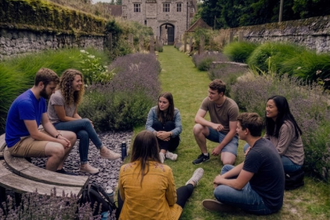















 Facebook
 Twitter
 YouTube
 LinkedIn
 Pinterest