


Gospel in Art: Memorial of Saint Bruno
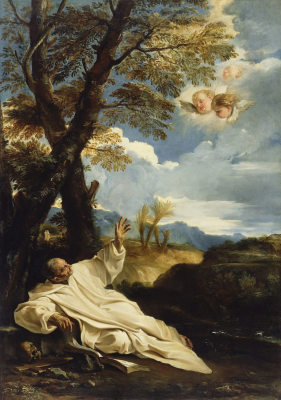
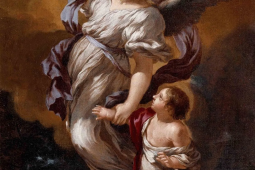
The Vision of Saint Bruno, by Pier Francesco Mola, 1660 © J Paul Getty Museum, Los Angeles
Source: Christian Art
Gospel of 6 October 2026
Luke 10:25-37
At that time: Behold, a lawyer stood up to put Jesus to the test, saying, 'Teacher, what shall I do to inherit eternal life?' He said to him, 'What is written in the Law? How do you read it?' And he answered, 'You shall love the Lord your God with all your heart, and with all your soul, and with all your strength, and with all your mind, and your neighbour as yourself.' And he said to him, 'You have answered correctly; do this, and you will live.'
But he, desiring to justify himself, said to Jesus, 'And who is my neighbour?' Jesus replied, 'A man was going down from Jerusalem to Jericho, and he fell among robbers, who stripped him and beat him and departed, leaving him half dead. Now by chance a priest was going down that road, and when he saw him he passed by on the other side. So likewise a Levite, when he came to the place and saw him, passed by on the other side. But a Samaritan, as he journeyed, came to where he was, and when he saw him, he had compassion. He went to him and bound up his wounds, pouring on oil and wine. Then he set him on his own animal and brought him to an inn and took care of him. And the next day he took out two denarii and gave them to the innkeeper, saying, "Take care of him, and whatever more you spend, I will repay you when I come back." Which of these three, do you think, proved to be a neighbour to the man who fell among the robbers?' He said, 'The one who showed him mercy.' And Jesus said to him, 'You go, and do likewise.'
Reflection on the painting
Saint Bruno, who we celebrate today, was born in Cologne around 1030 and became one of the great scholars and teachers of his age. He studied and later taught at Reims, where he gained a considerable reputation for being a very good professor. Among his pupils there was the future Pope Urban II. Yet Bruno gradually became convinced that God was calling him towards something altogether quieter. Around 1084, already in his fifties, he left behind the life he had known and, together with six companions, sought a place where they could live almost entirely for prayer. Their search eventually brought them to Hugh, Bishop of Grenoble, who led the seven men into the wild and remote Chartreuse Mountains. There they built a small church and individual hermitages, laying the foundations of what would become the Carthusian Order.
There is a wonderful story surrounding their arrival. Shortly before Bruno and his six companions appeared before him, Bishop Hugh had experienced a remarkable dream in which he saw God building a dwelling in the wilderness of the Chartreuse, while seven stars showed him the way towards it. Then seven men arrived at his door asking for precisely such a place of solitude. Hugh understood the coincidence as providential and helped them establish themselves in that mountainous wilderness. The seven stars would become closely associated with Carthusian imagery.
Our painting, The Vision of Saint Bruno, was painted around 1660 by the Italian Baroque artist Pier Francesco Mola. It is a large canvas, almost two metres high. Bruno lies almost absorbed into the wilderness, enveloped in the great folds of his white Carthusian habit. Beside him are a book, a cross and a skull: Scripture, prayer and Christ. All he needed. In the distance two fellow monks walk together, but Bruno is deliberately separated from them. This is the vocation he chose: community, certainly, but a community in which each monk also spends long periods alone with God. Even the landscape seems to participate in his prayer. Two great trees cross one another behind him, subtly forming another cross.
And then something happens. The clouds open and cherubim appear above. Bruno turns his face towards them and stretches out his hand, almost as though he wants to touch what he sees. Or maybe he is simply blinded by the celestial light. Perhaps that is Saint Bruno's gift to us today. Most of us are not called to disappear into the mountains of the Chartreuse, but all of us need some little Chartreuse within our lives: a place where the telephone is put down, the noise ceases, our endless activity stops, and we simply allow ourselves to be before God. Bruno's life reminds us that silence is not an absence of something; it can be the presence of Someone. The Carthusian tradition beautifully sums up its spirituality in the words "Stat crux dum volvitur orbis" - "The Cross stands while the world turns." The world continues to rush, change, argue and demand our attention. But the cross remains still at its centre.
LINKS
Christian Art: www.christian.art
Today's Reading: https://christian.art/daily-gospel-reading/luke-10-25-37-2026-2/
 Facebook
 Twitter
 LinkedIn
 Print
Print Email
Email









 Facebook
 Twitter
 YouTube
 LinkedIn
 Pinterest