

Gospel in Art: The Parable of the Good Samaritan
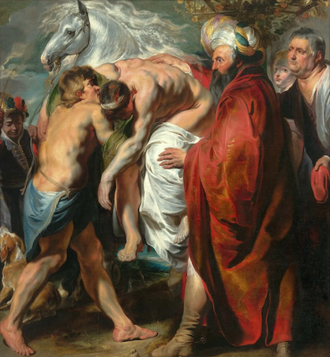
The Good Samaritan, by Jacob Jordaens,1616 © Louvre Abu Dhabi
Source: Christian Art
Gospel of 5 October 2026
Luke: 10:25-37
At that time: Behold, a lawyer stood up to put Jesus to the test, saying, 'Teacher, what shall I do to inherit eternal life?' He said to him, 'What is written in the Law? How do you read it?' And he answered, 'You shall love the Lord your God with all your heart, and with all your soul, and with all your strength, and with all your mind, and your neighbour as yourself.' And he said to him, 'You have answered correctly; do this, and you will live.'
But he, desiring to justify himself, said to Jesus, 'And who is my neighbour?' Jesus replied, 'A man was going down from Jerusalem to Jericho, and he fell among robbers, who stripped him and beat him and departed, leaving him half dead. Now by chance a priest was going down that road, and when he saw him he passed by on the other side. So likewise a Levite, when he came to the place and saw him, passed by on the other side. But a Samaritan, as he journeyed, came to where he was, and when he saw him, he had compassion. He went to him and bound up his wounds, pouring on oil and wine. Then he set him on his own animal and brought him to an inn and took care of him. And the next day he took out two denarii and gave them to the innkeeper, saying, "Take care of him, and whatever more you spend, I will repay you when I come back." Which of these three, do you think, proved to be a neighbour to the man who fell among the robbers?' He said, 'The one who showed him mercy.' And Jesus said to him, 'You go, and do likewise.'
Reflection on the painting
One of the beautiful ways of praying with the Gospels is to place ourselves within the scene. Rather than simply standing outside the story and observing what happens, we can step inside it and ask ourselves: where am I here in this story? Which person do I identify with? The wonderful thing about Jesus' parables is that they are so rich, we must look all the different characters that are part of each story. At one moment a parable may speak to us through one character; at another stage of our lives, we may suddenly recognise ourselves in someone completely different. The same Gospel remains unchanged, yet somehow it keeps finding new ways of speaking to us.
We usually hear today's parable as an invitation to become like the Good Samaritan: to notice the person in need, to stop rather than pass by, and to allow compassion to interrupt our plans. But perhaps today we might place ourselves somewhere else in the picture. Perhaps we are the wounded traveller lying beside the road. All of us know something of what it means to be wounded. Illness can leave us physically vulnerable; disappointment or grief can break our hearts; anxiety and exhaustion can leave us mentally drained. We have all been that wounded traveller.
What must have been especially surprising for the wounded Jewish traveller was the identity of the person who finally stopped. The priest passed by. The Levite passed by. It was a Samaritan, someone he might have regarded with suspicion, who knelt beside him, tended his wounds and carried him to safety. Jesus seems to be telling us that God's compassion does not always arrive wearing the clothes we expect. Help can come through an unlikely person, perhaps even through someone we would never have chosen ourselves. In our moments of vulnerability, therefore, we need to have the humility to allow ourselves to be helped by someone we least expected.
What is striking about our painting today, The Good Samaritan, painted around 1615-16 by the great Flemish Baroque artist Jacob Jordaens, is that the Samaritan is not really the visual centre of the composition at all. Our eyes are drawn first to the enormous, almost life-size body of the wounded traveller. Stripped of his clothes, helpless and exhausted, he slumps forward so dramatically that he seems almost to fall out of the painting and into our own space. Behind him, the Samaritan, richly dressed and wearing a turban, struggles to lift and support him. Jordaens has brought us extraordinarily close to the action: there is little landscape to distract us, no comfortable distance from which to observe the story. We are confronted instead with the weight and vulnerability of this wounded human body. Perhaps Jordaens therefore helps us to enter today's Gospel through the character we too easily overlook.
LINKS
Christian Art: www.christian.art
Today's Reading: https://christian.art/daily-gospel-reading/luke-10-25-37-2026/
 Facebook
 Twitter
 LinkedIn
 Print
Print Email
Email














 Facebook
 Twitter
 YouTube
 LinkedIn
 Pinterest