


Canada: Prayer walk in Vancouver reflects WCC Pilgrimage of Justice, Reconciliation, and Unity
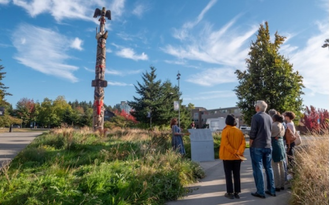
Reconciliation Pole by Haida artist James Hart. Image - MarceloSchneider WCC
Source: WCC
A prayer walk in Vancouver, Canada on 20 September brought a grassroots lens to the World Council of Churches (WCC) Pilgrimage of Justice, Reconciliation, and Unity.
"Let us, like them, be Christians led by God on the sacred path of reconciliation, justice, and peace."
As part an opening prayer to begin the walk, those gathered said: "We are so blessed to be on this land and to be together as those who seek a unity that is deeper than agreement."
First stop: Overlooking rose garden
Wendy Grant-John, a prominent leader in the Musqueam First Nations community, said, in 2014: "The water is really the heartbeat of our community. It really is the giver of life for us."
Those gathered prayed together: "God of the waters, bathe us in your healing waters. Bring us into peace and unity. We are thirsty for justice, for a world where water is protected and cherished."
Second stop: The Indian Residential School History and Dialogue Centre
The Indian Residential School History and Dialogue Centre's aim is to provide residential school survivors and their families with access to church and government records related to residential schools in Canada.
"Even today, these records remain incomplete and difficult to access for many residential school survivors," noted Bailey Bjolin from the University and the Canadian Council of Churches.
The pilgrims prayed together: "We confess that we, as the church, have been complicit in countless instances of harm and violence, and that we have kept others from flourishing by ignoring your call to love one another."
Third stop: University of British Columbia Main Mall
The prayer walk traversed the Main Mall of the University of British Columbia, where the school added diagonal lines connecting two existing parallel lines.
"Anywhere on the main mall where you see these diagonal paths? These used to be desire paths," explained Bjolin. "If you aren't familiar with the term, desire paths, also known as desire lines, are small trails that form when people repeatedly walk across green spaces or natural areas, usually on their way from one place to the next, instead of following the official trails or pathways."
These desire lines aren't sanctioned, and usually they are discouraged. "But it is almost impossible to keep people from making them and using them," said Bjolin.
Bjolin asked the group: "For how many of us has this experience of education been easy, linear, and gone exactly according to plan?"
They prayed together for the students. "May everyone who studies on this land see the desire lines that you have laid out for them," prayed those gathered.
Fourth stop: Beaty Biodiversity Museum
The Beaty Biodiversity Museum houses a million specimens. "Walking down the rows of display boxes in the museum, it is impossible not to be overwhelmed by the diversity of God's creation," said Bjolin.
"We are in awe of your creation," the pilgrims prayed. "We are in awe of the sparrows, the crows, jellyfish and slugs and ladybugs, the tiniest bacteria we will never see and the great blue whale, which we may someday get to see, but only if we are exceptionally lucky. God, as we imagine ourselves among the millions of your creation, let us hold each living and more-than-living thing in our hearts as precious, precisely because you made it and it is yours."
Fifth stop: Reconciliation Pole
The Reconciliation Pole has been on the campus of the University of British Columbia since 2017. It was designed and carved by a Haida artist, James Hart, with the help of many Haida carvers and artists in the community.
The pole recognizes the legacy of residential schools in Canada. "We read this pole, like all Haida poles, from bottom to top," explained Bjolin. "The bottom third of the pole represents the time before residential schools. The middle represents Indigenous people's experience during the time of residential schools, and the top third represents the time that comes after the last residential school closed in 1997."
Those gathered prayed for reconciliation. "Help us to listen deeply, to speak fearlessly, and to love one another as hard as we can," they prayed. "We do not know how to do this alone. We do not know how to get to that place of reconciliation, to that place where we experience justice and peace and unity together as you intend us to."
 Facebook
 Twitter
 LinkedIn
 Print
 Email








 Facebook
 Twitter
 YouTube
 LinkedIn
 Pinterest