


At COP17, a Gunadule theologian calls three crises one wound
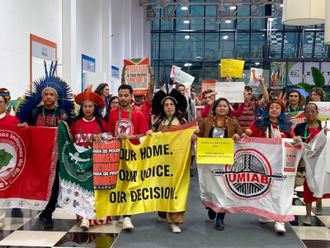
Indigenous people at the biodiversity loss COP17 in Yerevan, Armenia
Source: WCC
Three UN conferences meet in 2026 on three crises: desertification, biodiversity loss, and climate change. Jocabed Solano, an Indigenous Gunadule theologian from Panama, does not see three. "The world calls these climate change, biodiversity loss, and desertification, but for us they are one wound," she said in Yerevan, Armenia, on 20 October.
She was speaking at the Faith Hub, a space for faith groups at the UN biodiversity conference, COP17. With two young Indigenous church members from Finland and Bolivia, she spoke about the land behind all three negotiations, and who should care for it.
Solano comes from Guna Yala, the Gunadule territory in Panama. "Nabgwana, our Mother Earth, does not live in three pieces. In Guna Yala, families from Cartí Sugdup have already left their island, because Grandmother Sea is asking for what is hers," she said. "If Nabgwana is one, the three COPs must stop walking apart. We do not own her. We are her family."
The session, 'Indigenous and Ecumenical Perspectives for the Triple COPs,' was part of the World Council of Churches (WCC) programme at the COP17 Faith Hub where those Indigenous voices spoke for themselves.
Solano is director of Memoria Indígena, a grassroots collective, and a member of the reference group that guides the WCC Ecumenical Indigenous Peoples Network. She took an image from the Guna Congress and its sagla, a traditional leader who sings there. "In our Congress, the sagla does not speak from a chair but sings from a hammock that moves with the wind and the sea. We are trying to answer living crises from chairs that never move. It is time to climb into the hammock."
She also spoke about Article 8(j) of the Convention on Biological Diversity, the UN biodiversity treaty, which asks governments to respect and preserve the knowledge and practices of Indigenous peoples and local communities.
"Indigenous peoples do not bring traditional knowledge as loose data for a report. We bring knowledge systems with their own law, science, and spirituality. A system cannot be extracted. It has to be recognized, respected, and funded."
Far north of Guna Yala, Sámi lands face pressure of another kind. Sara Keränen, a young Sámi member of the Evangelical Lutheran Church of Finland, spoke of "exploitation of our lands and waters in the name of mining and forestry." She also named "the issue of green colonialism, which means that our lands are taken away from us in the name of the green transition."
Like Solano, Keränen did not set people apart from the land. "We are not separate from nature, we are part of it," she said. Keeping the land "in the hands of the people who have been taking care of the land and waters for ages, is a way not only to ensure the rights and livelihoods of Indigenous peoples, it is also a way to protect the land's biodiversity."
That care rests on knowledge. "We as Indigenous peoples know how to use the land in sustainable ways so all species can exist in harmony with each other, including human beings," Keränen said.
Jazmin Soto Mayta, a young member of the Bolivian Evangelical Lutheran Church who works with Indigenous Aymara communities, looked to the next generation. "Safeguarding biodiversity starts with securing Indigenous rights and preserving ancestral knowledge. We urge world leaders at the triple COPs to invest in intergenerational learning, because preserving ancestral wisdom in our own territories ensures the survival of all . . ."
She rooted that call in faith. "Clothed in the spirit of life, we are called to cultivate and restore creation from the faithfulness of God.."
Solano's word to churches came from faith too. "In Guna Yala we say: we do not own Nabgwana, our Mother Earth, we are her family. And you do not negotiate with family. You take care of her," she said. "Communities of faith can begin at home: restore their lands, let their money follow their faith, and stand with those who risk their lives to defend the land."
Ulaanbaatar hosted the desertification COP17 in August, and Yerevan the biodiversity COP17 in October. The WCC has carried the same case to both. The third conference, COP31, the UN climate conference, will meet in Antalya, Türkiye, from 9 to 20 November. The WCC goes to all three as part of the Ecumenical Decade of Climate Justice Action (2025-2034), its ten-year commitment to climate justice.
 Facebook
 Twitter
 LinkedIn
 Print
 Email









 Facebook
 Twitter
 YouTube
 LinkedIn
 Pinterest