

Ethiopian Orthodox church opens its forests to faith leaders
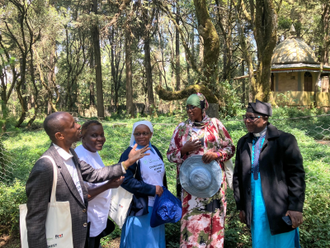
Church Forest Academy field visit. Photo: EOC-DICAC
In Ethiopia, much of what is left of the native highland forest stands around churches. Organizers of the new Church Forest Academy count about 35,000 church forests, from one hectare to 19,000 hectares in size. From 27 October to 3 November, faith leaders and practitioners from Kenya, Ethiopia, Uganda, Tanzania, and Nigeria are learning how these forests survived. They are also exploring how the same care can restore tree cover in their own communities.
The Ethiopian Orthodox Tewahedo Church, a World Council of Churches member church, launched the Academy on 26 October in Addis Ababa. It works through its Development and Inter-Church Aid Commission, together with OikoDiplomatique, a consultancy based in Nairobi, Kenya. Bread for the World (Germany) and private philanthropy fund the course.
Prof. Abba Hailegebriel Girma, academic vice president of Ethiopian Orthodox Tewahedo Church Holy Trinity University, declared the academy open on behalf of the church. Clergy and monastics have cared for these forests with local communities for generations, he said, and the forests have "preserved Indigenous vegetation, supported biodiversity, protected soil and water, and provided places for prayer and contemplation."
He was just as clear about the danger: "agricultural expansion, grazing, settlement, and wood extraction threaten many of these sacred landscapes." Conservation, he added, "should therefore promote climate justice, protect livelihoods, and involve women, young people, and local communities in decision-making."
The course opens amid renewed conflict in the north of Ethiopia and an El Niño expected to bring drought to some parts of the country and floods to others, the organizers say. El Niño is an unusual warming of the central and eastern Pacific Ocean that shifts rainfall around the world. The organizers see the forests as places of sanctuary, a heritage shared by the Amhara, Tigrayan, Oromo, Eritrean, and other peoples. OikoDiplomatique links their care to environmental peacebuilding: using shared care for land and forests to rebuild trust between communities.
Rev Dr Samuel Kobia, founder of OikoDiplomatique and former WCC general secretary, gave the keynote address. He called the church forests Śənä Fəṭrät, the "Islands of Eden." He said the communities least responsible for carbon emissions suffer the consequences first, and he turned to the churches of the industrialized world, his own ecumenical household included. "We who have preached the gospel of abundance must now sit at the feet of those who have practiced the gospel of restraint. This is not charity; it is repentance."
For Kobia, the forest canopy is "the ultimate ecumenical cathedral, where our shared humanity and shared vulnerability compel us to speak with one prophetic voice." He also placed women at the centre. "Across our continent, it is women who save seed, tend soil, and carry water," he said.
The group mixes faiths. It includes Catholic sisters, a Muslim sheikh, Protestant clergy, a philosophy lecturer, staff of faith-based organizations, and land restoration practitioners. They will learn about natural regeneration and eco-theology from Ethiopian experts, and stay with Orthodox monastic communities that look after church forests. Natural regeneration means letting trees regrow from roots and seeds in the soil, not planting seedlings. Eco-theology is Christian thinking about God's relationship with the natural world and the people in it.
Kobia ended with a hope for the next ten years. He wants to see new green circles on the maps of the countries taking part and beyond, "planted by Muslim hands and Christian hands and hands that belong to no tradition but honor the earth."
Through the Ecumenical Decade of Climate Justice Action (2025-2034), the WCC has committed to strengthening the voices and the work of local churches around the world as they protect creation. Its theme for 2026 is climate and biodiversity.
 Facebook
 Twitter
 LinkedIn
 Print
 Email










 Facebook
 Twitter
 YouTube
 LinkedIn
 Pinterest