

Pope Leo: 'Peace cannot be built by treaties alone'
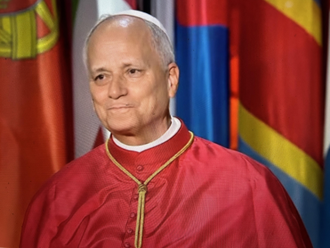
Pope receives warm welcome at UNESCO
Source: Vatican Media
On the first day of his Apostolic Journey to France, Pope Leo XIV returned to UNESCO 46 years after St John Paul II, calling for a renewed commitment to peace, truth and human dignity and warning that scientific and technological progress, when separated from ethics, can become an instrument of domination and destruction.
Addressing representatives of Member and Observer States, international organisations, academia and civil society on Friday afternoon, the Pope described UNESCO as a place where humanity can "reflect on itself, on its history and on its future."
Pope Leo XIV's address echoed that of St John Paul II, who became the first Pope to speak at UNESCO when he visited its Paris headquarters on 2 June 1980.
Forty-six years later, Leo XIV recalled his predecessor's words that "man lives a truly human life thanks to culture." The Holy See, he noted, has maintained a Permanent Observer Mission to UNESCO since 1952, and next year will mark 75 years of its presence at the organisation.
The Holy See, he continued, views UNESCO as a "privileged partner" in the service of the common good, particularly because authentic human development must concern "the development of each man and of the whole man."
At the heart of Pope Leo's address was a question he said every culture and every generation must confront: "What does it mean to be human?"
He linked that question directly to education, arguing that education cannot be reduced to the acquisition of skills or material advancement. "No education can be considered complete if it fails to address the question of life's meaning," he said.
The Pope reflected on the vulnerability shared by every human being, beginning with birth, noting that every person is born as a child, dependent upon others, and therefore enters the world within a relationship of care and responsibility.
"We are all born naked and in need," he said, describing humanity as dependent upon "bread and words, of care and affection."
If we forget this common experience, he added, we risk turning human life into a commodity rather than recognising it as a gift and responsibility.
The Pope devoted particular attention to the challenges posed by technology and artificial intelligence. He warned of a paradox in contemporary society: while increasingly sophisticated computational systems are described as possessing "intelligence," human beings themselves can be judged according to their efficiency and productivity.
"While 'intelligence' is attributed to computational systems," he said, "we struggle to recognize the inalienable dignity of human persons."
Artificial intelligence, he continued, can process and correlate vast quantities of information, but it cannot answer questions concerning the meaning of human life, which is rooted in lived experience.
He welcomed UNESCO's Media and Information Literacy initiative, which promotes responsible engagement with media and digital technologies, and called particular attention to children and young people.
"In the digital age, their vulnerability must never become an opportunity for exploitation," he said, urging that technology instead support their education, relationships and freedom to think and discern.
Turning to UNESCO's founding principles, Pope Leo recalled the words of the organisation's 1945 Constitution: "Since wars begin in the minds of men, it is in the minds of men that the defences of peace must be constructed."
Those words, he said, remain relevant eight decades after UNESCO was founded in the aftermath of the Second World War.
Scientific progress, when separated from wisdom, can become a weapon, while culture subjected to ideology, he explained, can descend into propaganda and education detached from truth can become a means of manipulating consciences.
"Peace cannot be built by treaties alone," the Pope maintained. Rather, genuine peace must arise from justice and from an "upright will" capable of recognising another person as "a brother or sister, a person like oneself."
Pope Leo used two biblical images to describe contrasting approaches to human coexistence: the Tower of Babel and Pentecost: Babel, he said, represents a unity imposed through domination, while Pentecost points towards a unity that does not erase diversity.
"Communion in no way suppresses diversity," he said. "Rather, it enables diversity to flourish in the harmony of voices and faces."
In a world capable of instant communication across continents, the Pope noted, communication has nevertheless not necessarily become more truthful. "Information is abundant, but it is not synonymous with wisdom," he said.
Without a shared ethical foundation, he warned, communication technologies can multiply false information and hinder rather than foster dialogue.
Pope Leo also addressed the difficulties confronting international institutions, noting that they are increasingly expected to respond to problems that no individual State can resolve alone while at the same time facing questions about their effectiveness.
In that context, he identified a virtue he said is "as greatly desired as it is rarely found": trust.
"Trust that differences do not necessarily constitute a threat; trust that honest dialogue can bring about a greater good than what individuals could achieve on their own," he said. The Holy See, he added, wishes to strengthen that trust in UNESCO and other international organisations.
The Pope concluded by linking education, science and culture to the work of peace, describing every child born into the world as a sign of hope and every person dedicated to the search for truth as performing "an act of hope."
"If all of us are firmly committed to the grandeur of our common humanity," he said, "peace can finally flourish."
Read the full text of Pope Leo's address:
www.vatican.va/content/leo-xiv/fr/speeches/2026/september/documents/20260925-francia-sede-unesco.html
Watch the Vatican Youtube film of the visit: www.youtube.com/watch?v=XIbOLh3lPD0
 Facebook
 Twitter
 LinkedIn
 Print
Print Email
Email













 Facebook
 Twitter
 YouTube
 LinkedIn
 Pinterest