

Sunday Reflection with Canon Robin Gibbons: 23 August 2026
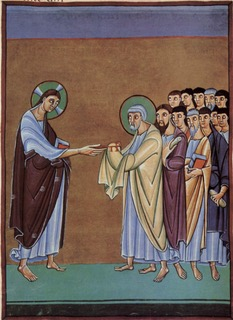
Meister des Perikopenbuches Heinrichs II - Wiki Image
Twenty-first Sunday in Ordinary Time
Lectionary: 121
We can learn a lot by sometimes taking a metaphorical journey into the great books of Civilisation. All of them have something to offer us no matter who we are or where we come from. In fact leaving the safety and security of the familiar and taking the time and trouble to explore and enjoy the great Classics can open for us some surprising gifts of great and profound wisdom, which often shed light on, or underline insights we find in our beloved Holy Scriptures. Knowledge is certainly power, or as a contemporary translation of Proverbs 24 : 5 puts it, "Wisdom brings strength, and knowledge gives power." This is an important point to remember given the context of our first and gospel readings this Sunday. We hear how both Eliakim and Cephas/Peter are given supreme administrative authority under the king for Eliakim, and the Christ for Peter. Whatever they open or shut cannot be undone by others, the keys symbolizing the 'delegated' power from the All Holy One. This is given in order to provide stable leadership in God's name. It is a reflection of the absolute but loving authority of God with us in the context of the Kingdom, but this authority is not theirs alone, it is delegated and shared in the context of ministry and it is used for service.
It is a fact of life that in our present age there are dissonant voices purporting to come from the Church calling us to listen to them as true. Unfortunately they are good at catching attention particularly at the moment, by using the social media networks sometimes claiming to be 'traditional' Catholics dissatisfied with this or that, often openly challenging the teaching office of Pope Francis and Pope Leo XIV, sometimes in strongly impolite language. They tend to suggest that the Second Vatican Council was somehow flawed and that all we need to do is return to a different moment in time when all was secure and clear. But beware of these voices, they have good 'sound bites' and use clever visual elements to get their message across, but they need to be carefully challenged to test their theories, constantly discerned to see if they have a deep relationship to the exciting, living and loving God. Do they affirm the true power of the keys and the clear authority of God's truth and love found in the living community of the baptised, or do they try to cause dissention, unease in the sense of negativity, fracturing communities and relationships? It is good to remember that an awakened conscience is vastly different from manipulated guilt trips with their stress on separation and sin! We require clear discernment to circumnavigate these siren voices.
In Book XII 36-110 of Homer's Odyssey, Circe tells Odysseus to beware of the Sirens as they will call him to destruction: "Next you will come to the Sirens who beguile all (men) that approach them. Whoever encounters them unawares and listens to their voices will never joy at reaching home, his wife and children to greet him. Instead the Sirens' tempt him with their limpid song." Odysseus does exactly as Circe suggests and in Book XII 165-200 passes by the Sirens in his boat, hears them, but remains safely outside their dangerous and seductive power. This can only do with fore knowledge of their dangerous qualities, and with careful preparation for himself by having the crew firmly bind him to the mast and ignore any request for his unbinding, and by plugging the ears of his crew with wax in order to resist the Sirens song: "… (the Sirens)..began their clear singing: "Famous Odysseus, great glory of Achaea, draw near, and bring your ship to rest, and listen to our voices. No man rows past this isle in his dark ship without hearing the honeysweet sound from our lips. He delights in it and goes his way a wiser man. We know all the suffering the Argives and the Trojans endured, by the gods' will, on the wide plains of Troy. We know everything that comes to pass on the fertile Earth."(Homer: The Odyssey - Book XII )
There is something valuable in this story of the Sirens that is a clear warning for us as we navigate our own way in the Barque of Peter, for there are voices that will lead us into places we should not go, or call us off the gospel path. Both Eliakim and Peter are directly called by God, as the Lord says to Shebna :" I will thrust you from your office and pull you down from your station.
On that day I will summon my servant Eliakim,* son of Hilkiah".(Isaiah 22: 19,20)
Peter too has this call from Jesus:" He said to them: "But who do you say that I am?" Simon Peter said in reply: "You are the Messiah, the Son of the living God."Jesus said to him in reply, "Blessed are you, Simon son of Jonah. For flesh and blood* has not revealed this to you, but my heavenly Father".(Mt 16 :15-17) Any delegated authority from God comes not through power, valour or virtue, but through a living and loving relationship, and the rock of secure faith, which is built upon the weakness of the sinner returning home to the rock of mercy and forgiveness!
The Petrine Office in the Catholic Church has evolved over time, it has also had its bad moments for it exists in real life not a film set! In recent years the Office of Peter has been understood more in terms of service and confirming the brothers and sisters of the Church in faith, but done with others. We cannot go back to the imperial past, for as LP Hartley wrote in his novel The Go-Between: "The past is a foreign country; they do things differently there." We can learn from it, take counsel from its great works, be inspired by its art and music but as the Scriptures teach us, we must go forward to the fullness of the Kingdom holding fast to our encounter with Christ in Word and Sacrament. We do this in the context of our living community, which we call 'Church' and to which we belong through baptism and confirmation as full active members, distinguished only by our various gifts and tasks.
The Keys of the Kingdom and the power to bind and loose are used to build up all the baptised into the One Body of Christ through our varied ministries of service in Charity and Love. It is as Lumen Gentium states:"Though they differ from one another in essence and not only in degree, the common priesthood of the faithful and the ministerial or hierarchical priesthood are nonetheless interrelated: each of them in its own special way is a participation in the one priesthood of Christ." (LG 2:10) This is part of our scriptural message this Sunday, a mystery of God at work through each one of us, priest and people, bishop and religious, but it is also a mystery of love at work in the Christ of all, just as Romans puts it: "For from him and through him and for him are all things. To him be glory forever. Amen." (Romans 11: 36)
Lectio
Lumen Gentium - Chapter II
10. Christ the Lord, High Priest taken from among men,(100) made the new people "a kingdom and priests to God the Father".(101) The baptized, by regeneration and the anointing of the Holy Spirit, are consecrated as a spiritual house and a holy priesthood, in order that through all those works which are those of the Christian man they may offer spiritual sacrifices and proclaim the power of Him who has called them out of darkness into His marvellous light.(102) Therefore all the disciples of Christ, persevering in prayer and praising God,(103) should present themselves as a living sacrifice, holy and pleasing to God.(104) Everywhere on earth they must bear witness to Christ and give an answer to those who seek an account of that hope of eternal life which is in them.(105)
Though they differ from one another in essence and not only in degree, the common priesthood of the faithful and the ministerial or hierarchical priesthood are nonetheless interrelated: each of them in its own special way is a participation in the one priesthood of Christ.(2*) The ministerial priest, by the sacred power he enjoys, teaches and rules the priestly people; acting in the person of Christ, he makes present the Eucharistic sacrifice, and offers it to God in the name of all the people. But the faithful, in virtue of their royal priesthood, join in the offering of the Eucharist.(3*) They likewise exercise that priesthood in receiving the sacraments, in prayer and thanksgiving, in the witness of a holy life, and by self-denial and active charity.
11. It is through the sacraments and the exercise of the virtues that the sacred nature and organic structure of the priestly community is brought into operation. Incorporated in the Church through baptism, the faithful are destined by the baptismal character for the worship of the Christian religion; reborn as sons of God they must confess before men the faith which they have received from God through the Church (4*). They are more perfectly bound to the Church by the sacrament of Confirmation, and the Holy Spirit endows them with special strength so that they are more strictly obliged to spread and defend the faith, both by word and by deed, as true witnesses of Christ (5*). Taking part in the Eucharistic sacrifice, which is the fount and apex of the whole Christian life, they offer the Divine Victim to God, and offer themselves along with It.(6*) Thus both by reason of the offering and through Holy Communion all take part in this liturgical service, not indeed, all in the same way but each in that way which is proper to himself. Strengthened in Holy Communion by the Body of Christ, they then manifest in a concrete way that unity of the people of God which is suitably signified and wondrously brought about by this most august sacrament
Text from the Homily of His Holiness Pope Benedict XVI at the Mass, Imposition of the Pallium and Conferral of the Fisherman's Ring for the beginning of the Petrine Ministry of the Bishop of Rome - St Peter's Square - Sunday, 24 April 2005
…Only when we meet the living God in Christ do we know what life is. We are not some casual and meaningless product of evolution. Each of us is the result of a thought of God. Each of us is willed, each of us is loved, each of us is necessary. There is nothing more beautiful than to be surprised by the Gospel, by the encounter with Christ. There is nothing more beautiful than to know Him and to speak to others of our friendship with Him. The task of the shepherd, the task of the fisher of men, can often seem wearisome. But it is beautiful and wonderful, because it is truly a service to joy, to God's joy which longs to break into the world.
Here I want to add something: both the image of the shepherd and that of the fisherman issue an explicit call to unity. "I have other sheep that are not of this fold; I must lead them too, and they will heed my voice. So there shall be one flock, one shepherd" (Jn 10:16); these are the words of Jesus at the end of his discourse on the Good Shepherd. And the account of the 153 large fish ends with the joyful statement: "although there were so many, the net was not torn" (Jn 21:11). Alas, beloved Lord, with sorrow we must now acknowledge that it has been torn! But no - we must not be sad! Let us rejoice because of your promise, which does not disappoint, and let us do all we can to pursue the path towards the unity you have promised. Let us remember it in our prayer to the Lord, as we plead with him: yes, Lord, remember your promise. Grant that we may be one flock and one shepherd! Do not allow your net to be torn, help us to be servants of unity!
 Facebook
 Twitter
 LinkedIn
 Print
Print Email
Email















 Facebook
 Twitter
 YouTube
 LinkedIn
 Pinterest