


Book: How Catholics Encounter the Bible
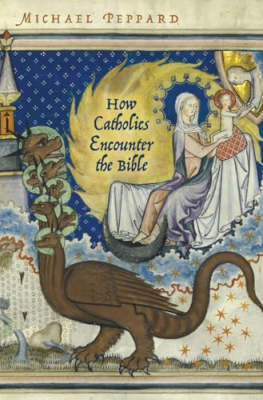
How Catholics Encounter the Bible by Michael Peppard.
Publisher: New York, Oxford University Press, 2025
ISBN 9780190948696
Michael Peppard is the American son of an Evangelical Protestant mother, who read her Bible every day, and a practising Catholic father who never opened the book but was satisfied with being able to say, "I know the stories." Perhaps to his own surprise, the author, now a Catholic Bible scholar, eventually realised that "my childhood was not half-empty of the Bible, but completely full - and deeper than I had imagined."
The difference between his parents - and the fundamental distinction between Catholics and Sola Scriptura Protestants - is that Catholics receive the Bible as mediated by lectionary, liturgy, art and music; in other words by the whole life of the Church. Catholics - when they really embrace their faith - are people who enter into the story, developing a Biblical and sacramental imagination that goes beyond words on a page.
How Catholics Encounter the Bible is an exploration of how "biblical stories infuse Catholic life, even though the textual correspondences are not always made explicit." The word 'Encounter' is key in this. Peppard explores how the Bible is encountered in Catholic Worship (notably through the Sunday lectionary), in the celebration of life-events (from baptisms to funerals), in art and architecture and then out beyond the church doors by Catholics working in the secular arena.
While visitors to a Catholic church might struggle to find a Bible in the pews they might well come across a reproduction of Michelangelo's Pietà, a scene which has no direct scriptural warrant (Jesus' mother not being mentioned in the Gospel accounts of Jesus' burial by Joseph of Arimathea) but is biblical through and through - a meditation on the Saviour's death which takes us back to his birth, tying together incarnation and salvation.
In some ways the most substantial section of the book is its critique of the Sunday lectionary. Our liturgical reading of the Old Testament leans heavily on a few prophetic books, leaving much of the Torah and Wisdom tradition un-read. Instead of reading stories at length, short passages are wheeled out, often merely to foretell what will be fulfilled (or superceded) with the coming of Christ. The risk of cutting the Church off from its Hebrew roots, repeating Marcion's wrong-turn, still lurks in this impoverished approach, even if since Vatican II we have all become accustomed to acknowledging Abraham as our Father in Faith. Catholic clergy in particular should wrestle with Peppard's chapter on 'The Old Testament and the Gospel' in search of a more adequate approach to the Mosaic Covenant. Sadly, the 2008 Synod on The Word of God's recommendation, that "an examination be carried out of the Roman Lectionary to see if the current selection and ordering of the readings is truly adequate to the mission of the church in this historical moment" seems to have landed on the 'too difficult' pile.
Peppard also builds on Regina Bosclair's analysis of the ways in which the lectionary consistently sidelines women. Thus the role of the Hebrew midwives in the Exodus story is airbrushed out while, in the New Testament, the key encounter of Mary Magdalene with the Risen Lord is never heard on a Sunday. Again, "None of the key women partners in Paul's ministry appear in the Sunday lectionary." Phoebe, the 'Deacon' of Cenchreae, whom the apostle entrusted with his key letter to the Romans, doesn't even make it to weekday Mass. Peppard's concludes: "the Bible may be an androcentric book, but sadly, the Catholic lectionary is worse."
After this critique, Peppard takes readers on a wideranging tour of prayer and devotions, the history of Christian art and, far too briefly, 'Poetry, Fiction, Song and Screen' (leaping from Dante to Flannery O'Connor, Bruce Springsteen, Mel Gibson, Martin Scorsese and a TV drama called 'Daredevil' - which you've either heard of or your haven't) before a final round-up of that apparently minority pursuit among Catholics, 'Bible Study and Scholarship', which offers a useful tour of significant papal documents and developing Catholic attitudes to Scripture. Peppard finally ends up where the Rosary begins, at the Annunciation: "It embodies how Catholic traditions can use a few verses to refract, like a prism, manifold meanings in prayer, imagination and doctrine. When we look at the many afterlives of this short story, we see that the Catholic tradition is indeed full of the Bible." Overall, this is a rich and rewarding read, leaving the Catholic imagination with much to meditate on.
Canon Rob Esdaile is Parish Priest of Woking & Knaphill
 Facebook
 Twitter
 LinkedIn
 Print
Print Email
Email











 Facebook
 Twitter
 YouTube
 LinkedIn
 Pinterest