
Fr Yacoub Rafidi with Friends of the Holy Land at WeBelieve
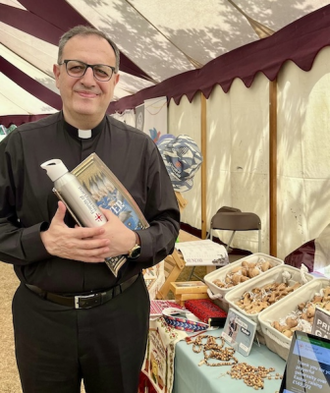
Fr Yacoub Rafidi at WeBelieve
Fr Yacoub Rafidi in conversation with Edmund Adamus and Brendan Metcalfe Friends of the Holy Land recorded at the WeBelieve festival for Radio Maria.
Charlotte (Radio Maria): This upcoming session is very special. It is called 'What's Going On in the Holy Land?' The Holy Land often reaches us through headlines, statistics and political arguments. This afternoon, we have the privilege of hearing directly from someone for whom it is home.
Father Yacoub Rafidi was born in Ramallah and ordained a priest of the Latin Patriarchate of Jerusalem in 1996. His ministry has taken him through parish life in Jordan, advanced study in Rome, and four years as rector of the Latin Patriarchal Seminary in Beit Jala.
Today, he is parish priest of Holy Family Church in Ramallah, director of the Latin Patriarchate Schools in Palestine, and secretary general of the Christian Educational Institutions in Palestine.
Joining him in conversation are Edmund Adamus, advocacy and engagement manager for Friends of the Holy Land, and Brendan Metcalfe, chief executive of Friends of the Holy Land. Friends works alongside Father Yacoub and other Christian institutions across the region to provide immediate relief and longer-term practical support. We hope this conversation helps us understand not only what Christians in the Holy Land are facing now, but also what faith, education and genuine Christian solidarity can make possible. Thank you so much for joining us.
Edmund Adamus: Thank you, Charlotte, for those kind words of welcome and invitation, and thank you all for taking the time and trouble to come. In this important conversation, I'd like to address a question to Father Yacoub first. You have been a priest and historian, a teacher, a seminary rector, and now leader of your home parish in Ramallah. What has it been like serving the people of your parish? Not just in recent times, but over the years, what is daily life like for Christians generally in the Holy Land?
Fr Yacoub Rafidi: Good evening, everybody. Life in the Holy Land is not normal, as you know and see on television. We have been in a bad situation for three years, since the beginning of the war, and our people are living through a very hard situation politically, economically and in daily life. We hope that Jesus, our peace, will give us real peace in the land blessed by his presence. But it is a difficult time for our people. There is a lot of fear, many restrictions on movement and a serious economic crisis. Thousands of people have not received their salaries; government employees receive only 20 per cent of their salaries. There is no tourism and no pilgrimage. Many people and many Christian communities depend on tourism and pilgrimage in the Holy Land. They work in hotels and restaurants and make souvenirs. They have struggled for over five years in reality, firstly with the ban on travel due to covid for 2 years then a brief respite for a year but the building momentum completely stopped by the onset of war in October 2023. At the moment very few people come to visit the Holy Land. It is sad to see the Holy Sepulchre and the Church of the Nativity without pilgrims. It is really very sad.
Edmund Adamus: Unemployment, and helping to address its challenges-especially among young people and young adults-is a major part of the mission of Friends of the Holy Land. Your area of expertise has long been education, particularly Christian education and Christian schools. How important is the provision of a Christian education for the Christian population? How crucial is it in the wider landscape?
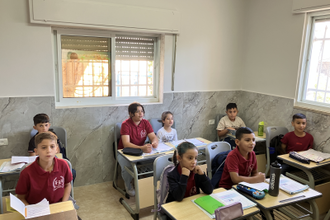
Fr Yacoub Rafidi: As you said, I am the general secretary of the Christian schools in Palestine: about 65 schools. These are pastoral schools, and the majority are beside churches. They have a wonderful role in the life of the Church. You see priests, sisters and catechists giving lessons, as well as Masses and rosaries. It is a Christian school and it is very important for our communities. When Patriarch Valerga re-established our patriarchate, he had two priorities. The first was the seminary, because without clergy there is no Church, and he also established schools, because the school makes the parish. Since then, we have had parish schools and pastoral schools. They are for Christians, and 65 per cent of the pupils in our schools are Muslims. Christian values are present: respect, freedom, respect for the other and for difference, and building bridges in society. This is very important for Christian values and education.
Edmund Adamus: We can often overlook how central the Christian school is to the life of the Church in the Holy Land, as it is elsewhere. In a region traumatised by conflict and mistrust between communities, formation in Christian and Gospel values-the Gospel of peace-for everyone who attends, not only Christian pupils, is extremely important in building a future of peace.
Brendan Metcalfe: The Christian population in Palestine is only about one per cent of the population. If a Christian child has to go to a public school, the public schools are currently in complete disarray because the Palestinian Authority is not funded. Class sizes are large, usually about 50, and teachers are not being paid properly. When I was there in January, teachers were receiving about 30 per cent of their salary, and some had only just been paid for October. In that environment, a Christian child is part of a very small minority and will receive no grounding in their culture or faith. We believe strongly that it is important to help families send their children to a Christian school, regardless of their resources. Christian schools are independent and receive no government funding. The fees are relatively low-about £1,000 a year-but families still need time and help to make those payments. Friends of the Holy Land is currently funding 200 children in schools, and we want to do more. We have offices in Bethlehem, Ramallah and Jerusalem. Our team meets parents, assesses their needs, and works directly with the Christian schools Father Yacoub has described. One of our major programmes helps children receive a Christian education.
Edmund Adamus: That answers part of my next question to Father Yacoub. When parents come to you worried that, because of unemployment or irregular income, they cannot meet the fees, what is your response? Friends of the Holy Land can help, but pastorally, how do you support them?
Fr Yacoub Rafidi: Our schools are for Christians first of all, so nobody should have to leave. We have a committee in every school. If we find a family that really needs help, we deal with it. We ask friends from all over the world, especially Friends of the Holy Land. This help enables us to continue our mission, to give poor people the right to education, and to keep our schools running. We have many employees, educators and teachers who need salaries, so that they can live with dignity as educators.
Edmund Adamus: It is not only about good studies and academic resources. Christian education is formation: formation not only of a good disciple of the Lord, but of a good citizen. Good citizenship serves the common good and builds bridges. The risk that deprivation poses to Christian education in the region is therefore very serious, and we must help as much as possible. Brendan, would you say more about the essential place of Christian education in the life of the Church there?
Brendan Metcalfe: The schools are embedded within parishes, and there are activities around them. Nearly every school and parish I visit has a Scout group, designed to help young people use their time well, be useful and give back to the community. These children are seeing daily intimidation. I was there in January and saw intimidation first-hand, as well as some violence. In that environment, there are many pressures on children to go astray or to be directed in a way that is not within our Christian ethos. Muslim parents also choose Christian schools because they want their children educated within a Christian ethos, to see positivity in life and perhaps avoid the grip of radicalisation. That is very important.
Brendan Metcalfe: The schools are also one example of the wider contribution of Christian organisations. The Christian community in the Holy Land has diminished-from around 20 per cent in the late 1940s, as Father Yacoub said at Mass, to less than one per cent in Palestine today. Yet Christian-run organisations operate schools, hospitals, clinics, welfare centres and mother-and-baby services. Friends of the Holy Land is one of those organisations because we are registered as a charity in the Holy Land. Together, Christian-run organisations are the third-largest employer in the country, after the government and UNRWA. They employ about 11,000 people, the majority of whom are not Christian. Their outreach reaches almost 50 per cent of the population in a variety of ways. In the midst of adversity, they provide an extraordinary amount of help. We need people to fund this work.
Edmund Adamus: That is the wonderful thing about the life of the Church everywhere, but particularly in the Holy Land. The scale of deprivation and adversity is immeasurable, yet the provision of welfare, education, health and medical aid punches above its weight in ways that can only be attributed to the grace of the Holy Spirit. It is a remarkable witness to the Gospel. The Holy Land is the only place on earth where Christianity was not imported. It is the cradle of our faith, and that makes it unique. Would either of you like to say something about that unique aspect of Christianity there?
Fr Yacoub Rafidi: For us, as the Church of Jerusalem, it is a great responsibility to be the continuation of the mission of Jesus in his land. Friends of the Holy Land and friends from all over the world help us to continue this mission and to keep the light of faith alive in the land that Jesus blessed.
Brendan Metcalfe: I am often shocked when I meet people who have been Christians for many years, perhaps even in ministry, but have never been to Jerusalem, Nazareth or Bethlehem. The Holy Land is sometimes called the fifth Gospel. People who visit, see and experience it often return with their faith completely reinvigorated and with a new understanding of Scripture. They also meet people such as Father Yacoub, whose heritage can be traced back to Pentecost. In services in Jerusalem, including at the Holy Sepulchre at Easter, families carry banners showing their heritage back to the beginnings of Christianity. Despite all the adversity, people say: 'We are witnesses to Christ here, and we witness here for Christians around the world.'
Brendan Metcalfe: The sad thing is that Christians in the West have, to some extent, forgotten them. Without any judgement or disrespect to other places, I see hundreds of people visiting Lourdes every year, but fewer going to Jerusalem and walking the Via Dolorosa to Calvary. We need to remind Christians that a Christian community is still very much alive in these places. There are Christians in Gaza. At the time of this conversation, about 600 Christians were sheltering in Holy Family Catholic Church and St Porphyrius Greek Orthodox Church. Their homes had been destroyed and their lives put on hold, and they were being supported by the Latin Patriarchate and others. They are often forgotten and not spoken about in the news. We need to think about how we can pray for and support these founding communities of our faith. Some people ask an Arab priest, 'Father, when did you convert?' Have they not read the account of Pentecost, where Arabs were among the first to hear the word? We must re-engage, re-energise and show solidarity with these people.
Edmund Adamus: It is important to remind ourselves that fellow Christians born and raised in the Holy Land trace their roots back to the Apostolic age and Pentecost. They feel a strong calling from God to be in that place and witness to the light of the Resurrection in circumstances that have often been dark. They regard that opportunity to witness as a profound honour. Because they are witnessing in such troubled times, they are also doing it on our behalf. Any act of solidarity-prayer, becoming better informed, or supporting organisations such as ours-is never in vain. It brings great consolation to know they are not forgotten, but remembered and cherished. To cherish means to bear someone deeply in mind. Let us consider how we can help Christians in the Holy Land feel cherished.
Edmund Adamus: Brendan, could you share something of the outreach, projects and work of Friends of the Holy Land?
Brendan Metcalfe: I often say that we are very different, almost unique, although that is a hackneyed phrase for a charity. Because we are registered as a charity in the Holy Land, we can maintain offices in Jerusalem, Ramallah and Bethlehem, as well as our own bank account there. When people come to our offices, we can offer immediate help directly. We balance humanitarian assistance with work that helps people see hope for the future. Our work falls into three broad categories: humanitarian, developmental and healing.
Brendan Metcalfe: We have local Christian staff who interview and assess people, in the manner of social workers, and we are guided by a local Christian committee drawn from all traditions. Some are parish priests and colleagues of Father Yacoub are Fr Remon Hadded in Aboud and Fr Rami Asakrieh in Jerusalem. Priests and other leaders refer cases to us, and each month we provide help or place people on a programme. At the moment, we are spending £25,000 each month on medical support. People cannot afford basic medication for heart disease, diabetes and other conditions, so we pay for medicines.
Brendan Metcalfe: There is also enormous unemployment. I believe it is 300k since the war started, permits have been cancelled and those workers are unemployed. People who relied on tourism have been waiting for tourists to return since COVID. It is not only hotels and restaurants: it is souvenir makers, farmers who supplied vegetables, and people who cleaned linen. That economy has not functioned properly for almost five years. The Palestinian Authority is also broke, so even a public-sector job is not secure, with employees receiving only 20 to 30 per cent of their salary each month.
Brendan Metcalfe: We help people use their skills in the community. We employ people to repair homes and schools, and we support local NGOs that might otherwise close by helping to pay salaries. We help people-mostly women-set up small businesses with grants of around £5,000 for equipment. These include goat farms, egg production, honey farms, sewing and food businesses. The aim is to generate enough income to put food on the table.
Brendan Metcalfe: To provide hope for the future, we help students attend school and study vocational courses. At Bethlehem University, we support people training in nursing, where there is a shortage. At the other end of the scale, a Salesian college teaches practical skills such as mechanics, solar power installation and electrical work. We support 50 students each year and, at the end of some courses, provide a set of equipment. We also support vocational courses in hospitality and, recently, IT and coding, because people can work from home if they learn how to code.
Brendan Metcalfe: Our healing work includes summer camps, where children receive trauma support through churches across the West Bank. There have been increasing issues of trauma in the schools. Father Yacoub, could you say more about that?
Fr Yacoub Rafidi: Normally, about 20 per cent of pupils in our schools need special help. In the current situation, all students need special accompaniment because there is so much fear, uncertainty and trauma. Friends of the Holy Land helps us run programmes that help children to heal, and also teachers, because teachers and students are in the same situation. Thank you for your help with these camps.
Fr Yacoub Rafidi: I would also like to emphasize the positive things. We have spoken a lot about difficulties, but in these difficult situations there is also the grace of God. Our communities are very strong. They are attached to our churches and parishes, and this gives us a lot of hope for the future. We have good, strong families, and there is support between them. This helps us continue our work and our mission.
Edmund Adamus: That family solidarity-families supporting one another through hard times through their shared faith and discipleship-is a crucial part of the witness we give as the Church: the Body of Christ suffering, but also risen and glorified. I would like to return to pilgrimage. Father Yacoub, you were speaking earlier about Ramallah and its association with the village of Emmaus. Could you tell us a little about that historical connection?
Fr Yacoub Rafidi: Emmaus is near Ramallah, and Ramallah is also on the route towards Nazareth. The tradition of the Holy Family discovering that the young Jesus was not with them on their return journey is remembered by my parish, Holy Family Church. Nearby, a fifth-century Byzantine church also recalls this event. There are two traditions identifying Emmaus, including the Franciscan tradition at Qubeibeh near Ramallah, and there are ruins dating from the first century.
Edmund Adamus: Brilliant. Brendan, would you like to add anything?
Brendan Metcalfe: I have the great good fortune and privilege of visiting two or three times a year. I was last in the Holy Land in January and plan to return in early September. Every visit brings a different aspect of my faith in the journey that engages me. At the time of this conversation, the FCDO website described Bethlehem, Jerusalem and Nazareth as areas people could visit.
Fr Yacoub Rafidi: It is safe for you, absolutely. For us, no; but for you, it is very safe. Israelis will welcome you and Palestinians will welcome you. You are safe.
Brendan Metcalfe: My wife and I went to Bethlehem for Christmas, and it was an amazing experience. We were in Jerusalem beforehand and visited the Church of the Holy Sepulchre. Usually there is a long wait and a substantial queue, but there were only about 20 people in the church, so we had it almost to ourselves. I was able to explore places I would normally have great difficulty reaching, including the place of the tomb of Joseph of Arimathea down underneath. For those who feel able to go, the holy sites are not busy. I encourage people to travel with a properly licensed pilgrimage operator and to contact us, because we know people who would love to welcome you to their homes, schools and churches. A visit is not only about ancient holy sites; it is about engaging with the 'living stones', and we have a living stone sitting next to me.
The other side is this: if we do not stand in solidarity with these people, there may be no Christian communities left for the next generation, worshipping in the land where Jesus conducted his ministry, died, rose again and saved us. How terrible would that be? Jerusalem has about 1.1 million people today, but only roughly 6,500 Arabic Christians who can trace their heritage back to the founding of our faith at Pentecost, This is a crisis, an existential time for our brothers and sisters in the Holy Land.
I encourage you to be awake and aware. Register on our website for news you may not see in the media. You will hear about people such as Father Yacoub and be able to pray alongside Christians in the Holy Land through prayers and reflections written by local clergy and others. Share that awareness, because many people do not know what is happening. We would also love to visit your parish, speak to the congregation and explore how we can stand in solidarity so these communities remain. That would be a great gift to take away from today.
Edmund Adamus: Thank you, Brendan. We now host a monthly webinar on the fourth Monday of every month at 7.30pm. It is a 30- to 45-minute presentation about our work, how people can help, and how they can join the conversation. Details are available through Friends of the Holy Land.
As we draw to a close, it is fitting that the Jerusalem cross is on the wall behind us in the college quadrangle: a beautiful reminder that the Lord is always close as we try to discern wisely how to do God's will. I would like to conclude with a special prayer from our bookmark prayer card.
Heavenly Father, we lift our hearts in hope and gratitude. We pray for all our brothers and sisters living in Palestine, Jordan and Israel. Bless every effort, every step and every decision that supports the mission of Friends of the Holy Land. Grant wisdom, patience and perseverance to all involved. May peace, protection and strength surround those in need, and may your love guide every action. We ask this through our Lord Jesus Christ, your Son, who lives and reigns with you and the Holy Spirit, one God, for ever and ever. Amen.
Let us place the needs of all our fellow Christians under the maternal intercession of our heavenly Mother, Mother of Jerusalem, Our Lady of Palestine, Our Lady of Israel. Hail Mary, full of grace, the Lord is with thee. Blessed art thou among women, and blessed is the fruit of thy womb, Jesus. Holy Mary, Mother of God, pray for us sinners now and at the hour of our death. Amen. Thank you, and God bless you all. Thank you for listening.
Find out more about the work of Friends of the Holy Land at: www.friendsoftheholyland.org.uk/
 Facebook
 Twitter
 LinkedIn
 Print
Print Email
Email




 Facebook
 Twitter
 YouTube
 LinkedIn
 Pinterest