


Paul Grey, A New Odyssey - an essay in diplomacy
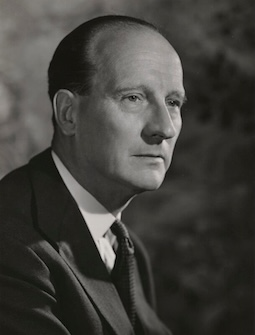
Sir Paul Grey - National Portrait Gallery - Creative Commons
What does a diplomat's musings have in common with a Homeric epic? Fresh from seeing the block-buster film, The Odyssey, I recently attended with curiosity the launch of diplomat Paul Grey's memoir, whose title echoes the Greek epic. Perhaps it was simply a history of his lengthy travels, I thought.
Unlike the blockbuster, Sir Paul Grey's book is not new, despite the name. He died in 1990, but my brother-in-law Nicholas Grey recently decided to edit and publish his father Paul's memoir, which had lain in a filing cabinet for over 30 years, before the typescript could be lost to posterity. Family and friends attended the July launch of 'A New Odyssey' at the family home in Elstead, Surrey. It is a gripping, if rather slow, read. Sentences are often long, though almost faultlessly constructed but patience is much rewarded. In 200 pages he reflects on a lifetime of public service with lively wit and wisdom.
Rather than a diary of his time in the Lisbon, Moscow, Prague or Berne embassies, this represents the distilled reflections of what it meant to practise diplomacy from an era before the death of Stalin to the days immediately before UK entry into the European Common Market. Nicholas writes, in his introduction,
'A main part of my father's memoirs describes his experiences and reflections on his very interesting time [in Moscow] as second-in-command of the Embassy. He was there for the two years leading up to Stalin's death. At the time of Stalin's death, the British Ambassador was away, and my father had to report to London on its likely implications. The American Ambassador sent an upbeat report; my father was much more cautious.'
Paul Grey went on, two years later, to become British Ambassador to Czechoslovakia in 1956 and in 1960, Ambassador to Switzerland, to finish his diplomatic career in 1964.
Paul's studies in Philosophy shine through, as he navigates his diplomatic way between the culture of the country he represents, and the culture of the country whose attitudes he must interpret to his masters in Westminster. Talking about the Russian revolutionaries' approach to the industrialisation they introduced with such ferocity, he writes,
'The Russian revolutionaries took the easy, and to them, the obvious way. They adopted most of the trappings of their [worst] predecessors. It was as if an English schoolboy were invited to become king, and chose as his model Henry VIII. It seems unlikely that an adult English tyrant today … would slip automatically into the techniques of repression employed by the Tudors. But it was quite natural that Stalin should assume the mantle of Ivan the Terrible'.
And he explores the European journey towards economic unity with sharp analysis, which would bear reflection today:
'The negotiations on British membership of the EEC may seem to be concerned with foodstuffs … but this is not at all what they are really about. The necessary should never be confused with the essential. What is at stake is whether there is such an entity as 'Europe' and, if so, whether it can be given a more precise shape than hitherto.'
'He certainly developed the essential skills of a diplomat, a fluency in European languages, an empathy and understanding of their histories, and their aspirations as nations and as people', his son commented. 'In any negotiation you reach a compromise, once you understand what is important to your negotiating partner.'
It was his classical references which interested me, however. At the end of Christopher Nolan's Odyssey, Matt Damon and Anne Hathaway as Odysseus and Penelope sail away into the sunset, to find peace and to honour the many dead casualties of the Trojan War. Paul hopes for a better Europe, as does Ulysses (Roman name for Odysseus) in the eponymous poem of Tennyson's.
'Some work of noble note may yet be done…. Come my friends, tis not too late to seek a better world'.
The Greek and Roman world are very present for Paul, who sees a metaphor for his own life in, particularly, the story of Odysseus. His life of service perhaps was a example to family and friends of that quest to seek a better world.
Of great importance therefore was Paul's dedication to his Catholic faith. A convert, quite unusually, through reading Thomas Aquinas, Paul Grey led a very active life in retirement with his service to the Church, a legacy his children have embraced. Nicholas lists his many services:
A trustee for Oxford University Catholic Chaplaincy as well as for The Tablet, a Knight for the Knights of Malta (his wife, Agnes was a Dame). Paul and Agnes helped with Meals on Wheels, and looked after the sick with the St John and St Elizabeth pilgrimage to Lourdes.
I have an unconfirmed recollection that he served on the first Justice and Peace Commission in England and Wales, set up in the early seventies. Certainly, he would have been consulted.
As a young activist in justice and peace issues I could not relate at the time to his vast scholarship and political experience, and had we been able to engage in discussion he would have corrected my simplistic views, whereby I saw the international stage in very black and white terms. He had limited experience of the global South, for instance (he does not write about his short time in Brazil during the war), and saw concerns about Africa or Asia as somewhat of a distraction from establishing peace in Europe. What I appreciate now however, is his dedication to hold to truth, and a concern for international understanding between peoples (a constant plea to 'respect the foreigner!) as a basis for peace. His section on propaganda makes very good reading today, as for instance, in his dry comment:
'Even quite intelligent and honourable men apparently do not see that to recommend themselves to the public by the devices used to promote pop-singers or packets of soap is to ignore the fact that, however admirable or indispensable singers or detergents may be, the qualities which the public require of them are not those for which they look in their political leaders'. A lesson for today!
Classicist to the end, he finishes the memoir with lines from Tennyson's Ulysses, illustrating his aspiration for a better world. Surely these lines also influenced Christopher Nolan, writer and director of The Odyssey, in his final shots of the hero heading towards the sunset,
'For my purpose holds
To sail beyond the sunset and the
baths of all the western stars, until I die….
Though much is taken, much abides; and though
We are not that strength which in old days
Moved earth and heaven, that which we are, we are.
One equal temper of heroic hearts,
Made weak by time and fate, but strong in will
To strive, to seek, to find and not to yield.'
For copies of the book please contact info@sarsenpress.co.uk tel: 01962 854281
 Facebook
 Twitter
 LinkedIn
 Print
Print Email
Email












 Facebook
 Twitter
 YouTube
 LinkedIn
 Pinterest