


Sunday Reflection with Canon Robin Gibbons: August 2nd 2026
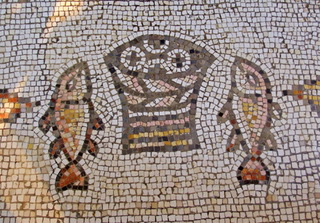
Church of the Multiplication of the Loaves and Fishes, Tabgha, Berthold Werner Wiki Image
Eighteenth Sunday In Ordinary Time
Lectionary: 112
1. The invitation of God
The enforced discipline of recuperation after my own operation has given me deeper benefits than simply the healing process with its periods of physiotherapy, exercise, relaxation and rest ( though I admit this last wasn't always painless!) There are the moments of thoughtful and quiet prayer , often wordless, what Simone Weil called in the title of her book: 'Waiting on God'. This isn't necessarily an active, known, time of waiting, it is simply the quiet space in a busy day, or that pause when we regard something that has caught our attention or made us think.
Weil puts it beautifully: "The beauty of this world is Christ's tender smile coming to us through matter." This smile of Christ is part of the invitation of God to gain our attention, for though we may seek God, the deeper truth is God is always seeking us. Isaiah tells us this in his very clear and evocative imagery:
" Thus says the LORD:
All you who are thirsty,
come to the water!
You who have no money,
come, receive grain and eat;
Come, without paying and without cost,
drink wine and milk!" (Is 55:1)
The invitation is direct and open, 'come' says the Lord God, but noy in any old fashion, for the invitation is to focus our whole attention and hear what God is inviting us to discover, a relationship that is covenantal, binding us to the Holy One despite our frailty, faults and failings! Isaiah lays it before us:
"Pay attention and come to me;
listen, that you may have life.
I will make with you an everlasting covenant".(Is 55:3)
This is an offer beyond any we can make, a generosity of immense and immeasurable love.
2. Listening to God
If we but take time to allow God into our hearts and minds our perceptions shift slowly at first, but always towards that lessening of scruple, removal of fear, the widening of our narrowness of vision. It becomes the discovery of a love at the heart of our deepest selves, a love this present world and Christianity desperately needs, but it requires of us the effort to truly listen with the ear of the soul. The monastic tradition teaches this little way, Benedict in the prologue of his Rule not only opens with the word 'Ausculta''listen' but then talks about the journey to knowing the Lord, as a movement from an initial stricture though reliance on the structure of rules towards the realisation of freedom in God's presence :' For as we advance in the religious life and in faith,
our hearts expand
and we run the way of God's commandments
with unspeakable sweetness of love".(RSB Prologue)
St Romauld, founder of the Camaldolese Benedictines, reminds us in his little Rule that this sweetness of love is the open-handed and generosity of God our mother ;
"Above all realize that you are in God's presence, like a little chick tasting and eating nothing but what its mother brings".(St Romuald, Little Rule)
In my own recent journey, pondering, thinking, letting go of inessential ideas, I realise just how true it is that we are held at all times in the hand and heart of God, without even being totally aware, but that this 'holding' permeates and shapes our actions, particularly including those times and areas of hardship, suffering and grief. This is the truth we hold on to, in the sure and certain hope of remaining covenanted to and with the Christ, it is as Saint Paul shares with us in the letter to the Romans a permanent bond of love : "For I am convinced that neither death, nor life, nor angels, nor principalities, nor present things,* nor future things, nor powers, nor height, nor depth,* nor any other creature will be able to separate us from the love of God in Christ Jesus our Lord".(Rm 8:28,39)
3. Encountering Jesus in grief
As an illustration of just how the presence of Christ is always with us, Matthew's story of Jesus' grief at John the Baptist's death provides us with some insight into the dynamic gift that Christ's love is. Normally at times of bereavement and loss we react exactly as Jesus does at first, we want to be alone, or at least in a safe space with those we love :'" When Jesus heard of the death of John the Baptist,he withdrew in a boat to a deserted place by himself".(Mt 14:13) This is a natural part of the process of grief and human loss, we need time and space to deal with the many different emotions, jesus shows us that this is right and proper, but in his own case, as in many of our own lives, grieving another is not about stopping the clock, holding time in a ransomed space where we do not allow the turning world entry. That is never the Christian answer to death, if love is God and God is immortal then the demands of love will take precedence over our personal grief, not by intrusion, but by complementarity, his grieving becomes a ministry of consolation.
Though he remains in a deserted place, crowds follow Jesus in his distress, and he seeing that they too have a greater need turns outwards, lets the empathy and love he has for his cousin propel him into the action of love. He has pity on them, he cures the living sick and he feeds the hungry. In a prefiguring of our Eucharist he takes bread, blesses it and gives it to his disciples to share with the crowds: "Taking* the five loaves and the two fish, and looking up to heaven, he said the blessing, broke the loaves, and gave them to the disciples, who in turn gave them to the crowds". Then we presume Jesus rests in the evening, to let the healing love of God assist his own sense of loss.
For me, as I hope for you, running throughout this story is the human quality of Jesus' as one like us, in loss grieving for his cousin, but, and it is a difficult 'but', it is also a step in faith that moves us from isolation to being able to turn that loss into a healing action full of hope for others, and for us a hope that we can touch and eat in those shared meals others give us but also the sacrament of the Holy Eucharist, where the fish that is Christ (ICHTYS) and the living bread that is his body. is given to us always by those who are his disciples.
I return to my friend Simone Weil and leave you with a small section of her writing, that, I think, sums up the ministry of jesus in the tale of his grief, and of how we can take from him the transformative gift of his spirit present to us : "The love of our neighbour in all its fullness simply means being able to say to him: "What are you going through?" It is a recognition that the sufferer exists…as a (hu) man, exactly like us, who was one day stamped with a special mark by affliction. For this reason it is enough, but it is indispensable, to know how to look at him in a certain way.
This way of looking is first of all attentive. The soul empties itself of all its own contents in order to receive into itself the being it is looking at, just as he is, in all his truth."
(Simone Weil, Waiting for God)
Lectio
Romans 8:35, 37-39
Brothers and sisters:
What will separate us from the love of Christ?
Will anguish, or distress, or persecution, or famine,
or nakedness, or peril, or the sword?
No, in all these things we conquer overwhelmingly
through him who loved us.
For I am convinced that neither death, nor life,
nor angels, nor principalities,
nor present things, nor future things,
nor powers, nor height, nor depth,
nor any other creature will be able to separate us
from the love of God in Christ Jesus our Lord.
St Romuald's Brief Rule
Sit in your cell as in paradise; put the whole world behind you and forget it; like a skilled angler on the lookout for a catch, keep a careful eye on your thoughts.
The path you must follow is in the psalms - don't leave it. If you've come with a novice's enthusiasm and can't accomplish everything you want, take every chance you can find to sing the psalms in your heart and to understand them in your head; if your mind wanders as you read, don't give up but hurry back and try again.
Above all realize that you are in God's presence, like a little chick tasting and eating nothing but what its mother brings.
 Facebook
 Twitter
 LinkedIn
 Print
Print Email
Email













 Facebook
 Twitter
 YouTube
 LinkedIn
 Pinterest