


Gospel in Art: Feast of Saint Mary Magdalene
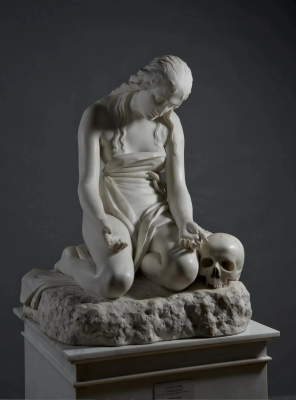
Repentant Mary Magdalene, by Antonio Canova, 1808, marble © Hermitage Museum, Saint Petersburg
Source: Christian Art
Gospel of 22 July 2026
John 20:1-2, 11-18
On the first day of the week Mary Magdalene came to the tomb early, while it was still dark, and saw that the stone had been taken away from the tomb. So she ran and went to Simon Peter and the other disciple, the one whom Jesus loved, and said to them, 'They have taken the Lord out of the tomb, and we do not know where they have laid him.'
Mary stood weeping outside the tomb, and as she wept she stooped to look into the tomb. And she saw two angels in white, sitting where the body of Jesus had lain, one at the head and one at the feet.
They said to her, 'Woman, why are you weeping?'
She said to them, 'They have taken away my Lord, and I do not know where they have laid him.'
Having said this, she turned round and saw Jesus standing, but she did not know that it was Jesus.
Jesus said to her, 'Woman, why are you weeping? Whom are you seeking?'
Supposing him to be the gardener, she said to him, 'Sir, if you have carried him away, tell me where you have laid him, and I will take him away.'
Jesus said to her, 'Mary.' She turned and said to him in Aramaic, 'Rabboni!' (which means Teacher).
Jesus said to her, 'Do not cling to me, for I have not yet ascended to the Father; but go to my brothers and say to them, "I am ascending to my Father and your Father, to my God and your God." '
Mary Magdalene went and announced to the disciples, 'I have seen the Lord' - and that he had said these things to her.
Reflection on the sculpture
Saint Mary Magdalene speaks to the restless seeker within each of us. Few human experiences are more universal than the longing to search for something that seems just beyond our grasp: happiness, peace, love, purpose, or God Himself. Beneath so much of our joy and sorrow lies this deep yearning of the human heart. In the Gospel for her feast, the risen Lord asks Mary, "Woman, why are you weeping? Whom are you looking for?" She weeps because she cannot find the One whom she loves. Her tears are the tears of every human heart that has experienced loss, absence, or the ache of an unfulfilled longing.
Yet Mary's search does not end in despair. The turning point comes when the risen Christ simply speaks her name: "Mary." In that single word, she recognises Him, and her grief is transformed into overwhelming joy. Even then, however, she must learn that she cannot cling to Jesus as she had known Him before. "Do not hold on to me," He tells her, for He is returning to the Father. From now on, He will remain just as close to her, but in a new and deeper way. This beautiful encounter assures us that although many of our earthly longings may remain unfulfilled, our deepest longing - for the Lord Himself - will never disappoint. Christ knows each of us by name and continues to call us into a relationship that neither death nor absence can destroy.
On this feast of Saint Mary Magdalene, we honour the woman who remained faithfully at the foot of the Cross and became the first witness of the Resurrection. Once wounded and searching, she was transformed by the boundless mercy of Christ into the joyful bearer of the greatest news the world has ever heard. For this reason, the Church honours her as the apostola apostolorum, the "apostle to the apostles", a title popularised by Thomas Aquinas, because she was sent by the risen Lord to proclaim His Resurrection to the disciples.
Antonio Canova's Penitent Magdalene captures our saint with extraordinary tenderness. Kneeling upon the ground, her head bowed and her body almost collapsing under the weight of sorrow, she seems utterly absorbed in prayer. Beside her rests a skull, the ancient Christian reminder of the passing nature of earthly life. In her hands she would have held a gilt-bronze cross (which has now been lost). The polished marble appears almost to breathe, conveying not only physical beauty but the quiet beauty of a heart that has surrendered itself entirely to God.
Perhaps that is why this sculpture continues to speak so powerfully today. Mary Magdalene teaches us that repentance is not about remaining imprisoned by our past, but about allowing Christ to transform it! Her tears are not the end of her story; they become the beginning of a new life. In her kneeling figure by Canova we recognise our own journey: laying down our burdens, holding a cross in our hands and allowing the Lord, who calls each of us by name, to raise us up.
LINKS
Christian Art: www.christian.art
Today's image: https://christian.art/daily-gospel-reading/john-20-1-2-11-18-2026/
 Facebook
 Twitter
 LinkedIn
 Print
Print Email
Email














 Facebook
 Twitter
 YouTube
 LinkedIn
 Pinterest