


Gospel in Art: Saint Apollinaris, Bishop, Martyr
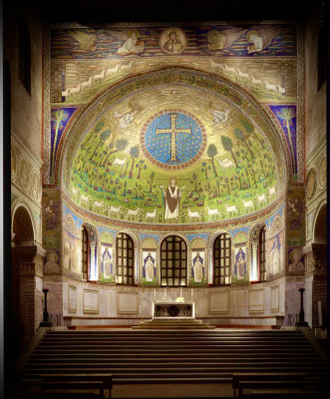
Mosaic of Saint Apollinaris, 6th century, © Sant'Apollinare in Classe, Ravenna
Source: Christian Art
Gospel of 20 July 2026
Matthew 12:38-42
At that time: Some of the scribes and Pharisees answered Jesus, saying, 'Teacher, we wish to see a sign from you.' But he answered them, 'An evil and adulterous generation seeks for a sign, but no sign will be given to it except the sign of the prophet Jonah. For just as Jonah was three days and three nights in the belly of the great sea creature, so will the Son of Man be three days and three nights in the heart of the earth. The men of Nineveh will rise up at the judgement with this generation and condemn it, for they repented at the preaching of Jonah, and behold, something greater than Jonah is here. The queen of the South will rise up at the judgement with this generation and condemn it, for she came from the ends of the earth to hear the wisdom of Solomon, and behold, something greater than Solomon is here.'
Reflection on the Early Mosaics
Today we celebrate Saint Apollinaris, the first bishop of Ravenna and one of the earliest great missionaries of the Western Church. He was born in Syria and became a disciple of Saint Peter, who sent him to northern Italy to proclaim the Gospel in the bustling Roman port city of Classis, near Ravenna. The Roman Martyrology describes him as a faithful shepherd who spread "the unsearchable riches of Christ" among the nations. His ministry was marked by perseverance in the face of opposition. Tradition tells us that he endured several periods of imprisonment, exile, and persecution, yet continued preaching with courage.
Eventually, Apollinaris suffered a glorious martyrdom, probably during the second century. Whether he died directly from his wounds or after years of hardship remains uncertain, but the Church has always honoured him as a martyr who gave everything for the faith. His legacy transformed Ravenna into one of the great Christian centres of the ancient world, renowned for its magnificent churches and dazzling mosaics that still bear witness to the triumph of the Gospel.
The great portrait mosaic of Saint Apollinaris in the apse of the Basilica of Sant'Apollinare in Classe captures this good shepherd in a remarkable way. He stands with arms outstretched in the very centre, in prayer, surrounded by a lush green landscape and a flock of twelve sheep, symbolising the Christian people entrusted to his care as a bishop. There is a serenity and order to the scene that speaks of heaven itself: the faithful shepherd standing peacefully among his flock, now free from the struggles and persecutions of earthly life. The mosaic reminds us that every Christian is called to guide others towards that eternal pasture where Christ, the Good Shepherd, gathers all his people into one.
According to ancient accounts, after converting many people in Ravenna, he was beaten so severely by his opponents that they carried him out of the city, assuming that he would die. Yet, once he had recovered, he quietly returned to his flock and resumed preaching as if nothing had happened. This cycle is said to have repeated itself several times throughout his life: suffering, exile, return, and renewed missionary zeal. When his friends urged him to flee for his own safety, he reportedly replied that a shepherd must never abandon the sheep entrusted to him.
LINKS
Christian Art: www.christian.art
Today's image: https://christian.art/daily-gospel-reading/matthew-12-38-42-2026/
 Facebook
 Twitter
 LinkedIn
 Print
Print Email
Email











 Facebook
 Twitter
 YouTube
 LinkedIn
 Pinterest