


Answering Pope Leo's call for nonviolence

Image: Pax Christi International
Source: Pax Christi International
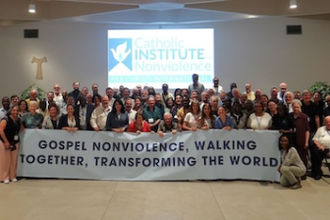
Last month, Marie Dennis (Pax Christi USA's 2022 Teacher of Peace) and Pace e Bene's Ken Butigan, the co-directors of the Catholic Institute for Nonviolence (a project of Pax Christi International), joined Catholic Nonviolence Initiative director Nicolás Paz in Rome facilitating the institute's seminar 'Answering Pope Leo's nonviolent appeal. The event featured scholars of strategic nonviolence Kathleen Gallagher Cunningham (University of Maryland), Jonathan Pinkney (University of Texas), and Cecile Dubernet (Catholic University of Paris). See more about the seminar here.
Marie, Ken, and Nicolás also met with Vatican officials, as Pope Leo held an Extraordinary Consistory (a meeting of 178 cardinals from around the world) In Rome from June 26-27 focused on "affirming that the just war theory is out of date."
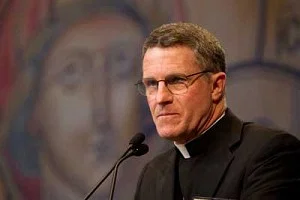
At the conclusion of that historic Extraordinary Consistory, Pope Leo XIV highlighted the importance of the "nonviolent response to the many forms of violence," signalling a growing shift from the traditional "just war" theory.
Over the course of the two-day meeting, cardinals from around the world reflected on the roots of contemporary conflict, which the Pope noted lie in a culture of power. Pope Leo declared that "war is never blessed by God," while Cardinal Víctor Manuel Fernández, prefect for the Dicastery for the Doctrine of the Faith, warned that the Church's social teaching has too often been "manipulated to provide a theoretical foundation for the most unjust wars."
In his concluding address, Pope Leo declared: "I… found particularly valuable the way some of you addressed the theme of the nonviolent response to the many forms of violence. It is a profoundly evangelical way of living in history, the fruit of contemplating Jesus's way of acting. It does not consist in renouncing conflict or in a passive attitude, but in choosing to confront it without reproducing its logic. It does not renounce truth or remain silent in the face of evil but refuses to defend it with violence and to transform the other into an enemy: it begins by disarming oneself. It thus reveals the logic of Easter, in which love manifests itself as stronger than hatred and forgiveness breaks the spiral of revenge."
The Pope went on to say, "It begins by disarming oneself," through reconciled hearts and disarmed words. "God desires peace for every nation and every people," the pope declared. "Therefore, we must not resign ourselves to violence. Violence will not have the last word. God continues to open paths of reconciliation and peace throughout history. We have the responsibility to walk them with courage and to help the world recognise them. This is the strength of the Crucified and Risen One: a strength that does not destroy the enemy, but makes it possible to rediscover a brother."
He then alluded to questions that retiring the just war theory might raise. As he said, "several groups have emphasised the need to further explore the topic of self-defence in light of the profound transformations that have occurred in the nature of contemporary conflicts. This reflection deserves further development with the necessary theological and pastoral rigour."
Now is the time to embrace clear nonviolent paths forward, including "nonviolent defence" rather than violent defense or what some have called "proportional defence."
This call for rigour by the Pope directly echoes recent milestones within the Church's ongoing synodal process; notably, the Synod on Synodality's Study Group 9 recently concluded that because modern war overflows so deeply into civilian life, "the recourse to frameworks used in the past for legitimate defence -and even more so for 'just war'- appears increasingly inadequate."
Many of these themes were explored just days earlier at the seminar "Answering Pope Leo's Nonviolent Appeal," organized in Rome by the Catholic Institute for Nonviolence, an initiative of Pax Christi International, where scholars presented research proving that nonviolent approaches - such as Unarmed Civilian Protection and Civilian-Based Defence) - provide effective, evidence-based strategies for conflict zones.
"Current research and worldwide experience demonstrate that active nonviolence is not passive resignation, but an effective strategy for addressing violent conflict," said Marie Dennis, co-director of the Catholic Institute for Nonviolence. "By bringing this data to the heart of Rome, we are showing that a commitment to nonviolence is both a profound moral imperative and an eminently practical strategy for global stability."
As theological discernment continues, the Catholic Institute for Nonviolence and Pax Christi International stand ready to support the development of the theological and pastoral frameworks necessary to transition the Church from the paradigm of "just war" to the active, faithful nonviolence centred on the teachings of Jesus Christ.
 Facebook
 Twitter
 LinkedIn
 Print
Print Email
Email












 Facebook
 Twitter
 YouTube
 LinkedIn
 Pinterest